Toxic water from Texas oil production is set to be treated and pumped into rivers
Published in Business News
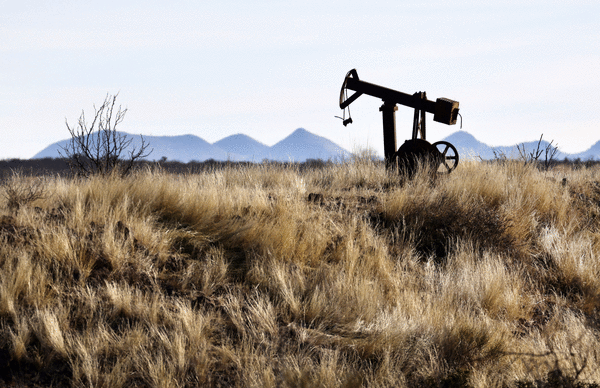
Texas is about to deploy a potential solution to the oil industry’s toxic wastewater problem — but it’s a move that carries environmental risks of its own.
State regulators are working to issue permits that would let four companies, including major landowner Texas Pacific Land Corp. and pipeline operator NGL Energy Partners LP, release treated wastewater from the Permian Basin into the Pecos River near New Mexico, regulatory filings show. At least one could be granted as soon as the first quarter of 2026, according to Texas Pacific.
Oil and gas wells in the Permian, the largest U.S. shale basin, generate 21 million barrels per day of water laden with salt, chemicals and heavy metals. Drillers have been disposing of most of that fluid by pumping it back underground, a practice that has triggered earthquakes and leaks.
The proposed projects would be the first in a new generation of Permian treatment plants that would clean the industry’s wastewater, allowing it to be jettisoned above – rather than below – the ground. If successful, they could reduce underground disposal and provide water to irrigate crops and cool data-center equipment.
Yet cleaning up the water would raise costs for producers grappling with low crude prices, dealing a blow to a basin that’s crucial to President Donald Trump’s goal of energy dominance. And the prospect of the oil and gas industry discharging wastewater into Texas rivers, even after treatment, is alarming environmentalists. Regulators have yet to prove such releases are safe amid growing concern about their effects on human health and ecosystems.
“It’s really dangerous,” said Virginia Palacios, executive director at the Texas government watchdog Commission Shift. She doubts whether oil companies and state regulators can be trusted to fix an environmental liability they created in the first place.
“The main problem has been that the industry is always looking for shortcuts,” she said.
A Bloomberg News investigation in September found that Texas allowed oil and gas companies to increase the volume of wastewater pumped into shallow underground reservoirs, even though state regulators were warned by their own staff that the fluid could leak to the surface from old wells. Regulators placed pressure limits on wastewater disposal and are reviewing a handful of pilot projects that aim to find new outlets for treated fluid, including some run by Texas Pacific.
The Texas Commission on Environmental Quality said in an emailed response to questions that it won’t allow treatment plants to discharge wastewater that is dangerous to aquatic life, violates state water quality standards, endangers drinking supplies or threatens human health. The agency said it’s monitoring water quality at four locations on the Upper Pecos River and two sites on the river’s Red Bluff Reservoir.
At least two of the applications for river discharge under review by the commission, known as TCEQ, are on track to move forward to a stage when the draft permits are available for public viewing and anyone with concerns can call for a hearing, filings show.
Shale producers blast water, sand and chemicals into wells to break apart rock and allow oil to flow — a process known as hydraulic fracturing, or fracking. With wastewater disposal volumes expected to grow almost 40% over the next decade, the Permian's biggest operators want to find alternatives to pumping it underground.
One option is to reuse the wastewater for fracking. But since salt-laden water occurs naturally in shale formations, more fluid comes out of a well than goes in. That means that more water is produced than can be used again in new frack jobs, limiting the industry's ability to use recycling as a long term solution.
Water is becoming such a serious challenge for the Permian, which produces more oil than any OPEC member aside from Saudi Arabia, that operators will spend $101.3 billion managing it through 2030, according to Bluefield Research, a data and analytics provider. Texas Governor Greg Abbott signed a bill into law in June providing $20 billion for water infrastructure in the state, funds that could be used partly for treatment projects proposed by the oil and gas industry.
The biggest hurdle to scaling up water treatment is cost. Estimates for cleaning wastewater vary widely because projects are still early stage, but some are in the range of $2 or $3 per barrel of water, mainly due to the large amount of energy needed. That’s multiples higher than the 65 cents to $1.50 a barrel expense of injecting underground, according to Bluefield.
Texas Pacific, founded during the Wild West Era of the late 19th century, sees a business opportunity. It could receive a permit to release cleaned-up wastewater into rivers and streams as soon as the first quarter of next year, Robert Crain, executive vice president of the company’s water division, said in an interview.
The 10,000 barrel-a-day pilot project may only treat 0.05% of the basin’s water, but executives believe it could solve a huge environmental problem and become a new revenue source once the technology is deployed at greater scale.
Wastewater, known as produced water, is as much as five times saltier than the ocean. As such, Texas Pacific envisions a handful of intensive early steps such as freezing it and using membranes to reduce salinity. Then the fluid will be put through reverse osmosis and ultimately sanitized with a chemical agent or an ultraviolet light.
On three occasions, Texas Pacific passed a five-day test to show organisms can reproduce in its cleaned-up water and a seven-day test to demonstrate that aquatic life can grow, Crain said.
“Everybody wants to be scared of what’s in produced water. It is safe to drink,” Crain said of the treated water, adding that he has done so himself. In any case, “we’re a long way away from this water going directly back into drinking-water systems.”
Texas Pacific said that while it welcomes scrutiny of its water treatment and reuse projects, its goal is to maintain standards far above existing protocols.
“This is the complete oppositive of a shortcut — we are investing significant time and resources into research, testing and fabrication where we could have otherwise chosen to do nothing," a spokesperson for the company said in an email.
Other companies are also pursuing wastewater treatment ventures. Exxon Mobil Corp., Chevron Corp., ConocoPhillips and Coterra Energy Inc. are working with Aris Water Solutions Inc. on a project to test several new technologies to lower the salt content of wastewater, including using membranes and thermal distillation, or separating impurities from water using heat. Exxon plans to have a fully operational treatment facility by the end of next year as part of its goal to “deliver sustainable water solutions” for the Permian, according to a spokesman.
Chevron wants to turn a “waste product into a resource,” said Brittany Cheben, the company’s Permian water strategy manager. “Our aim is to preserve fresh water for human use by repurposing this water for industrial applications, non-food agriculture, or municipal uses like golf courses.”
As part of a project backed by shale giant EOG Resources Inc., Tetra Technologies Inc. is testing the limits of membranes used to remove salts from Permian wastewater at its lab near Houston. The goal is to make them more durable so they can be used for a longer time before needing to be replaced, reducing costs.
“Produced water is going to be a problem for many, many years,” Tetra Chief Executive Officer Brady Murphy said in an interview. “These types of solutions have to be brought to the market. And they will.”
Regardless of what method companies use to filter the water, they’ll still have to dispose of what’s left over. That likely means shooting it back underground using a yet-to-be-determined volume of water. Some of the waste could also be mined for valuable minerals like lithium.
Along with proposals to pump treated wastewater into rivers and streams, companies are testing out discharge onto land.
Data center developers, who are eyeing West Texas amid the artificial-intelligence boom, are potential customers for oil wastewater. Texas Pacific sees cooling the facilities’ equipment as a possible opportunity to generate sales for the treated water.
Farmers may also be buyers. A handful of pilot projects are underway to spread small amounts of cleaned-up wastewater on test plots in West Texas, where crops such as alfalfa and cotton are grown.
Jeremy Louder, a fourth-generation farmer near Midland, Texas, believes this could help revive agriculture in the water-starved region. Conditions are so dry that he grows wheat to prevent runoff and erosion, preserving what little water he has for his sorghum crop.
Holding a head of wheat as he looked out across his 13,000 acre (5,261-hectare) ranch, Louder pointed to a cluster of water tanks and wastewater disposal equipment near Exxon’s operations about a mile away. The way he sees it, cleaned-up water could allow for year-round growing.
“If there was a plant over here, we would grow one summer crop, one winter crop, and then we would have a permanent grass,” Louder said. “That water would be utilized all the time. We could push it further by double-cropping if we had to. We’ve got the land available.”
Still, farmers are unlikely to have the cash to pay for large volumes of cleaned-up water. Groundwater, though dwindling, is essentially free.
Another challenge for companies pursuing wastewater treatment is convincing the public that the fluid has been filtered and sanitized enough to be safe. Despite the industry’s insistence that technology can turn toxic waste into clean — even drinkable — water, Ira Yates has doubts.
Yates, a descendant of a prominent oil dynasty and president of the environmental nonprofit Friends of the Pecos River, supports pilot projects to test treated wastewater on land. But he thinks it’s way too early to discharge it into the state’s rivers. The Pecos River is a delicate and complex ecosystem that has been a crucial source of water in arid West Texas for hundreds of years, Yates said.
“There’s still a reasonable doubt,” he said, “that maybe there’s something in the water that we’re not seeing.”
©2025 Bloomberg L.P. Visit bloomberg.com. Distributed by Tribune Content Agency, LLC.










Comments