Dennis Anderson: Retiring fisheries boss says fish-finding gadgets will be regulated
Published in Outdoors
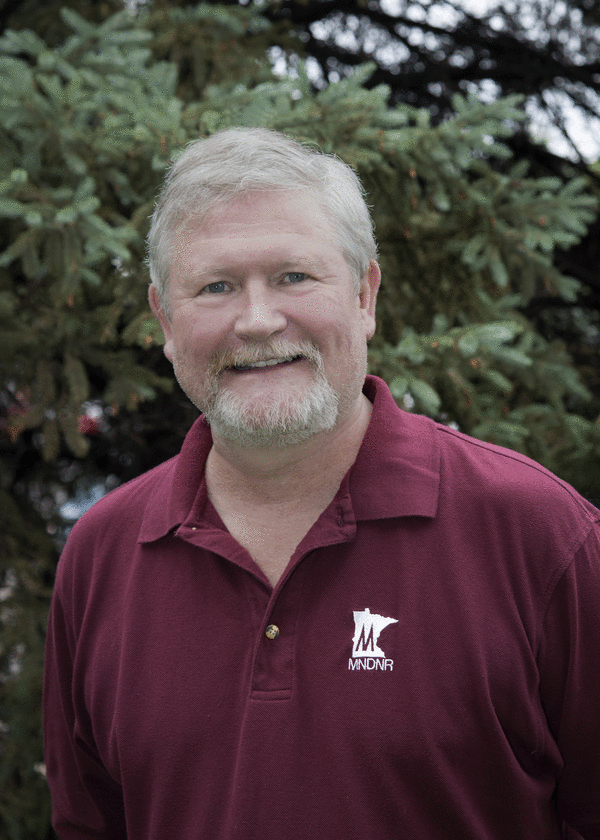
MINNEAPOLIS — Department of Natural Resources fisheries section chief Brad Parsons grew up in southeast Wisconsin. After graduating from the University of Wisconsin-Stevens Point, he studied Kokanee salmon as a University of Wyoming graduate student.
Hired in 1986 by the Minnesota DNR as a research scientist, he worked briefly in Waterville before relocating to Glenwood, where he studied bluegill and crappie population dynamics, walleye stocking, shallow lake dynamics and angler expectations, among other subjects.
Parsons was Metro Region fisheries manager before being appointed fisheries section chief in 2018, leading a staff of about 275. In this interview, which has been edited for clarity and length, Parsons discusses his 40 years with the DNR. He retires Sept. 8.
— Q: When you were named fisheries chief in 2018, Mille Lacs was a hot topic.
— A: [When I was the Metro Region fisheries manager,] the lake was coming off four bad year classes and we were only able to offer catch-and-release walleye fishing. When we got to 2013, with its excellent year class, our goal was to protect it. To do that we had to continue catch-and-release walleye fishing, which was hard on everyone.
— Q: With this year’s three-walleye limit on Mille Lacs, that seems a long time ago. What changed?
— A: We started seeing multiple good year classes not only of walleyes, but of perch and tullibees. The first was 2017, then 2021, 2022 and 2024. There were challenging times in there, like 2019, when anglers’ harvest quota was low, but the bite was good. In those years, hooking mortality can be high.
— Q: What occurred to produce the better Mille Lacs walleye year classes?
— A: Protecting the 2013 year class was part of it. Conservative harvest restrictions overall helped. Also, zebra mussels leveled off in the lake, after their initial population explosion.
— Q: The DNR sets Mille Lacs harvest quotas in conjunction with the Mille Lacs and other Chippewa bands. How is that relationship?
— A: We’re on solid footing. People shouldn’t forget during the lean years, the bands’ allocations were reduced as well. We’re not precisely together in our thinking all the time, but our discussions center on what’s best for the lake.
— Q: Big-picture threats hover over all Minnesota fisheries, as they do at fisheries elsewhere. Invasive species and climate change are two. Anglers’ use of technology is another.
— A: Forward-facing sonar is an issue, and artificial intelligence likely will shorten the learning curve on how to use these units effectively. What will it mean for catch rates? We’re not sure. Anglers who use this equipment say they release most fish they catch. But what about hooking mortality? My belief is this and other fishing technology is OK, as long as it doesn’t dampen experiences for other anglers.
— Q: Do you worry anglers who don’t use these gadgets will give up fishing, concerned they can’t compete for harvest?
— A: It comes down to a philosophical question of what fishing means to different people. To some it’s using technology. For others it’s figuring out fishing without tech’s help. We want fishing to be for everyone, so long as what fishing means to you doesn’t hurt others’ opportunities.
— Q: Will Minnesota someday restrict fishing technology?
— A: I think so. If by using forward-facing sonar while muskie fishing, for example, you’re increasing the mortality of these fish, that’s a problem. Wintertime crappie anglers using the same type of sonar can present the same problem. Should you be able to catch and release a bunch of crappies in 40 feet of water and claim you’re letting most of them live by releasing them? We know many of them don’t live.
— Q: Your proposal to reduce the walleye limit from six to four will go before an administrative law judge, who will determine whether the change is justified.
— A: We put the proposal out for public comment and enough people opposed it, so we’ll go to a hearing this fall or winter. A judge will decide if we followed the legal process. I think it’s the right thing to do. It’s reasonable. People are always saying we’re reactive, rather than proactive. This is proactive.
— Q: What’s your overall assessment of Minnesota fisheries?
— A: We’re in a good spot. No other state has the large walleye lakes we have. Leech, Upper Red, Winnie, Vermilion, Mille Lacs and the others. Also, our many medium-size lakes — the Gull chain, Minnetonka and many others. And, of course, our many panfish lakes. These are some of the best fisheries anywhere, and we’re managing them right.
— Q: You were hesitant to agree to year-round bass fishing, even though much of it would be, and is, catch and release. What were your concerns?
— A: I worried some people might use the opportunity to target spawning walleyes, pike or muskies. In the end, the issue was whether we should take away legitimate opportunities because of theoretical concerns about illegal harvest. I came around, and it’s working well.
— Q: What didn’t you get done as fisheries chief you wish you had gotten done?
— A: I wanted to help establish a Mississippi River Commission, which would bring together fisheries managers from 28 states in the Mississippi River basin. I wish we had gotten rough-fish limits established. I had hoped by now construction had begun on the new Waterville hatchery. That won’t happen until this winter or next spring.
— Q: What kind of fishing do you enjoy most?
— A: All kinds, including shore fishing, whether it’s on the banks of Pool 2 of the Mississippi or sitting alongside a trout stream in the southeast. What makes me happiest is seeing a kid ride by on a bike with a fishing pole, headed somewhere to fish from shore.
©2026 The Minnesota Star Tribune. Visit startribune.com. Distributed by Tribune Content Agency, LLC





Comments