Dennis Anderson: Conservation revolution in the making? Citizens council gains support.
Published in Outdoors
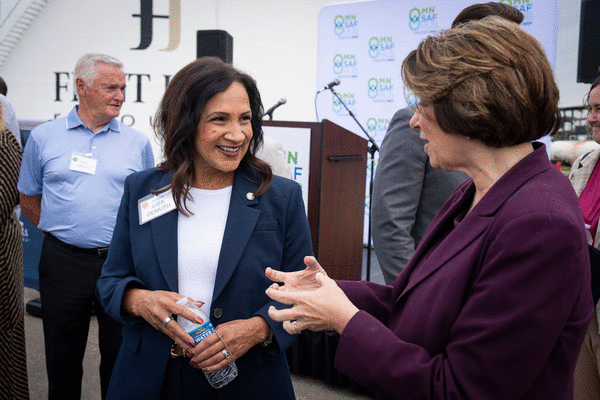
MINNEAPOLIS — A fish, game and wildlife management revolution might be underway in Minnesota, as support for a Citizens Conservation Advisory Council gained widespread backing at Game Fair, which recently concluded its six-day run in Ramsey.
Gubernatorial candidates Amy Klobuchar and Lisa Demuth said at the fair that they are open to the council idea, which would have a citizens panel advise the Department of Natural Resources (DNR), legislators and the governor on key fish, wildlife and habitat issues.
Almost 90% of 288 survey respondents at the fair also supported the proposal.
The survey, in the form of a questionnaire, was offered to anyone who stopped by the booth of the Duck Summit Group, which in March hosted the 2026 Minnesota Duck Summit in Nicollet, attracting 300 waterfowlers and sponsored the survey. (Disclosure: I helped organize the Summit.)
Minnesota hunters, anglers, wildlife advocates and other conservationists never have had a public, ongoing venue to voice their opinions, concerns and ideas about important natural resource issues.
Many other states have had similar councils or conservation commissions for decades.
Missouri’s Conservation Commission, for example, was formed early last century and is made up of four citizens. Each of Minnesota’s neighbors — Iowa, Wisconsin and the Dakotas — has a similar council that meets regularly to hear sportsmen’s and sportswomen’s concerns.
“The idea appeals to me 100 percent,” said Brett Bowser, who lives in Starbuck in west-central Minnesota. “I was born and raised in Pennsylvania, which had a similar sportsmen’s advisory council. I was very active in FFA and 4H, and when I was in high school, our governor proposed a similar youth outdoors advisory council to encourage kids to get outdoors. I was appointed to it, and I found it very valuable.”
John Cooper was a U.S. Fish and Wildlife Service special agent — a game warden — for 22 years, based in Pierre, S.D. Later, for 12 years, he was secretary of the South Dakota Game, Fish and Parks Department (the equivalent of a Minnesota Department of Natural Resources commissioner), after which he served on that state’s Game, Fish and Parks Commission. The latter approves South Dakota hunting and fishing regulations, helps guide department policy and serves as a liaison to the public.
“The commission provides an important way for knowledgeable outdoors people from around the state to listen to the opinions and ideas of other outdoors people throughout South Dakota,” Cooper said.
As envisioned, a Minnesota Citizens Conservation Advisory Council would consist of perhaps seven or as many as nine knowledgeable and experienced hunters, anglers and other conservationists from throughout the state.
Council members would be unpaid and would meet monthly in different parts of Minnesota, where they would hear concerns and ideas not only about fish, game and wildlife, but about the lands, waters and habitats that support these resources. (Meetings would also be streamed online.)
The council would discuss their findings with the DNR, the governor and the Legislature in an attempt to define conservation priorities and encourage action.
Nate Osmonson of Harmony, Minn., in the southeast part of the state, supports the idea.
“As an individual sportsman, oftentimes you feel like you’re overlooked or too small to reach the people who could make changes,” Osmonson said. “To have a council you could speak to would be really important and would make me, as a very active sportsman, feel like I’m being heard. I work in the outdoor industry, and I talk to people every day who have the same complaint.”
Brian Myres of St. Cloud, a retired banker, is a leader of the Duck Summit Group and a companion organization, Minnesotans United for Conservation, which was formed to push the conservation council idea.
“Clearly, Minnesota waterfowlers are concerned about management of the state’s ducks, based on our survey at Game Fair,” Myres said. ”About 79 percent want the duck opener returned to Oct. 1, 69 percent want the hen mallard and wood duck limits reduced and 62 percent want duck hunting to end at 4 p.m. until MEA weekend. But the largest group — 88 percent — wanted the conservation council."
The council proposal isn’t new.
In 2007, a blue-ribbon panel of conservationists and legislators appointed by Gov. Tim Pawlenty concluded a Minnesota Conservation Commission should be formed to “provide strategic direction and oversight to the DNR on policy and budget matters, identify needed state conservation policies and programs, and coordinate intergovernmental delivery of state conservation policies and practices.”
Jim Demgen of Brainerd believes Minnesotans have waited long enough for the panel’s recommendation to become reality.
“I hear from all kinds of people in northern Minnesota — fishermen, hunters and people who just like the outdoors,’’ Demgen said. “Absolutely, they’re not being heard. I think we do need a sounding board for these people in the form of a council. And it doesn’t exist right now.”
Concerns about the council proposal, said Myres, generally fall along two lines. One is that no one wants more government bureaucracy. A second is how council members would be appointed.
“These wouldn’t be bureaucrats listening to other bureaucrats, they’d be citizens listening to other citizens,” Myres said. “Yes, the governor would appoint council members. But appointees would have to meet clearly defined requirements regarding their outdoors experiences and knowledge.”
Brian Siebenaler of Hastings owns a cabin on Big Stone Lake, near the Minnesota-South Dakota border, where he manages 30 wood duck houses.
“On the conservation front,” he said, ”we’re fighting a battle we’ll never win, unless we get people together."
———
More information is at minnucon.com, website of Minnesotans United for Conservation.
©2026 The Minnesota Star Tribune. Visit startribune.com. Distributed by Tribune Content Agency, LLC






Comments