Orca sighting at Seattle's Ballard Locks is great news for salmon
Published in Outdoors
SEATTLE — Several shiny black fins emerged from the water near the Ballard Locks just after 5 p.m. last Monday, as onlookers snapped photos and videos. They belonged to transient orcas, or Bigg’s killer whales, one of two types of orcas that frequent the Salish Sea.
Scientists said the killer whales were likely attempting to hunt seals and sea lions in the area.
“They are animals that are adaptable and will take advantage of any situation that presents itself for prey,” said Deborah Giles, a scientist at the SeaDoc Society.
While sightings like these are rare, Giles said it’s not impossible for orcas to have traveled this close to the Ballard Locks before. The water is deep enough for megayachts to stay afloat, so killer whales should have no trouble navigating the area and using echolocation to swim safely.
Alana Lyons, 38, of Fremont, was visiting the Locks with her family when they noticed fish and seals suddenly disappearing. That’s when they heard a splash and a crowd of people cheering.
“That’s the closest I’ve ever seen an orca,” she said.
Lyons’ family was visiting from Georgia when they spotted the killer whales.
“I just wrapped up work, my family was visiting me from Georgia … I wanted to give them a completely unique Pacific Northwest experience,” she said.
While two orcas were clearly visible in the video she took, Lyons said she saw at least four. She also said her stepdad spied what might have been a baby orca swimming alongside an adult.
What do orcas mean for salmon recovery?
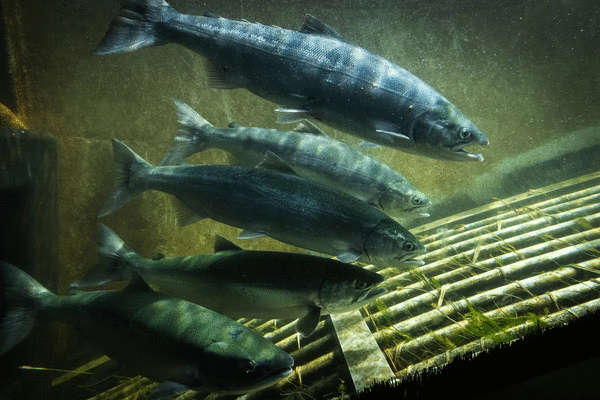
August is also peak season for Chinook salmon passing through the Locks. Usually, seals and sea lions, the fish’s biggest predators, can be spotted lurking nearby in anticipation of their next meal, but Giles said Monday’s killer whale sightings spell exciting news for salmon.
She said this is the “best-case scenario for salmon recovery.”
Because salmon can get pinched below the Locks, the man-made structure makes the area a hot spot for seals, sea lions and fish-eating birds to gather.
Marine biologists, lawmakers and tribes have debated for over a decade how to control the record numbers of seals and sea lions which have overpredated salmon across the state, including near the Locks.
Experts have proposed firecrackers, seal bombs and recordings of orca sounds to scare off the marine mammals. Several of the state’s U.S. representatives also introduced legislation to allow more seal and sea lion killings as a form of population control. These animals have exactly one natural predator — orcas.
“There’s no better deterrent than a mammal-eating killer whale,” Giles said.
In 1996, the city submerged “Fake Willy,” a 16-foot-long fiberglass orca into the water near the Locks to ward off seals and sea lions hoping to feast on the salmon passing through. KISW’s Bob Rivers even released a song about the orca which went:
Whoa Fake Willy gonna block the locks
He’s a fiberglass guy
Block the lock
So that the fish don’t die.
Unfortunately for the city and Rivers, who championed the plan to float a fake orca near the Locks, marine mammals were undeterred by the underwater scarecrow. Seattle scrapped the idea.
“Fake Willy” sits on display near the Ballard Locks visitor center today, after he was donated back to the Locks in 2019.
Thirty years ago, he had little luck controlling seals and sea lions, but maybe his real-life orca buddies can pull it off this time around.
© 2026 The Seattle Times. Visit www.seattletimes.com. Distributed by Tribune Content Agency, LLC.






Comments