Dennis Anderson: Minnesota's outdoors needs more role models like these two
Published in Outdoors
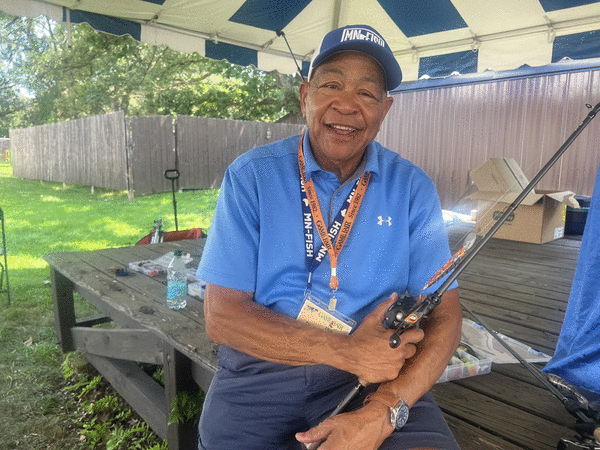
MINNEAPOLIS — The other day at Game Fair, Danny Suggs was spinning tales about river fishing. Expert in the pursuit of smallmouth bass, he knows where these fish hang out as water spills and bends downstream, congealing in riffles and pools, seams and eddies.
That Suggs is a Black man was considered a nonfactor by the dozen or so attendees of his Game Fair seminar, all of whom were white. The outdoors is a great equalizer, and anglers often speak the same language regardless of color, a fact that’s also true for hunters, hikers, paddlers — the gamut.
Not far from where Suggs regaled his fellow anglers, Cartrell Cooper was talking to a pair of dog owners, their charges tethered to them by leashes.
The owner of Big D’s Dog Solutions and a former military dog trainer, Cooper was attuned not only to the people, but their dogs.
“The dogs are easier to understand,” he’ll tell you.
In Minnesota, where the Black population is approaching 10% of the state’s 5.8 million residents, Suggs and Cooper remain outliers among outdoors enthusiasts. Highly qualified in their specialties, they nevertheless spend much of their time fishing, dog training and hunting surrounded by a sea of white faces.
Given the lack of Minnesota outdoors outreach programs that target Black residents and other minorities, particularly in the metro, where most people of color live, that’s unlikely to change anytime soon.
“If you’re a minority and you hunt or fish or otherwise spend time outdoors, the problem is you don’t often see other people who look like you doing those things,” Cooper said. “For some people, that can be a real roadblock to getting involved.”
Suggs agrees. At various times in his long career in the fishing industry, he has played host to kids’ fishing clinics in an attempt to promote youth participation in the outdoors. He also started a school fishing team at Totino-Grace High School in Fridley, and at one time was TV host and executive director of the POCO Tournament Trail — POCO standing for People of Color Outdoors. Featuring mostly Black anglers, POCO’s bass-fishing contests were regionally broadcast in the southeast U.S.
“A lot of minorities who fish now, and who fish competitively, fish because they saw people who looked like them fishing on television,” Suggs said. “It’s important to have role models.”
Suggs came to Minnesota from Illinois in 1973 to play hockey — a rarity, obviously, for a Black kid from a state that at the time was not a hockey hotbed.
Suggs started skating at age 7, and by 15 he was playing with the University of Illinois Urbana-Champaign club team. One day the Mankato State hockey coach saw him handle a puck, and the next thing he knew he was in Mankato, later switching to football at the same school.
“That was the first time I’d been away from home, going to Mankato,” Suggs said. “But I loved it. I fished the Minnesota River while I was in college, and after graduating, I started fishing tournaments. Eventually, I became tournament director of the Minnesota Pro/Am Bass Tour, Randy Moss’ bass tourney, the Silverado tourney, Denny Green’s tournament, the Minnesota Wild tourney, a lot of them. I also had a TV show called ‘Fishing Time with Danny Suggs.’ Today, I’m on the board of MN-FISH.”
Cooper, by contrast, is a Minnesota native, growing up in south Minneapolis. Always dog crazy, he got his first best friend, a fox terrier, as a gift from his older sister when he was in fourth grade. Using a book and magazines as guides, he trained the terrier to point and retrieve.
“My mom and dad wanted me to become a veterinarian, and I started college at Hamline, but they didn’t have an animal science department,” Cooper said. “So I transferred to UW-River Falls, where I also played football.”
After graduation, Cooper enlisted in the Air Force and was assigned to Lackland Air Force Base in Texas, where military working dogs are developed. Later stationed in Italy, he traveled back and forth to Lackland for advanced training with dogs in explosive and drug detection, and search-and-rescue.
Though he hoped for a career in law enforcement when he was discharged, he soon learned his military training wouldn’t help fast-track that career. So he opted for a series of day jobs that supported his weekend dog-training businesses.
Now, after traveling the country for years to show customers’ dogs at competitions, Cooper keeps a few canines in training, while traveling to clients’ homes to deal with problem dogs.
He recalled a time when he addressed a large audience that had a handful of Black members, a few of whom approached him to ask questions afterward.
“Would they have come up to me if I was white? I don’t know. But the fact that I’m Black probably made it easier,” he said.
A digression here:
Years ago, I was a Big Brother to a young Black kid from north Minneapolis. Despite the love of his grandmother, who doubled as his parent, he faced daunting problems: poverty, a crummy school, neighborhood crime and gunfire, and bikes that were stolen as fast as he got them.
And yet ... groups such as the Boys and Girls Clubs of the Twin Cities and their many great programs, including those at its Voyageur Environmental Center in the west metro, can, and do, make a difference.
But they’re too few, and too far between.
Which is a problem for all of us. Because in the not-too-distant future, virtually every major Minnesota outdoor activity will run low on supporters — and money.
The reason: Baby Boomers and their immediate follow-on generations are graying out. Gone with them will be their high participation rates in the outdoors and their willingness to pick up the tab for conservation-related programs.
If their replacements don’t include a significant percentage of the nation’s growing minority populations, the state’s natural resources and the pastimes — and lifestyles — they support will suffer.
“As I tell people in my seminars,’’ Suggs said, “the outdoors can bring people together.’’
Let’s hope so.
©2026 The Minnesota Star Tribune. Visit startribune.com. Distributed by Tribune Content Agency, LLC





Comments