Dennis Anderson: Fattening up for winter, Minnesota bears draw near-record hunter interest
Published in Outdoors
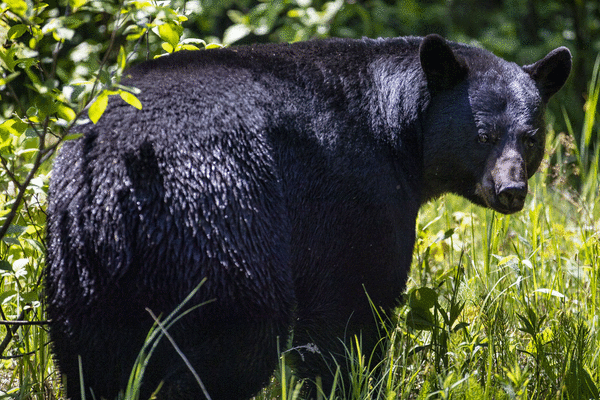
MINNEAPOLIS — Black bears near Dennis Udovich’s northeast Minnesota home are in a feeding frenzy, chomping berries, plums and whatever else they can find to gain as much as 30 pounds a week.
Winter is coming, and they need all the fat they can get.
In his 47th year as a bear hunting guide, Udovich is similarly obsessed. In the woods every day, he checks his baits, scavenges for bear scat and measures bruin tracks, the longer the better.
About 75% of bears killed by hunters are felled during the first two weeks of the season. So, Udovich wanted to be ready when hunting began Sept. 1.
“We’ve got hunters coming from as far away as Georgia,’’ Udovich said. “We get calls all year from people who want to hunt with us. If someone says they just want to shoot a big bear and don’t care about the meat, I tell them they won’t hunt with us. If they say, ‘Why not?’ I say, ‘You don’t respect the animal.’ ”
About 16,000 black bears roam Minnesota’s hinterlands, from the Twin Cities north to the Canadian border.
Except to hunters, most are ghostlike, unseen — even where they’re relatively plentiful.
“The bear range in Minnesota has expanded significantly,” said Andy Tri, a Department of Natural Resources (DNR) bear research scientist stationed in Grand Rapids. “With that, we’re seeing increased demand for hunting, especially near the southern part of the state’s bear zone, from the Twin Cities north.’’
Bears that roam from the metro to Brainerd are particularly fat and happy, Tri said. Females usually have cubs in their fifth year. But where the metro blends north to a mix of farmland and woods, some sows reproduce as young as 3 years of age.
“Oaks in the bears’ southern range, and their acorns, are particularly attractive and healthy for bears,” Tri said.
The number of hunting permits the DNR issues each year, together with the abundance — or scarcity — of berries and other natural food, largely determines how many bears hunters kill.
A near-record 27,572 hunters applied for bear permits this year, Tri said, and more than 9,000 are expected to hunt, killing perhaps 3,500 bears.
Statewide, Tri said, the berry crop has been pretty good. Exceptions include areas of extreme drought, such as near Ely, where recent wildfires burned more than 70,000 acres across Minnesota and Canada.
Udovich, who lives in Greaney, Minn., southwest of Orr, has been on the lookout for berries all summer.
“We had a drought in June, but we had timely rains in the weeks since,” he said. “Juneberries dried up. But we’ve had chokecherries, raspberries and plums. High bush cranberries are ripening, but a little soon, I think.”
If food is scarce, bears will travel a long distance, including to garbage dumps, cabins and bird feeders. Sometimes they move for reasons that seem mysterious, perhaps even to them.
“One of our radio-collared research bears lived near Grand Rapids for 12 years,” Tri said. “Then for some reason she traveled to Atikokan, Ontario, and had cubs. Then she came back to Grand Rapids. Now, every other year, she goes back to Atikokan.”
In the late 1970s, I got to know Lynn Rogers, who was a black bear researcher living in Ely. After his retirement in 2007, Rogers founded the North American Bear Center.
By then, he had gained fame (or infamy, in the DNR’s view) for befriending, feeding and ultimately walking with bears. In doing so, Rogers said, he gleaned information he couldn’t otherwise obtain. Many mainstream researchers, however, considered his methods foolhardy, if not dangerous.
One day in 2007, I told Rogers I’d like to meet one of his bears. I had hunted black bears out West and had been chased from a Boundary Waters campsite by a pair of stubborn bruins.
But I had never seen a wild bear up close and personal.
“OK,’’ he said.
On the appointed day, Rogers, Star Tribune photographer Brian Peterson (now retired) and I expended a fair amount of time, effort and brow sweat bushwhacking though thick northeastern Minnesota woods.
Our target bear, a female, was in perhaps a 20-square-acre area, we knew, because she wore a positioning collar Rogers was zeroing-in on with a handheld antenna.
When we were in sight of the bear, Rogers called to her softly and held out a handful of hazelnuts. Ten minutes might have passed before the four of us were seated on the forest floor while Rogers drew a blood sample from the bear and changed batteries in her collar.
The bear, which Rogers called Brave Heart, breathed heavily while appearing patient, kind of, and impatient, kind of.
Spoiler alert: No one got hurt.
But I wouldn’t do it again.
I mention this because nowadays, Minnesota’s bears draw a lot of interest from a lot of different people, nearly all of whom hold the animal in high regard.
It wasn’t always so.
Before 1971, when Minnesota bears became a game animal and began enjoying the protections that status conveys, they often were shot on sight.
So poorly valued were bears that whitetail hunters got a free bear permit with their deer license. Willy-nilly, cabin owners and townspeople were among those who gunned down bears indiscriminately, oftentimes gut-shooting them so they’d stumble to their deaths far from the scene of the crime.
Except it wasn’t a crime.
Fast forward a half century, and bears are thriving.
In research funded by hunters, Tri has 50 Minnesota bears fitted with radio collars and colorful ear tags — animals he asks hunters not to shoot this fall while he continues to study their behaviors and habitat requirements.
Udovich, meanwhile, and the more than 100 bear guides listed on the DNR’s website, regard bruins as trophies.
And every day in summer, Ely tourists by the score pony up a couple of sawbucks, or thereabouts, to enter the North American Bear Center to learn about, and see, one of Minnesota’s most fascinating animals.
Without having to sit with them in the woods.
____
©2026 The Minnesota Star Tribune. Visit startribune.com. Distributed by Tribune Content Agency, LLC






Comments