Mac Engel: USA's second 'Miracle on Ice' offers one sad difference from the original
Published in Olympics
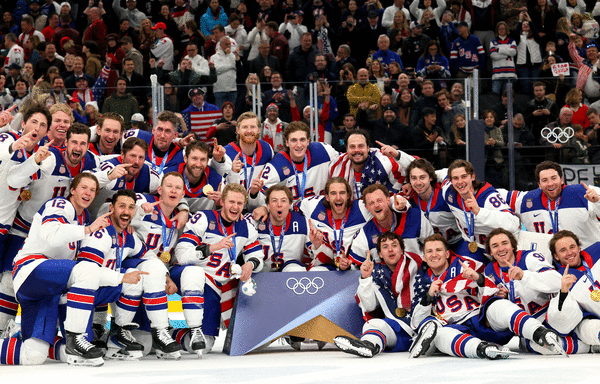
A niche sport that is mostly beloved by the hard core rather than the casual fan unified a nation at 9 a.m. on Sunday, something that America’s most popular game — football — can never achieve.
Hockey, a sport that most Americans don’t completely understand and only a few have actually played, bonded a nation because for all of our money and our might, this is a game where Team USA is often the underdog. It’s always more fun to cheer for the team that shouldn’t win.
On the same day 46 years after the U.S. enjoyed its greatest sporting moment — a 4-3 win against the U.S.S.R in the hockey semifinals of the 1980 Winter Olympics — its team won gold with a 2-1 overtime win over the Canadians of the 2026 Games in Italy.
Just as Team USA should not have won the gold medal in 1980, it needed a miracle against the best team in the world, Canada.
There are so many obvious comparisons to be made between Team USA’s win over Canada, and its victory against the Soviet Union with one glaring distinction. Unlike the win in ‘80 that brought together a nation for an extended period in the face of foreign enemies, now those adversaries are our neighbors, or family members.
The similarities between Lake Placid and Milan
In 1999, I interviewed the captain of that 1980 USA team, Mike Eruzione for a story on a team, and a tournament, that has been celebrated and documented like few ever have. He delivered an answer that by now he has uttered no less than 10,000 times.
“We touched a whole country,” Eruzione said. “That was the nicest part of the victory. So many people felt good about themselves and where they lived. We added a great deal of excitement to a nation, that’s what the Olympics are about. It’s about a nation and people felt that pride ...
“The pride that we were Americans.”
When USA forward Jack Hughes beat Canadian goalie Jordan Binnington at the 1:41 mark of overtime on Sunday for the golden goal, it was hard not to feel that same sense of pride. Money has tainted so much of sports these days, but the ideal of the Olympics, and playing for your country, still has not lost its power to convince fans that sports can be pure.
(Unless you’re Eileen Gu.)
The Olympics, more than World Cup in soccer or any other international game, is the one event where Americans are on the same page, united by a flag we share.
That particular game against the Soviet Union was an easy unifier; a team comprised of amateurs playing against glorified professionals during the Cold War.
For that story in 1999, I interviewed one of the Soviet’s defenseman, Viacheslav Fetisov, who said, “Before we left (Moscow) we had a meeting with a high communist official from the Kremlin who told us how important this Olympics was.
“It was important to show the rest of the world how good the system is. And jokingly at the end they said we can’t lose in hockey, especially to the U.S. It was almost impossible to lose to them. Not even in a bad dream did we think we would lose. That was probably the best team in the history of Russian hockey.”
That game was hockey, but the riding on the outcome was the American way versus communism.
The sad differences between Lake Placid and Milan
In February 1980, America’s economy was in recession, unemployment was at eight million, and there was still lingering anger over the Vietnam War, and the Watergate scandal.
As fractured as Americans were, they were unified in their feelings over the 52 hostages taken in Iran, where they would be for 444 days. There was unification in the anger at the Soviets, who had recently invaded Afghanistan, a move that led President Jimmy Carter to announce that the U.S. would boycott the 1980 Summer Olympics in Moscow.
Here in 2026, most of our national disgust is not against an overseas opponent, but the guy across the street because they refuse to agree with our latest point of view. On any topic.
Unlike in 1980, when our media consumption menu was radio, three TV channels and print, we now have so many options competing for our decreased attention spans that we no longer know what is true, a lie, or AI.
The discourse, and disagreements, have made much of our daily routine so toxic that we don’t realize the poison we drink daily.
At least for a few hours on Sunday, Americans put aside those differences in agreement to support a USA hockey team where most couldn’t name more than two players.
These days, that’s a miracle.
____
©2026 Fort Worth Star-Telegram. Visit star-telegram.com. Distributed by Tribune Content Agency, LLC.






Comments