Vahe Gregorian: DeSean Jackson never played for Chiefs, but they're a fascinating part of his journey
Published in Football
KANSAS CITY, Mo. — More than 30 years after the Chiefs cut him a second time, Byron Jackson still has dreams of catching passes in their uniform. And he still calls the free-agent experience in the early 1990s here “really life-changing.”
Most of all, though, that was in terms of the soon-to-be traumatic way it led to finding himself and doing what he was meant to: become a documentarian.
“I feel like that’s truly my purpose,” he said Tuesday in a phone interview with The Kansas City Star, adding, “I fell in love with capturing life.”
You can see just why with the Prime Video release Thursday of the feature-length “Go Deep: The DeSean Jackson Story” — all of it culled from what he conservatively estimated was 5,000 hours of video footage taken over more than 35 years.
The result is a poignant, raw, intimate and compelling portrait of both his electrifying younger brother — who holds the NFL record for most receptions of more than 60 yards (26) — and their volatile and complicated father, Bill.
Working with writer-director Mandon Lovett, Jackson said, the goal was to make it fluff-free and real.
“We wanted people,” he said, “to kind of live with the journey.”
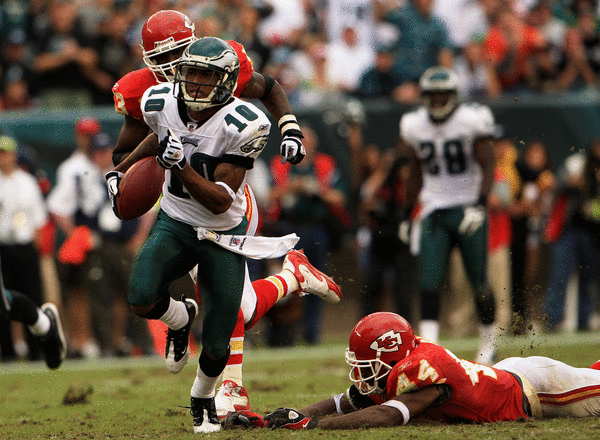
While DeSean Jackson never played for the Chiefs in his 15-year, six-team career, the Chiefs make for a fascinating part of that journey.
What started with Byron’s time here included an ongoing influence on DeSean’s training, and a wild cameo for him at Chiefs camp in River Falls, Wis., that we’ll come back to.
Then there was his selection by the Philadelphia Eagles as the 49th pick overall in the 2008 NFL draft.
That reflected a seminal moment toward an instrumental relationship in the rise of the recent Chiefs: Before Brett Veach had even been promoted to a scout and still was serving as Andy Reid’s personal assistant, Reid assigned him to evaluate receivers. Veach was a devout believer in Jackson, who was undersized at 5-foot-9-ish, and passionately made the case.
If that wasn’t the start of Reid’s enormous trust in Veach, it certainly was a key next step along the way to Veach having the credibility to be a vital force in drafting Patrick Mahomes and ultimately becoming the Chiefs’ general manager in 2017.
Reid isn’t visible in the documentary, which largely focuses on the making of Jackson to get to the NFL.
But his voice is strikingly relayed on the day of the draft when Jackson is elated to finally get the call but deflated by an apparent message that Reid didn’t want to deal with his father — who had been persistently difficult on DeSean’s coaches back to the Pop Warner days.
“That call kind of sent everybody through a little bit of drama …” Byron Jackson said. “Everybody had heard of my dad and how he was, (so) it kind of wasn’t really a shock. But it was a shock because you didn’t expect that on draft day, you know what I mean?”
As it happened, though, Reid became a major influence and, soon, a surrogate parent after Bill in May 2009 died from pancreatic cancer — a death tenderly handled by Byron as he recorded scenes in the hospital he now supposes the camera helped make him “immune” to in real time.
Over the years, DeSean Jackson often referred to Reid as a father figure. And when the Eagles cut Jackson after the 2013 season, a year after they’d ousted Reid and he was coaching the Chiefs, Jackson said at a news conference that Reid’s “was a shoulder I leaned on through this.”
“Can you imagine your dad pushing you so hard, and then as soon as you get there after the first year, he passes away?” Byron said. “So I think Andy felt bad and really wanted to be there for DeSean. So they developed a really, really strong relationship.”
Over the years, Byron came to enjoy that sort of relationship with his father.
But it was hard-earned, especially after Byron was cut by the Chiefs that second time and briefly spent time in the Canadian Football League before realizing he was done with the game.
Bill Jackson, though, wasn’t ready for Byron to be done with it.
That’s consistent with how promotional material for the documentary described him:
“Bill Jackson saw football as the way out—a path that would put his family on the map and provide the life he never had but always dreamed of. He poured everything into that belief, pushing his sons with an intensity that was equal parts love and obsession. Bill was a tireless advocate for his boys, but also a polarizing figure — clashing with coaches, alienating front offices and dividing opinions at every level.”
So Bill and Byron argued about his future.
Next thing you know, the father was pulling a gun on the son and putting it to his head and throwing all his clothes out of the house.
Devastated as Byron was by the episode, which led to two years without speaking with his father, it liberated him to pursue what he really wanted: working in television and film and soon landing an editing job with Fox Sports for more than 20 years.
In the middle of all that, he resolved to begin filming DeSean’s athletic exploits around the time he was 6 or 7 years old.
Somehow, that became a bridge back to a relationship with their father.
“The gun was his weapon because he was frustrated with me,” said Byron, who had his own regrets in their arguments. “The camera was my weapon to make peace with my dad.”
In that span, Byron also spent time coaching DeSean mindful of what he’d learned from Chiefs receivers coach Al Saunders.
Or as Byron called him, the greatest wide receivers coach in the history of the NFL.
“He was so detail-oriented, and so I became the same way that Al was toward me and the receivers of Kansas City,” he said. “I was like that with DeSean at a young age … making sure he wasn’t false-stepping, making sure he was catching the ball, looking (it) in, making sure he was getting his head around out of the break.
“I just felt like Al Saunders in my brother’s ear his whole life.”
He put together a more direct line some years later.
Seeking to get DeSean as close to actual action as possible so he wouldn’t be as overwhelmed as he felt when he was with the Chiefs, Byron got him on the sidelines of major-college games even by his early teens.
When DeSean was 16, Byron called Saunders and asked if he could bring DeSean to camp in River Falls. Saunders was happy to have him. Then he surprised Byron by calling DeSean onto the field from the sideline to throw him some passes with Chiefs players milling around.
“I thought taking him to training camp would humble him a little bit,” he said, laughing. “And he’s out there, like, ‘I think I can play with these guys.’”
So as DeSean was clarifying where he belonged, so was Byron — who still hasn’t stopped filming and currently is tracking DeSean’s coaching career at Delaware State.
DeSean’s stance on being the subject, Byron said, has remained simple:
“If you’re going to film me, you’ve got to film the good with the bad,” Byron recalled DeSean Saying.
“I filmed all of it,” Byron continued, “… as you can tell.”
To a powerful result.
____
©2026 The Kansas City Star. Visit kansascity.com. Distributed by Tribune Content Agency, LLC.






Comments