Rio ready: Inside how the Ravens are preparing for international game
Published in Football
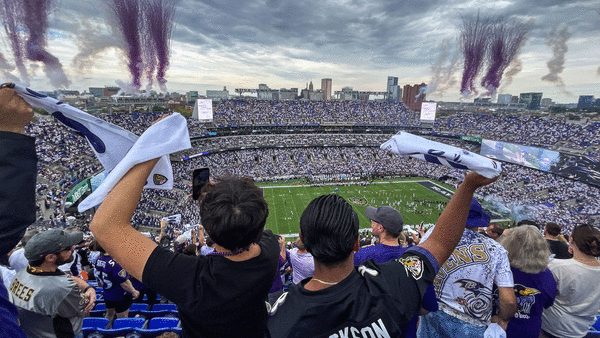
BALTIMORE — It was June 4. The Ravens were still a few months away from deciding who would even make their roster, but a more pressing deadline loomed: They had to make sure their ketchup made it onto an ocean freighter bound for Brazil.
Brazilian ketchup is, after all, different from the stuff in the United States.
“We’re trying to make sure we replicate what we’re doing here, there,” Simon Gelan, the Ravens’ vice president of operations, said. “Every away game we try to do the exact same thing. Trying to replicate that in another country is different, but that’s the cool part of the job.”
Ketchup was just one of hundreds of items, along with a variety of non-perishable food, heavy equipment restricted from air cargo and other supplies, that needed to be shipped to the South American country long before Baltimore or the Dallas Cowboys will arrive for their game Sunday at Maracanã Stadium.
Getting it there was just one step in a series of hundreds, part of a process that involves constructing a roughly 40,000-pound mobile command center for a couple hundred people — players and coaches, training staff and team officials — who make up the traveling circus that is an NFL road game.
When the show goes international, no detail is too small. And the challenges multiply.
Which is why, about three weeks after the league announced that the Ravens and Cowboys would be playing the NFL’s first regular-season game in Brazil’s sprawling former capital city, Gelan and Ravens vice president of travel Joan Fennekohl were among a cadre of team officials who landed in Rio de Janeiro for their first reconnaissance mission.
The pace, like the city’s vibe, was fast and furious.
They spent a couple of hours scouting both hotel options offered by the NFL because the host Cowboys hadn’t yet decided on which of the two they’d hunker down at. Then they raced off to each of the two practice facility options.
The Ravens will conduct their lone practice of the week in Brazil on Friday afternoon at Espaço Lonier, the training ground used by the Botafogo football club. Space will be tight, so players will get partially dressed at the hotel.
Field conditions and logistical challenges
Then there was the stadium.
Maracanã, which hosted the 2016 Olympic Games and the FIFA World Cup Final in 2014 and 1950, needed a close examination. The Ravens had to coordinate the locker room setup, map out the logistics of everything that would have to move in and out of the building and offer a discerning eye on the condition of the grass field.
Last year, in a game in São Paulo between the Chargers and Kansas City Chiefs, L.A.’s director of equipment operations beseeched players to wear detached cleats with longer studs to help on the slick soccer field.
Whether Ravens or Cowboys pack alternative footwear options remains to be seen, but for some, playing conditions will be top of mind. The past week offered some controversy when players from a Brazilian soccer team lambasted the field conditions at Maracanã. One player said the penalty areas were in poor condition and another argued the uneven grass made it “harder and harder” to control the ball.
The NFL has been in close contact with both teams and already sent the cavalry south to ensure safe playing conditions come Sunday. Ravens coach Jesse Minter said he “feels pretty good” about measures the league has taken to ready the playing surface.
“If there was a real concern, there would have already been contingent plans being made,” Cowboys executive vice president Stephen Jones said on a recent radio hit. “I know how the league works, about where we play the game if it weren’t there, and there’s none of that. So, I think we’re full speed ahead.”
Those are just part of the logistics.
NFL players aren’t different from anyone else, and they need travel documentation, including passports, to enter the country.
The last time the Ravens played an international game, a 24-16 victory over the Tennessee Titans in London in 2023, one assistant on former coach John Harbaugh’s staff didn’t make it to the first day of practice there. He’d forgotten his passport before boarding the team plane, so he had to return home to retrieve it and catch a later commercial flight.
Details big and small matter. All of it takes dozens of people and coordination akin to an orchestra, with every section having to hit its cue.
“Things like customs take a really long time to get all our things through,” Fennekohl said, adding that the Ravens’ staff also consults with their counterparts around the league. “That’s been a big process: how the equipment is getting through and how long it’s taking. That’s the biggest thing.”
The Ravens already sent a 52-foot semitrailer of essentials to Rio. That doesn’t even include uniforms. It includes insurance sets of practice clothes in case anything gets held up at customs; nine pallets of water, Gatorade, football gloves, and training room supplies; and two pallets of nutrition items.
The NFL also supports both teams on the ground, including game operations representatives and translators throughout the process. But teams are also creatures of habit and control. They know what they need, how they want it and when they want it there.
Given the league’s ever-expanding international footprint — nine games this season including in Australia, the U.K., France, Spain, Germany, and Mexico — it’s a requisite routine.
So far, so good.
During one of multiple trips to Rio, the Ravens’ advance staff went out to a dinner where no one spoke English. They ordered sushi, and nobody got sick.
“That was kind of fun to navigate,” Fennekohl said.
Athletes embrace unique road game
The players have it easier.
For them, an NFL road game is an NFL road game, whether it’s in Cleveland or on another continent. The routine remains largely intact, though they’ll have a Brazilian-themed dinner Friday night.
They will have a mostly normal week of practice in Owings Mills before departing on a direct chartered flight Thursday evening. They’ll have practice later that day before the usual Saturday walk-through and a game on Sunday.
The flight will cover roughly 5,000 miles and last about 10 hours. Rio de Janeiro is only an hour ahead of East Coast time, so there’s little body clock adjustment.
“We have put a lot of time into looking into it,” said coach Jesse Minter, whose former team, the Los Angeles Chargers, played the Kansas City Chiefs in Sao Paulo last season. “So, we feel good about what we are going to do, and, again, [we] put a lot of [thought] into it, [we’ll] study it [and] figure it out. I do not think there is a perfect answer for any of that stuff. It is all about how the team plays when the ball is kicked off.”
Running back Justice Hill, who played in London in 2023, doesn’t see much difference.
“It just feels like a road game even though it’s a road game where it isn’t — where everybody is in the stadium against you,” he said.
He’s less sure about the field.
“I don’t know what to expect,” he said. “I remember watching the first Brazil game [in 2024 in Sao Paulo], and everybody was slipping around, so that’s on my mind.”
Hill is also a travel buff, so he embraces playing a game in an exotic, far-flung locale more than others.
In early 2020, before the COVID-19 pandemic gripped the world, he joined former Ravens Mark Ingram and Gus Edwards on a vacation to Sao Paulo. The visit sparked a global interest in the native Oklahoman.
“You see how people in lesser situations are way happier sometimes, and have a different outlook on life,” he said. “Here in America, a lot of people are in a rat race grinding to where you don’t feel really connected to too many people when you’re out and about.”
Hill has also been micro-dosing water from outside the U.S. for years, a routine he says he follows on any international trip to get his body used to the different bacteria elsewhere and avoid falling ill.
Fourth-year linebacker Trenton Simpson hadn’t left the country before the NFL. Now Jamaica and Puerto Rico are among his favorite spots, and he credits fellow linebacker Roquan Smith, a well-traveled veteran, with expanding his worldly interest. This will be his first trip to Brazil.
“I see it as a blessing, the places football has taken me to,” Simpson said. “To be able to go out there and play football and allow my mom and some of my family members to come see another country and see me play football is a blessing.
“When you step out of your culture and go see new places, it’s like, man, there’s so much more to this world.”
For some, it’s all new. Neither second-year cornerback Keyon Martin nor rookie tight end Matt Hibner has ever traveled out of the country.
Martin is looking forward to “just stepping outside the hotel and looking around.” If players get enough downtime, he’d like to see Christ the Redeemer, a 98-foot-tall statue of Jesus Christ and one of the seven wonders of the world. “I’ll try to check that out, take a couple pictures to send back home and let my people know I’m out here ballin’ in Brazil.”
Hibner has an expert one phone call away. His older brother, David, enjoyed a cup of coffee and professional volleyball in Brazil. “Obviously this is more like a business trip,” the Ravens rookie said, “but it will be cool to see the culture down there.”
This trip doesn’t pose the physical challenges of a trip to Australia, like the Los Angeles Rams and San Francisco 49ers endured earlier this month. It’s not like going to Europe either, where they’d have to cross an ocean and adjust their bodies. This is a roughly 10-hour direct red-eye with a one-hour time difference, and the biggest hurdle for players will be sleeping on a comfortable team jet.
“Catching up on sleep and not having that as a detriment is a big part of [the adjustment],” said tight end Durham Smythe, who has played in London and Germany international games. “Other than that, I treat it like every other week.”
In that sense, the trip shouldn’t be much, if any, more challenging for players than any other. Their biggest objective is the same as it always is: a win.
That, after all, will help them where they are ultimately trying to go.
For everyone else, though, the game began months ago — mapping out a plan with whiteboards and spreadsheets, scouting trips and customs forms, lining up hotel rooms and practice fields, sorting ocean freighter schedules and the hundreds of items they’re carrying, down to the correct ketchup.
“International games,” Fennekohl said, “are kind of like the Super Bowl.”
©2026 Baltimore Sun. Visit baltimoresun.com. Distributed by Tribune Content Agency, LLC.






Comments