Main booster could be source of Vulcan launch failure, ULA says
Published in Science & Technology News
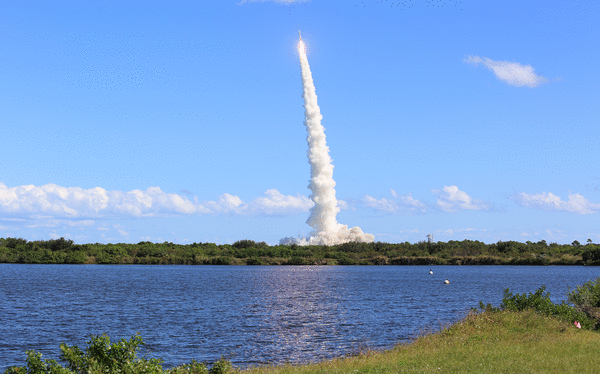
United Launch Alliance turned its focus to the first-stage booster as the potential culprit behind Sunday’s failed mission of its Vulcan rocket that resulted in the loss of 40 Amazon Leo satellites.
In what was the first mission for Vulcan in more than nine months, what looked like a solid launch from Cape Canaveral Space Force Station ended up a failure with the company saying Tuesday that it had lost telemetry about 10 minutes into flight.
“Early indications are that just after liftoff the launch vehicle experienced low booster performance, resulting in stage separation occurring when the vehicle was low in altitude and below minimal velocity to reach orbit,” ULA stated.
The first-stage booster is powered by two BE-4 engines that were manufactured by Blue Origin.
This particular flight also used six solid rocket boosters to augment the BE-4s on liftoff. Those SRBs, built by Northrop Grumman, seem to have operated as designed, ULA stated. Ahead of the mission, they were a source of concern, having been the reason for the nine-month delay. On its last flight, one of the nozzles on one SRB burned off, but the rocket was still able to get its payload to orbit.
“All indications are that the solid rocket booster performance was nominal, following nozzle improvements implemented for this launch,” ULA stated.
ULA also said it’s unlikely the upper Centaur stage and its RL-10 engine had any issues.
“The Vulcan second stage appears to have started nominally, and the RL-10 engines were operating as planned. The second stage was performing well but was unable to recover from the performance loss resulting in loss of mission,” the statement reads.
Of note, the two BE-4 engines had modifications put in place before launch by Blue Origin along with every other BE-4 engine already manufactured for ULA. A valve issue on the BE-4 engine was cited as the reason behind the massive explosion during a test hot fire of its New Glenn rocket earlier this year.
New Glenn uses seven of the BE-4 engines, and Jeff Bezos’ company has been working to get the heavily damaged launch pad at Canaveral’s Launch Complex 36 up and running, pushing for a return to launch in early 2027.
ULA did not state the BE-4 was reason behind the low booster performance, but if it was involved it may slow down Blue Origin’s efforts to return to flight.
ULA said it was still in the data-gathering process.
“The FAA will oversee the ULA-led investigation, be involved in every step of the process, and approve ULA’s final report, including any corrective actions,” the company stated. “It is very early in the process, and we want to focus on the data and avoid speculation until the investigation is complete.”
The mission was the first time out of 134 flights since 2006 that ULA had failed to get a rocket payload to orbit. ULA was founded as a joint venture of Lockheed Martin and Boeing.
Vulcan is ULA’s replacement for its Atlas V and Delta IV family of rockets. It first flew in 2024, although it is already years behind schedule. This most recent mission was only its fifth flight as ULA worked through other issues with the rocket.
After February’s incident, which was Vulcan’s first national security mission, the Space Force announced it would not fly on Vulcan again until it solved the nozzle issue. It was a repeat of a similar nozzle burn-through that was seen on Vulcan’s second flight, and one that officials had said had already been solved.
While ULA may have figured the nozzle issue out, it has bigger problems if it cannot nail down why the first-stage booster underperformed. This was the first of 38 missions it is supposed to fly for Amazon as it tries to get its internet constellation up and running so it can compete with the likes of SpaceX’s Starlink program.
ULA also has more than two dozen national security task orders awaiting a working Vulcan rocket.
“We truly understand the impact this has on our customers and are committed to returning to flight as safely and quickly as we can,” the company stated.
_____
©2026 Orlando Sentinel. Visit orlandosentinel.com. Distributed by Tribune Content Agency, LLC.






Comments