Florida pitches temporary Space Academy at UCF, new Cape Canaveral campus by 2031
Published in Science & Technology News
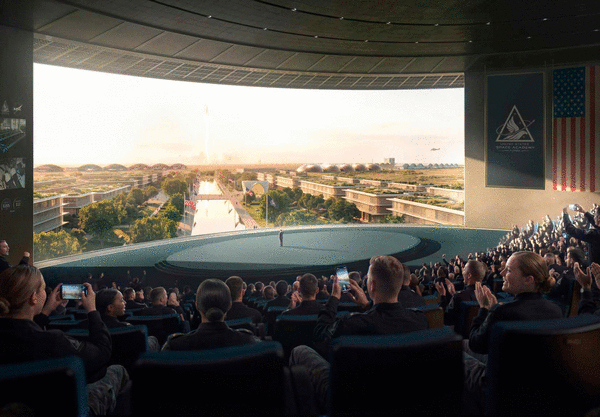


ORLANDO, Fla. — Florida, eager to land the newly announced United States Space Academy, would open the new school at the University of Central Florida in 2028 while building a permanent 1,000-acre campus at Kennedy Space Center.
The state’s bid for the space academy is outlined in a 65-page document released Tuesday. It envisions 300 students enrolling in the academy at UCF but about 1,200 taking classes once the full campus is built on the Space Coast by 2031.
That new campus would include academic buildings, a parade ground, a football stadium and close proximity to Florida’s flourishing space industry, home to regular rocket launches and related industries.
Florida leaders say their state is the obvious choice for the academy that President Donald Trump authorized in an executive order in August. The order creates a new federal service academy that would educate both military and civilian students.
“Florida is the nation’s leader in space exploration and innovation, and we have the infrastructure, workforce, and proven track record to ensure America remains at the forefront of the space industry,” said Gov. Ron DeSantis in a press release. “The new Space Academy belongs in Florida, and we are ready to help prepare the next generation of Americans to lead our nation’s efforts in space exploration.”
The competition for the academy is intense, with Ohio, Virginia, Maryland, Alabama, Nevada, Pennsylvania, Tennessee, Louisiana, Arizona, Texas and Colorado also vying for the new school.
NASA Administrator Jared Isaacman is chairing a presidential commission expected to give its recommendations before the end of the year for where the physical location of the academy would be, along with governance framework, service obligations for graduates and legislative requirements.
Florida’s plan is to lean on UCF to accommodate the first 300 students to begin in the fall of 2028, centered at the 98,000-square-foot University Tower located on Research Parkway. It would act as its own distinct college at UCF.
“Florida is leading America’s future in space, and UCF is helping power that future through groundbreaking research, industry partnerships, and the development of a highly skilled workforce,” said UCF President Alexander Cartwright in the release.
“As America’s Space University, we are helping drive the discoveries and prepare the leaders who will define our nation’s next era in space. We are proud to support Florida’s pursuit of the U.S. Space Academy and build on that momentum together.”
The inaugural class would also receive support from with support from Embry-Riddle Aeronautical University in Daytona Beach and work with the Space University Research Consortium, which includes several other Florida universities in partnership with NASA.
At the same time, work would begin with groundbreaking in 2027 on the permanent home for the Space Academy adjacent to the former space shuttle landing facility, which is leased by Space Florida. It would support a class of 1,200 students across 3 million square feet of infrastructure when open by fall 2031. It’s also situated on a part of KSC that could expand to 6.9 million square feet and support 4,000 students.
“The campus is deliberately organized and oriented toward Kennedy Space Center’s active launch complexes, creating a constant visual and experiential connection between academic life and the extraordinary missions taking place beyond its boundaries,” the proposal reads.
“From mission simulation and spacecraft operations to propulsion testing, advanced research and astronaut training, these capabilities exist independently, but have never been brought together within a single, fully integrated academic campus,” the proposal reads.
Space Florida built a website (spaceflorida.gov/ussa ) outlining its pitch on how the state would support the academy.
A big part of the pitch is the campus’ proximity to the active military, civil and commercial presence on the Space Coast. Space Florida notes the state has more than 150,000 aerospace jobs, $34.1 billion in annual aerospace economic activity and 220 projects in the pipeline valued at $6 billion.
The idea is that students would benefit from learning alongside active missions underway at Kennedy Space Center, Cape Canaveral Space Force Station and the growing commercial footprint in the region including SpaceX, Blue Origin, Lockheed Martin, Boeing, Northrop Grumman and others.
“Placing the new U.S. Space Academy in Florida simply makes sense,” said U.S. Sen. Ashley Moody in the release. “Our Space Coast has been the nation’s gateway to the stars since the beginning of the U.S. space program — placing the academy here means its students have a front-row seat to the new innovations coming out of both NASA and the private sector, giving them connections and experience they can’t get anywhere else.”
The state has already invested more than $680 million in space transportation infrastructure with much of it near the proposed site at KSC. The area is already home to a $140 million satellite processing facility for Amazon, and what is now know as the Launch and Landing Facility will build out infrastructure to support an annual aerospace industry expo, including an air show, called Capeweek.
Space Florida President and CEO Rob Long said the state is prepared to get to work to make its pitch a reality.
“Florida has spent years building the financing tools, university partnerships and operational capability to stand up an institution like this, and that readiness means we can move quickly and efficiently,” he said. “We’re ready to help make the United States Space Academy a reality on the Space Coast.”
_____
©2026 Orlando Sentinel. Visit at orlandosentinel.com. Distributed by Tribune Content Agency, LLC.






Comments