At Seattle AI Week, upbeat tech industry outlook is met with protests
Published in Science & Technology News




Hundreds of people gathered in Seattle this week to discuss the region’s future as a hub for artificial intelligence research and businesses, but disruptions by climate activists underscored the rising tension surrounding the technology.
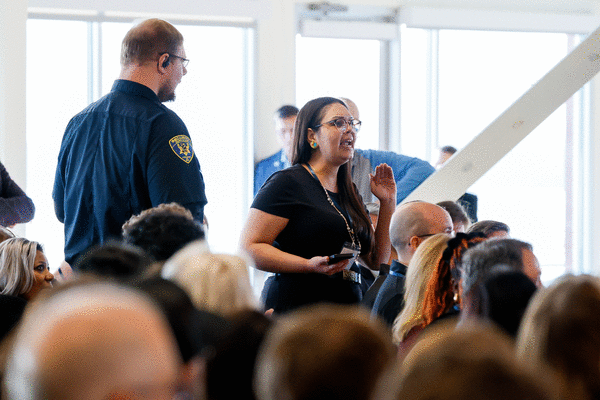
During Seattle AI Week’s opening panel on Monday, demonstrators in the audience confronted Beau Perschbacher, a senior policy adviser to Democratic Gov. Bob Ferguson. They argued his presence on the panel with Mattie Zazueta, from OpenAI’s global affairs team, and his attendance at an event with Microsoft leaders reflected Big Tech’s influence over state government, which the protesters blamed for preventing regulation of AI companies.
“These and many other companies are actively ruining the environment with their data center expansion, as well as the economy,” said Roberta Sam, a member of Climate Defiance and the first of three disrupters during panel discussions on Monday.
The opening event was held at the AI House, a space at Pier 70 for startups and others involved in artificial intelligence. AI Week runs through Friday.
The region’s AI industry is growing, with 577 AI companies operating in the Seattle area as of last year, according to a new University of Washington analysis.
Kirby Winfield, a founding partner at Ascend, a venture capital firm, said, “If you actually do the math, Seattle is a top-tier startup ecosystem.” He pointed to a CBRE report ranking Seattle second for AI talent and noted it is home to the world’s two largest cloud providers — Amazon Web Services and Microsoft Azure.
Even so, former Gov. Christine Gregoire, a Democrat, warned that other states would love to lure Washington’s businesses away. This echoed concerns she’s raised previously that Washington’s economic prowess is slipping, in part because of policy choices backed by leaders in her party.
“We’re among the nation’s leaders in technology and innovation,” Gregoire, who now leads Challenge Seattle, a group that represents some of the region’s largest companies, told attendees. “Yet we’re close to the bottom when it comes to the environment for businesses.”
Seattle ranks fifth nationally in the number of AI companies, according to the UW analysis, which was authored by Foster School of Business researchers Suresh Kotha and Ming Zhu Wang.
Kotha noted that venture capital is spread across a wide number of AI firms in the region.
Seattle’s top three AI startups, XBOW, Starcloud and Story, took 14% of the $4.14 billion raised from 2023 through early this year. In California’s Bay Area, the top three startups took 65%, according to the UW report.
Kotha said this “broad, not top-heavy” structure means the Seattle region’s AI economy doesn’t rise or fall with a single company.
Meanwhile, many founders have ties to large local companies or the University of Washington. About 1 in 8 Seattle AI founders last worked at Microsoft or Amazon, and about 1 in 8 attended UW.
'Power for people, not for tech'
Though industry leaders and researchers made a case that Washington can lead in the global AI build-out, the protests left an imprint on the conference.
In addition to the three protesters who disrupted panel talks, 10 demonstrators in kayaks (along with a dog in one of the boats) floated in the water near Pier 70 during the opening of the event on Monday.
The paddlers, who held up an orange sign that read “Power for people, not for tech,” represented three groups: Climate Defiance, Oil and Gas Action Network and Seattle-based Troublemakers.
A handful of protesters also gathered outside the AI House on Tuesday morning.
The groups want data center moratoriums and strict state regulations on AI technology, where the public has as much say as industry. Beyond data centers’ electricity and water demands, they seized specifically on proposals for natural gas pipeline expansions that are expected to help fuel power generation.
In response to the protesters, Perschbacher highlighted chatbot regulations state lawmakers and the governor approved earlier this year and Washington’s strict environmental laws.
He said environmental concerns about data centers are “legitimate,” but did not speak to the pipeline proposals before conference staff escorted the demonstrators away.
'This is beautiful. We don’t want to ruin it'
The initial disruption drew scattered boos from the crowd of about 200, but attendees acknowledged the demonstrators were voicing widely held anxieties.
“Nobody knows what’s coming,” Richard Starnes, a managing director at the consulting firm Accenture, said during a panel about AI and jobs. “Maybe the protesters are right, but everyone’s got a point of view on this.”
Joe Braidwood, founder and CEO of Glacis Technologies, a Seattle-based startup focused on creating records of AI activity, said the protests were “actually kind of promising.”
“People care enough to want to come together and talk and disagree and figure this out,” he said.
Asked about the protest, Nick Ellingson, vice president of innovation and entrepreneurship for the Washington Technology Industry Association, which hosted AI Week, said the purpose of the event was to have discussion and debate.
The protesters each bought a $100 ticket to attend, according to the activists, and Ellingson said the disruption wouldn’t change the Washington Technology Industry Association’s plans to keep the event open in the future.
Washington, he said, should lead on AI precisely because residents here care about the environment.
He gestured toward Elliott Bay as twilight fell. “This is beautiful,” he said. “We don’t want to ruin it.”
©2026 The Seattle Times. Visit seattletimes.com. Distributed by Tribune Content Agency, LLC.






Comments