To beat China, NASA streamlines plans to keep 2028 moon landing target
Published in Science & Technology News
NASA’s hopes for a 2028 moonshot to return humans to the lunar surface has pushed the agency to make changes, including spiking original orbital plans and delaying a full version of the astronauts’ new spacesuits.
The details were revealed during an Artemis program update last week. While Artemis III, a low-Earth orbit mission, remains on target for a launch next summer, the follow-up Artemis IV mission had a bevy of mission parameter shifts revealed, all designed to keep a landing on the lunar south pole possible as the U.S. competes with similar efforts by China.
“China will soon have reusable rockets. They have spacecraft and landers and an infrastructure for a credible two-launch architecture to put their astronauts on lunar surface in the next three years,” warned NASA Administrator Jared Isaacman.
The urgency to beat the Chinese relates to the value of frozen water in the permanently shadowed craters at the moon’s south pole. The ice could be converted into both oxygen to breath as well as rocket fuel to support a permanent lunar outpost. The worry is that China might put down some sort of winner-takes-all marker if they get their first.
To combat this, NASA has thrown out much of the original Artemis plans, which were made before Isaacman took over as administrator, but it still requires one of either SpaceX’s or Blue Origin’s lunar landers to be ready for the mission.
Isaacman said plans are moving forward with both, and NASA won’t make the call until next year as to which of the landers will get the job.
“We have no intention of surrendering a viable path to the surface before the data and schedule compels us to do so,” Isaacman said.
Both the lunar landing version of SpaceX’s Starship and Blue Origin’s Blue Moon MK2 landers have yet to fly. Pathfinder versions of both aim to launch as part of 2027’s Artemis III to make sure they can dock with NASA’s Orion spacecraft. Then both companies have to solve the complicated fuel puzzles of how to get the landers to the moon.
NASA’s altered mission plans for either lander are designed to keep 2028 viable.
“It’s been a deliberate effort, including where we could simplify flight — deciding where we could simplify our requirements, streamline designs and improve mission probabilities of success,” said Artemis Program Manager Jeremy Parsons.
Gone is the original plan of having Orion meet up with either lander using the near-rectilinear halo orbit that was used on the uncrewed Artemis I test mission.
That orbit, which was a more efficient choice over the long-term for the now-canceled orbiting lunar gateway space station, only made close enough passes to the moon for landing attempts every 6.5 days. Parsons said keeping that orbit for Artemis missions now, which are geared to support an eventual lunar base, would be “a costly orbit that requires quite a bit from a propellant perspective.”
“By removing that requirement on our lander partners and giving them some additional options, we can increase our mission availability as well as reduce the number of launches required,” he said.
Now the target is getting Orion into a more traditional lunar orbit. NASA also outlined exactly how Orion would work with each lander to accomplish the mission. Starship would aim for the more useful low lunar orbit while Blue Moon would meet up with Orion at a higher, but still useful elliptical polar orbit.
SpaceX may have the edge for this as NASA is opting to rely on Starship to actually push Orion to the moon. The lander version of the spacecraft would still have to go about getting fueled up by an estimated 6-8 previously launched fuel-loaded Starships that would then transfer that into a depot orbiting at low-Earth orbit.
Then Starship would fill up at this orbiting gas station and head out to a high-Earth orbit to meet up with Orion, where they would dock and Starship would be handling the trans-lunar injection burn heading for that low lunar orbit that circles the moon about every 90 minutes. From there Starship would take two of the four Orion astronauts down to the moon’s south pole, and then head back up to Orion to bring the astronauts back. Orion would make the return trip on its own power.
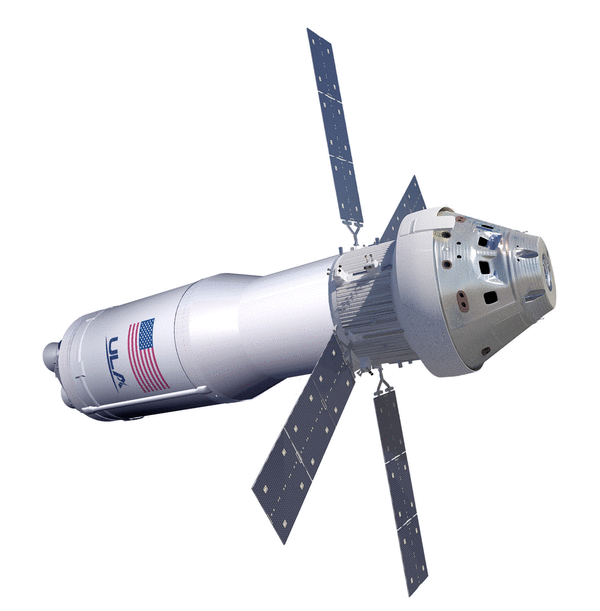
Another facet of that launch plan is what NASA needs to get Orion to the high-Earth orbit rendezvous position. The agency has in hand an upper stage called the interim cryogenic propulsion stage, of ICPS, the last of three manufactured by United Launch Alliance to be used atop the Space Launch System rocket as part of the Artemis program.
NASA doesn’t need the ICPS for the Artemis III mission next year, so it can use it on Artemis IV to get Orion to right altitude. Its purpose previously had been to get Orion to that high-Earth altitude so that Orion’s engines in its own propulsion service module could perform a trans-lunar injection, which is exactly what happened on Artemis I and II, both of which used the ICPS.
A key to the benefit of using ICPS on Artemis IV lies with the mobile launcher at Kennedy Space Center’s Launch Complex 39-B. It’s configured for the ICPS right now, and any change means NASA will need to also change the mobile launcher.
That’s exactly what is in store if NASA opts to go with Blue Origin’s Blue Moon MK2, because while that lunar lander will get to the moon on its own, the flight plan for Orion and Blue Moon’s rendezvous requires Orion to also get to the moon on its own.
Since Orion by itself does not have the propulsion capacity to get it to low lunar orbit, NASA is instead opting to bring on a new upper stage from ULA called the Stretch Centaur.
This stage has yet to be manufactured, but is relying on a production line for the Centaur V, the upper rocket stage already in use by ULA for its Vulcan rockets. The Stretch Centaur, though, will have some adjustments, and NASA is still working on adding on a “kick stage” to the Centaur that would together have enough to get Orion to low lunar orbit.
And the mobile launcher would have to undergo modifications to take on what would be a taller rocket.
“The designs for what those mobile launcher modifications will be, the hardware that’s going to be required for it, we’re going to procure that before the end of the year and do these things in parallel,” Isaacman said.
That change, though, to the mobile launcher will have to come eventually since there is only the one ICPS left. NASA will have to use version of the Centaur V for every SLS launch after it’s gone. Of note, though, NASA is only committed to using SLS through Artemis V, with the hope that Starship and New Glenn themselves can be relied on for future Artemis missions in some yet-to-be detailed manner that may or may not include Orion as well.
In one sense, the idea that the mobile launcher will need to be adjusted to handle a taller rocket because of larger upper stage raises question as to why NASA didn’t just follow through with the original Artemis plan.
That was to have a larger version of SLS using the Boeing-built Exploration Upper Stage (EUS), which in turn would use the new mobile launcher 2 (ML2), which for now sits idle next to the Vehicle Assembly Bulding at KSC. Initial construction on ML2 was near completion after years of delays and cost overruns before NASA shut down work earlier this spring.
So now NASA will have to spend money on ML1 and spend more money to purchase at least one and potentially more Centaur V stages from ULA.
“Ultimately, we are staying underneath the overall funding curve that was projected for EUS,” Parsons said. “So, this is overall a cost savings relative to EUS, and we believe we can deliver more units that are actually more capable relative than the EUS.”
If NASA opts to use Blue Origin, the plan calls for Orion to meet up with the Blue Moon MK2 lander at the higher polar elliptical orbit, which takes about nine hours to circle the moon.
Orion would rely on the Stretch Centaur to get there on its own, while the Blue Moon lander has to make its own way for the rendezvous.
Blue Origin’s plan to solve that propulsion puzzle also features multiple launches. It will fly up three transfer stages launched from Cape Canaveral on New Glenn rockets loaded with fuel that will then hook up together with the lander, which itself will be launched on Blue Origin’s in-development larger version of New Glenn.
Two of the transfer stages will get Blue Moon to the lunar polar orbit, while the third stage would be used to get Blue Moon down to low lunar orbit after picking up the two astronauts from Orion, which would remain at the higher polar orbit during the mission.
Parsons touted both options as better than the original Artemis plans.
“The closer we can get Orion to the moon, the more design margin we have, the more risk reduction, the more mission availability, and the more overall options become available to us,” he said.
One other big change for the moon missions is a spacesuit with much less capacity than what was envisioned for lunar landings. Axiom Space has been tasked with designing the new suits, the full versions of which would allow for long-term extravehicular activity.
The versions planned for Artemis IV, though, referred to as the “sortie suits,” would be pared-down versions of Axiom’s Extravehicular Mobility Unit.
NASA plans for only a pair of two-hour moon walks at most for the early missions, and so has dialed back requirements severely so that 2028 remains viable for Axiom Space. The cost of this falls within the existing contract, but will be paid out as a task order.
“This is all about proactively addressing early Artemis mission challenges and not going straight to the end state with lunar surface EVAs. Instead, we’re taking an achievable, iterative approach,” Parsons said.
--------------
©2026 Orlando Sentinel. Visit at orlandosentinel.com. Distributed by Tribune Content Agency, LLC.






Comments