'Incredible progress' for Blue Origin rebuild of Cape Canaveral launch site, CEO says
Published in Science & Technology News
ORLANDO, Fla. — Blue Origin continues to push through a rebuild of its launch pad at Cape Canaveral Space Force Station after suffering catastrophic damage in a rocket explosion earlier this year.
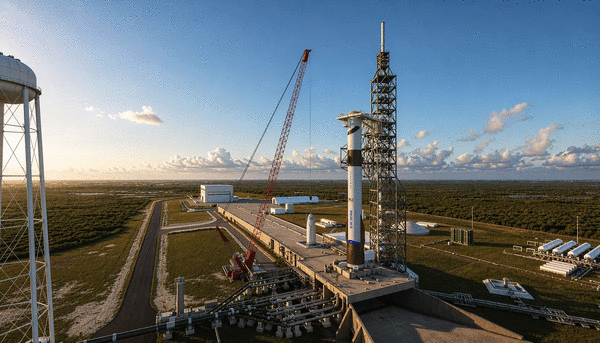
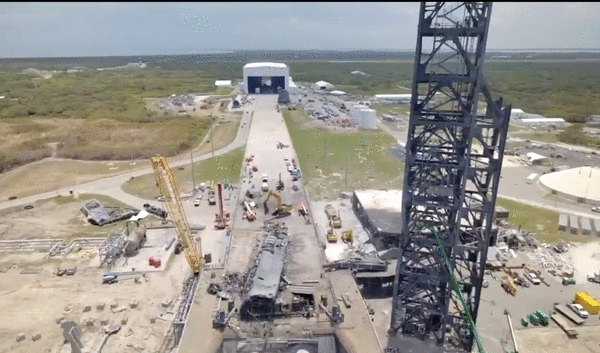
CEO Dave Limp posted side-by-side drone images of Canaveral’s Launch Complex 36 showing the extensive damage seen May 29 the day after a hot fire test destroyed one of its New Glenn rockets and the rebuild efforts that have taken place in just over three months.
The explosion that took place May 28 produced a massive fireball seen across Central Florida and registered 2.5 on the Richter scale, according to the United State Geological Survey.
At first, it was feared the launch complex would be offline for more than a year as it mirrored a similar pad explosion seen a decade earlier by SpaceX at Canaveral’s Space Launch Complex 40.
It destroyed what had been only the third New Glenn first stage the company had manufactured along with a second stage along with the transporter erector tower used to bring to the pad and raise the rocket into position. Also destroyed was one of the lightning towers on the site, but the main launch tower remained viable.
The survey of damage led Blue Origin to shift its plans on how New Glenn could be launched, removing the need for a transporter erector at all and instead pursuing a method that would use cranes to lift a rocket into position on the launch tower.
The modules for the damaged tower were removed and have since been refitted to support that operation, all of which keep the company on track to try and launch again before the end of the year, Limp said.
Earlier in September, the company began transporting the refurbished modules to restack them on the updated vehicle access tower.
“We designed and installed floors, pneumatics and electrical panels, and backbone piping on the modules,” Limp said. “And we’re moving the elevator to the side of the vehicle access tower, freeing up significantly more floor access for our new (concept of operations).”
Cleanup of debris was complete in nine days and teams swarmed the site to begin the rebuild.
Much of the supporting equipment at the launch site survived. In addition to the vehicle access tower, other recoverable infrastructure included a tank farm, the integration facility building adjacent the pad and a water tower.
The return of New Glenn to flight is essential for NASA’s plans for its Artemis moon program.
A version of Blue Origin’s Blue Moon MK2 lunar lander is supposed to fly as part of the Artemis III mission in mid 2027.
The company still has one of its first stage boosters, which was feared damage as it was housed within the adjacent integration facility at LC-36 when its sister rocket stage exploded.
The rocket stages are manufactured at Blue Origin’s massive campus in Merritt Island. The booster named “Never Tell Me The Odds” made successful launches and landings on both the second and third ever flights of New Glenn.
“Lots of questions about Never Tell Me the Odds. Alive and well. On the way to the Integration Facility,” Limp posted this week.
When New Glenn does return to launch, it will likely need to use that booster again.
Meanwhile, a new upper stage was shipped last week from Florida to NASA’s Stennis Space Center to undergo its own hot fire testing.
--------------
©2026 Orlando Sentinel. Visit at orlandosentinel.com. Distributed by Tribune Content Agency, LLC.






Comments