NASA needs more astronauts, and applications are now open
Published in Science & Technology News
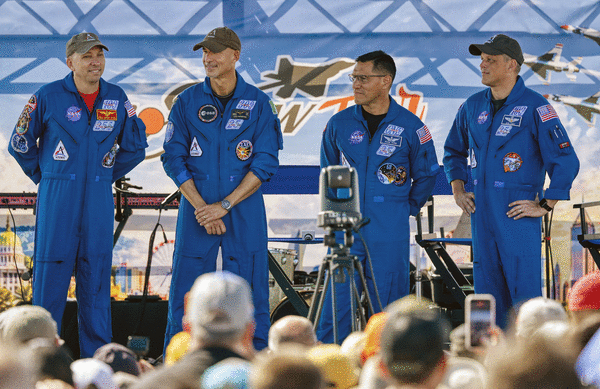
NASA has only 32 active astronauts right now, and the agency wants more.
“There is no single résumé that makes somebody an astronaut,” said NASA Deputy Administrator Matt Anderson, standing in front of a gaggle of blue-suited space veterans at this weekend’s Max Power air show at Kennedy Space Center.
It included some who had flown on the space shuttle, several who had flown to the International Space Station and four crew assigned to next year’s Artemis III mission.
“You heard it from them directly. Look at the people standing on this stage. Different backgrounds, different careers, different experiences. What connects them is excellence, discipline, teamwork, service, and the willingness to raise their hand when the opportunity came. That’s what I’m talking about.”
One of those present was Jack Hathaway, who recently returned from a stay on board International Space Station as part of Crew-12 on what was his first spaceflight. He is a member of the 2021 class of astronauts, and there is one class chosen since still in training.
“I’m like an old astronaut now! Like, there’s a new class that’s still in the office right now, and we’re about to pick a third where I’m about to be not the new guy anymore,” he said. “I’m excited about it. It’s going to be really awesome to get some new blood and new people in.”
Hathaway, who came to NASA after first being a naval aviator, grew a recognizable mustache for what turned out to be nearly eight months in space. Now shorn of his facial hair, he said it lasted only a couple of weeks after his return to Earth.
“It turns out it was just too unruly in gravity. I could handle it in microgravity, but down here I just — I couldn’t do it,” he said.
Hathaway didn’t rule out a mustachioed return, though, if chosen for a future lunar mission with Artemis.
“I can grow a mustache pretty fast, so I think I would have one for the next mission,” he said.
It’s not only moonbound Artemis missions, but also continued flights to the space station through at least 2030 that have NASA scrambling for more to join its corps.
Anderson tried to stoke up fervor among the thousands gathered to see the astronauts on stage.
“Somewhere in this crowd may be a young boy or girl who will one day be standing on this stage alongside these heroes,” he said. “They may help build the moon base, they may conduct science on another world, they may sit inside a spacecraft pointed toward Mars and carry the American flag farther than it has ever gone before. And this is your chance to be part of what comes next: the Artemis Generation.”
He also touted the forthcoming United States Space Academy, which has yet to have its location revealed, although Florida officials have been putting their hand in the ring to try and have it based on the Space Coast.
Anderson said wherever the NASA-led civilian federal academy ends up, it will begin accepting applications in 2027 and students beginning classes in summer 2028.
“If you are between the ages of 17 and 22 in July of 2028, you are eligible to go to your United States Space Academy. We are going to take alumni from that academy — a NASA-led academy — and make astronauts just like these great patriots,” he said.
As far as those gunning to join NASA now, the application for the new class is open to U.S. citizens with a master’s degree in a STEM field, although there are alternative windows for those seeking doctoral program degrees, those already with a medical degree and those with test pilot skills.
“Astronaut candidates must pass NASA’s long-duration astronaut flight physical and demonstrate strong leadership, teamwork, and communication skills,” according to a NASA press release.
The final choices for the new class are expected to be announced in late 2027. The application opened at the USAJOBS.gov and runs through Dec. 3.
NASA has selected 370 astronaut candidates with the first Mercury 7 announced in 1959. Several notable astronauts have hung up their flight suits this year, including all four members of the Artemis II mission who flew around the moon.
The current astronaut class, nicknamed the Platypi by the class ahead of them, remain in training from applications that opened in 2024 and drew more than 8,000 candidates. Only 10 were chosen. They began training in 2025 and will join the corps next year after completing two years of training.
“For those who apply, becoming a NASA astronaut is more than a career opportunity,” said Scott Tingle, chief astronaut and chair of the Astronaut Selection Board. “It is a chance to join a legacy of explorers who have pushed the boundaries of discovery and play a role in the missions that will shape humanity’s future in space. The next generation of astronaut candidates could help write history while inspiring future scientists, engineers and explorers.”
_____
©2026 Orlando Sentinel. Visit orlandosentinel.com. Distributed by Tribune Content Agency, LLC.






Comments