'California's coast is not for sale': State battles Trump plan to limit coastal oversight
Published in Science & Technology News



SANTA MONICA, Calif. — In a striking demonstration of support, hundreds of fired-up Californians rallied in Santa Monica to speak out against the Trump administration’s attempt to wrest local control over the state’s beloved coastline.
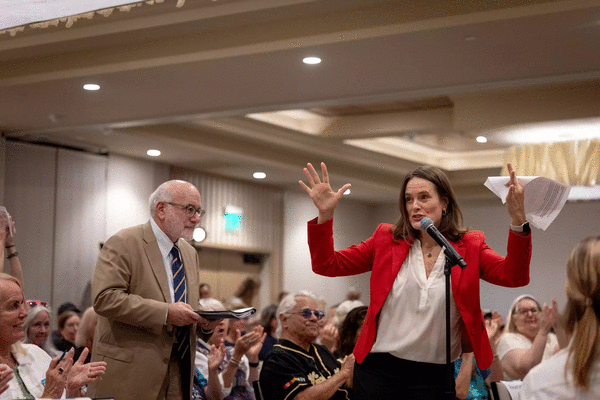
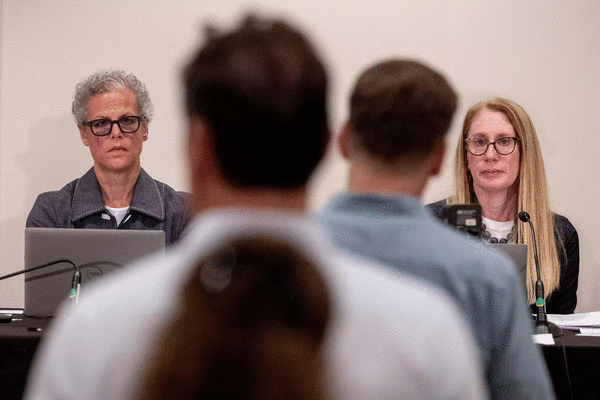
The Golden State’s top environmental leaders, along with prominent elected officials, environmentalists, business coalitions, community activists, Indigenous groups and everyday citizens, packed a public hearing Monday before the National Oceanic and Atmospheric Administration’s Office of Coastal Management, which has been tasked with conducting an unprecedented investigation that could ultimately strip California of its power to say no to federal projects.
Experts see the investigation — framed as a performance review of the state’s coastal management practices — as a thinly veiled attempt by Trump officials to open California’s coast to more offshore oil drilling, more rocket launches and possibly even floating nuclear reactors. If the federal government succeeds, many worry it could set the stage for similar actions in other coastal states.
“I’m scared, not because we haven’t built something worth protecting — we have. I’m scared because this meeting is performance theater. In some ways, the decision seems already made,” said Maureen Ellenberger, a resident of Santa Barbara who said she is haunted by the possibility of another oil spill. “But I’m speaking today anyway, so there’s a record. So years from now… everyone will know we fought, that we did not consent.”
Citing California’s “environmental extremism,” Trump officials are attempting to decertify the state’s authority under the federal Coastal Zone Management Act, or CZMA. The act grants coastal states the right to review and object to any project in federal waters that clashes with state policy.
For the last five decades, the CZMA has been celebrated as a bipartisan co-management framework between coastal states and the federal government — and in California, the process had been relatively smooth through every presidential administration until Trump’s.
Tensions escalated in May when U.S. Commerce Secretary Howard Lutnick declared that “California has repeatedly and unfoundedly obstructed spaceport development in bad faith” and announced that he was ordering a fresh evaluation of the state’s CZMA compliance using a “new approach.” He specifically instructed NOAA, which is under his purview, to take offshore oil production, pipeline maintenance, spaceport infrastructure, desalination projects and undersea cables into consideration, citing national priorities and economic interests.
Performance reviews under the CZMA are not uncommon (most states are subject to a routine review every five to 10 years) but what’s unusual in this case is the callout to specific industries, as well as the politically charged nature of how the review was announced (state officials learned they were under review through a social media post from the U.S. Department of Commerce).
What was also unusual was the fact California had also just undergone a routine review during the Biden administration.
A draft of that review, which was completed in 2024, but not finalized because of the change in administration, gave top marks to the three California agencies charged with implementing the CZMA — the California Coastal Commission, the California State Coastal Conservancy and the San Francisco Bay Conservation and Development Commission. The review found no issues.
The new Lutnick-ordered review began in earnest on Monday with the only hearing that people can attend in-person during the 45-day-public comment period. (Two virtual hearings will be held Tuesday and Wednesday, and NOAA is required to review all written comments that are submitted from members of the public through Aug. 22.)
More than 15,000 people have written comments so far, and for more than four hours Monday, surfers, fishers, marine scientists, community activists, business owners, real estate brokers and Californians from a wide swath of interest groups — many traveling from Marin, San José, Mendocino and other parts of the state — lined up to speak before NOAA’s acting director for coastal management.
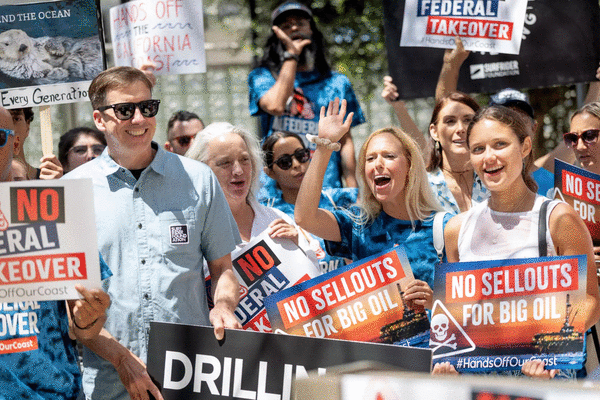
Nobody in attendance spoke in favor of the federal review. As people in the crowd held up signs declaring “NO FEDERAL TAKEOVER” and “NO SELLOUTS FOR BIG OIL,” speakers expressed their love for the California coast and urged federal officials to take note of the state’s thriving marine economy.
The crowd erupted in whoops and applause after each person finished their three minutes of public comments. A number of speakers, some moved to tears, expressed afterward that they had never been more proud to be a Californian.
“It was just example after example after example of how the state’s coastal management program is working — it was really putting into the record those facts and also just so many personal stories,” said Jennifer Savage, a longtime policy advocate for Surfrider Foundation who drove more than 670 miles from Humboldt to testify at the hearing. “It showed more than anything that being able to go to the beach is such a unifying shared joy in California.”
The state’s top environmental leaders also took turns speaking about how the CZMA has long facilitated open dialogue and collaboration between the state and federal government.
“We sincerely hope that this review is not merely a pretense for removing California’s ability to hold public hearings on offshore oil and gas projects,” said Kate Huckelbridge, executive director of the Coastal Commission. “California has received very little information about why this new federal review is being undertaken. Still, we welcome a fair and transparent evaluation. Our record speaks for itself.”
Out of the more than 3,700 federal actions that have come before the Coastal Commission for review since the 1970s, the commission has aligned with the federal actions 96% of the time, Huckelbridge said.
Current and former coastal officials also spoke about their experiences with past reviews and questioned the unusual timing of this evaluation and how it doesn’t follow standard procedure.
“I have personally participated in several periodic reviews, and what has happened in this review is unprecedented and, quite frankly, bizarre. There is absolutely no basis for reopening the periodic review conducted in 2024,” said Jack Ainsworth, who had worked at the coastal commission for 34 years and led it for seven of those years. “I would also note that California is recognized as the gold standard for integrated coastal management in the United States and around the world.”
What happens after this week’s hearings will be uncharted territory, but experts say that if the review does end up taking issue with California’s coastal management program, the state should be given the opportunity to respond to any proposed changes. The process laid out in the law appears to include multiple steps and opportunities for discussion, they said.
At a rally outside the meeting room Monday, more than a hundred environmentalists gathered alongside Congress members, county supervisors, Indigenous leaders, environmental justice groups and business coalitions to further amplify the many voices that represent California.
“The Creator put us here to coexist and to collaborate in caring for our mother ocean and for all her relatives, all of her inhabitants and all those who call this coast home,” said Toni Cordero, a former tribal chair of the Coastal Band of the Chumash Nation who also served as a deputy state attorney general for more than 25 years. “We must remember them. It is their homelands, their well-being and their futures that are also at stake under the guise of ensuring compliance with the Coastal Zone Management Act.”
The crowd waved signs and cheered again as Wade Crowfoot, California’s secretary for natural resources, stepped up to speak.
“It has been clear from Gov. Newsom to Atty. Gen. Bonta to our legislators to our congressional delegation: California’s coast is not for sale, and a hostile takeover of our coast by the federal government... won’t be tolerated,” Crowfoot declared.
“So rest assured,” he said, “we stand in strong solidarity with everyone here today — whether you’re a tribal government, a local government, a conservation organization or just somebody that likes to get out and be on a beach that’s safe and healthy, we are making our voices heard.”
©2026 Los Angeles Times. Visit at latimes.com. Distributed by Tribune Content Agency, LLC.






Comments