Mechanics say they're losing business as vehicles get more high tech
Published in Science & Technology News
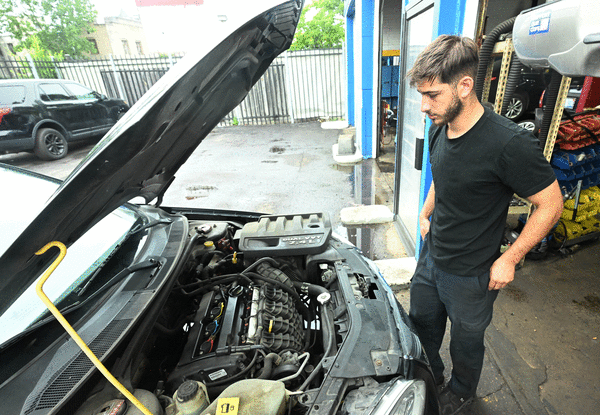
High-tech features are making vehicles more expensive and difficult to repair, putting pressure on already strained car owners and posing an existential crisis for mom-and-pop mechanics, analysts and consumer advocates say.
At issue is the shift from mostly mechanical vehicles to "big four-wheel rolling computers," as one auto industry analyst said. Local mechanics say they're facing roadblocks accessing the tools and information needed to work on modern vehicles, potentially giving dealerships a monopoly on maintenance and repairs of new models.
"Not even just mechanics; the customers are frustrated with that," said Mohsen Harb, manager at Detroit's Cass Auto repair shop. "Because instead of them being able to go to their mechanic and getting it fixed for a much cheaper price, they're gonna have to go to the dealership and pay three times that to get a fix just because the dealership or the company itself is not allowing these mechanics to get the right tools to be able to fix it."
Concern about who can repair increasingly tech-heavy vehicles — whether that be dealerships, neighborhood mechanics or vehicle owners — is getting attention from the White House and Congress, although so-called right-to-repair legislation in the U.S. House is moving slowly.
President Donald Trump told reporters that he spoke with leaders of Ford Motor Co. and General Motors Co. in June about "a move on to stop people from fixing their cars. I thought we’d do something about that."
Days later, the president issued a memo directing the Environmental Protection Agency to "consider deprioritizing civil tampering enforcement actions against anyone who, in good faith, attempts to fix his or her own vehicle to its original configuration." The memo is primarily directed at making it easier to tweak vehicle emissions systems.
Decades ago, independent mechanics or handy DIY-ers could fix most auto issues with "a good set of Craftsman tools," iSeeCars.com analyst Karl Brauer said. Now, many repairs require automaker-specific software available through subscriptions that can cost thousands of dollars a year.
For example, Tesla charges $3,188 for an annual subscription, according to the mechanics and aftermarket parts trade group Auto Care Association. Ford Motor Co. charges $2,500 a year for access, and General Motors Co. charges $1,200 a year.
"As cars have become basically big four-wheel rolling computers, all the things that go with computers, like regular updates to the software, are commonplace now," Brauer said. "Many of them can't be done over the air, and if you're not a dealer service center, but an independent (mechanic), your access to those updates is dependent on things like those subscriptions."
Both dealerships and independent mechanics have to pay for software subscriptions, according to the National Automobile Dealers Association, which in a statement said non-dealer mechanics "already have the information they need to service vehicles."
"For mechanics to invest in the scan tools and the equipment to fix modern vehicles, it's quite an expensive business decision," said Michael Chung, who heads market research for the aftermarket service trade group Auto Care Association. "Because as the technology advances more quickly, being able to access the data or ... do a scan of a vehicle that has many more electronic and computer-oriented parts, that becomes a big investment decision for shops."
Consumer advocates and analysts told The Detroit News that if roadblocks to tools and software lead to dealerships gaining an exclusive hold on modern vehicle repairs, independent shops could shutter and put car owners at the mercy of dealer prices.
"A lot of the independent mechanics are going to be driven out of business as more and more of the cars that are coming in are these newer models," said Nathan Proctor, who leads so-called right-to-repair efforts at national consumer advocacy organization Public Interest Research Groups. "It's going to either be too expensive or they're just not going to be able to conduct the repairs without paying for subscriptions that are just not in their self interest to pay for."
What automakers, dealers and mechanics say
The higher use of software throughout vehicles is giving automakers more control over who can fix vehicles, Brauer said.
"There's no way for an independent dealer to say, 'Well, I'll just get my own software engineers; we'll come up with our own way,'" he said. "It's impossible. So that's where the nature of the car's design, and thus the nature of the repair process is so different and so much easier to control at a manufacturer and a dealer level versus just hardware (and) hard tools and material tools that you would have used to fix cars 50-60 years ago.
"The manufacturers would love to have more control over who repairs the car and have basically more of a monopoly on that and make it so that it's impossible to get the cars repaired outside of the dealers," Brauer continued. "The dealers would love that, obviously. That's where dealer profit comes from."
Ford did not respond to a Detroit News request for comment on the issue, and both GM and Stellantis NV referred questions to the Alliance for Automotive Innovation, a national automaker trade group. The group pointed to an agreement automakers signed in 2014 promising equal access to information and tools for repairs between dealers and independent mechanics.
In a statement following Trump's memo on emissions system work, Alliance President and CEO John Bozzella said the organization believes in the importance of "protecting both automotive intellectual property and confidential business information."
He said Trump's memo "builds on the longstanding commitment from automakers to provide consumers and independent repair shops with the same repair instructions, tools and diagnostic codes they provide franchised auto dealers."
Yes, your repair bill is probably higher
The cost of vehicle maintenance has been rising steadily for decades. Factors include more expensive vehicle parts, more demanding safety requirements from federal regulators, a shortage of qualified vehicle techs and steep competition between automakers to offer more high-tech features.
Vehicle maintenance and repair prices spiked starting in 2022 after COVID-19 caused widespread disruptions throughout the auto industry and a crippling microchip shortage.
Costs rose 36% between May 2022 and May 2026, according to the U.S. Bureau of Labor Statistics. This year alone, maintenance costs increased 6%.
Price increases for aftermarket auto parts are driven by tariffs, more advanced tech and expensive rare earths and metals needed to make parts, Chung said.
"Those costs are being passed on to the consumer," Chung said. "So if the manufacturer has to pay more for the part, and then they have to sell to the shop at an increased price, you then sell it to the consumer, you or I, at an increased price."
Proctor placed some of the responsibility on automakers for the added complexity of vehicles and subsequently higher repair costs.
"The manufacturers would, in the public, say, 'Oh, well, we're trying to do these safety things, and this is really sophisticated,' you know, '" Proctor said. "But of course, if they wanted to engineer systems that were both safe and fixable, that would be possible."
Customers are responding to higher costs by deferring maintenance that's not urgent, opting for lesser-grade replacement parts or doing maintenance, such as oil changes, and repairs themselves, Chung said.
Bigger mechanic bills are mounting as drivers keep their vehicles longer due to high sticker prices for new models, compounding the pain for consumers. Allen resident Andrew Dunn said he spends roughly $4,000 a year to keep his used vehicles running.
"It probably is cheaper" than buying new, said Dunn as he waited for a tire patch on his 2008 Land Rover SUV at Cass Auto. "But at the same time, it makes you want to just leave that vehicle, get rid of it and get something else."
Harb said customers at Cass Auto sometimes pay more for a repair than a vehicle is currently worth to avoid new car payments. Mechanics at the shop on Friday replaced the engine on a 2013 Hyundai Accent sedan worth about $4,000. The engine cost $5,000, Harb said.
"Nowadays these cars are so expensive," Harb said. "The car market's crazy, so a lot of people would rather just put the money into their older vehicles than go buy another car and have to put money into that one."
(Staff Writer Ben Warren contributed.)
©2026 www.detroitnews.com. Visit at detroitnews.com. Distributed by Tribune Content Agency, LLC.






Comments