Drones transporting organs? It could be more efficient, NASA Langley study shows
Published in Science & Technology News
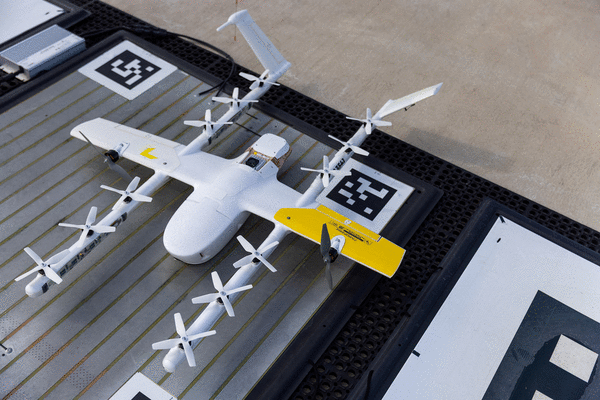
Drones could be a viable way to make transportation of potentially life-saving donated kidneys more efficient, according to a recent study conducted at NASA’s Langley Research Center in Hampton, Virginia.
On June 5, researchers had drones take human kidneys on two 15-minute flights in loops around NASA’s testing range beyond line-of-sight for about 7.5 miles each time, reaching a peak height of 250 feet. Based on biopsies of the kidneys before and after, the preliminary findings show no sign that the flights negatively affected the kidneys, according to the researchers.
Organs are typically transported using a mix of ground transportation by a medical courier, and charter or commercial aircraft, but it’s always a race against time. Organs only last for so long before the health outcome for the recipient is impacted, though advancements in technology have allowed organs to survive longer trips.
Drone transportation could address challenges like traffic congestion and other bottlenecks, and expand access to patients in more remote locations, according to Doug Wilson, executive vice president of Virginia Beach-based LifeNet Health, which provided the kidneys used in the study and helped to assess their status before and after the flights.
“The goal is not necessarily to replace existing transportation methods but to explore whether drones could complement them in situations where speed, reliability, or access are critical,” Wilson said in an email.
Currently, 3,000 Virginians and 100,000 people nationwide are waiting for a life-saving transplant, according to Wilson. Thirteen people die every day waiting for an organ transplant, according to the Health Resources & Services Administration, a federal agency.
The study was funded by NASA and conducted in partnership with LifeNet and the Richmond-based United Network for Organ Sharing (UNOS). UNOS described the study in a news release as “groundbreaking,” and it was the first time NASA had tested whether human organs can be transported beyond line-of-sight by drone, according to John Koelling, director of NASA Langley’s Aeronautics Research Directorate.
Koelling said Hampton Roads is the perfect testing ground for this new means of transporting organs because “every problem you’re going to face in trying to make this a reality is all right here,” noting the presence of military installations, nuclear power plants, densely populated urban areas, and a major port.
To be adopted widely, Koelling said they would need to show that drones could safely handle the weight of the organ on flights beyond line-of-sight and significant regulatory hurdles with the Federal Aviation Administration would need to be cleared.
“This is sort of proof of concept for us,” Koelling said. “The technology to do this is pretty much largely in place.”
The drone used in the study was an Alta X quad-rotor drone made by Freefly, which has the highest maximum payload of any drone in NASA Langley’s inventory, according to Jim Burgess, an unmanned aircraft systems engineer who was the flight‑test team lead for NASA. The Alta X can carry a maximum payload of about 33 pounds, according to the company’s website.
Past studies have shown drones can carry organs safely but in those cases people had to be on rooftops to maintain line-of-sight, according Burgess.
“It’s not necessarily scalable to always have spotters up on rooftops,” Burgess said.
The kidneys used in the study were donated for research because they were not accepted for transplant, according to Kaitlin Swanner, senior policy analyst for UNOS. They were kept in a container similar to how organs are typically packaged for transport, put on pumps to help keep them healthy before and after the flights, and the researchers monitored vibrations and pressure throughout the flights.
Swanner said drones would likely be used to help with the “first mile, last mile” part of the organs’ journey, from the donor hospital to the airport and from the airport to the patient’s hospital.
“Most organs are traveling pretty far so that makes it more logistically challenging to get the organs from the donor to the patient,” Swanner said. “We think (drones) will be particularly helpful in areas where there’s a lot of traffic congestion.”
The majority of the donor organs Sentara receives are from farther than 250 miles, according to Karl Neumann, program manager for Sentara’s transplant clinic. Neumann said any improvement in the efficiency of organ transportation would mean greater confidence that the organ is going to work for the patient.
While this research is promising, Wilson said the most immediate way to help save lives is for more people to register to be an organ donor.
_____
©2026 The Virginian-Pilot. Visit pilotonline.com. Distributed by Tribune Content Agency, LLC.






Comments