'Serial monogamists' who love scandal, Chicago zoo's same-sex penguin couple showcase animal diversity
Published in Science & Technology News
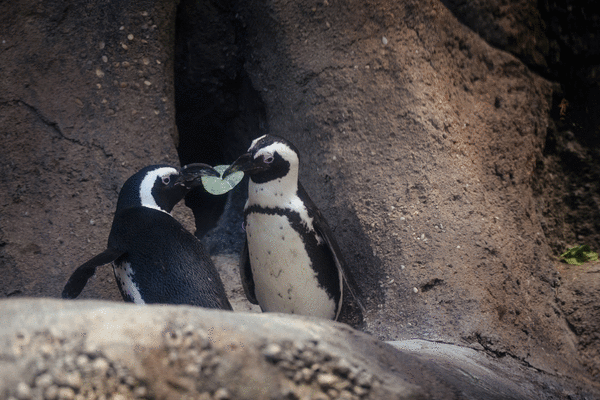
CHICAGO -- Maureen Cleary likens the love lives of the African penguins at Chicago's Lincoln Park Zoo to a soap opera. Pilchard and Maynard would probably be the couple starring in such a drama, said the zoological manager of birds.
The same-sex duo arrived in 2016 as additions to the zoo’s newly opened penguin habitat, Cleary said. Maynard, now 22, hailed from Pueblo Zoo in Colorado and Pilchard, 11, from the New England Aquarium.
But Maynard was already in a relationship — at least at first. That is until the other half of his bonded pair, a female named Aiden, started hanging out in both Maynard and Pilchard’s nest boxes, Cleary said.
Then, in another twist, Aiden set her sights on a different penguin, one whose mate had recently passed away. Maynard and Pilchard, however, decided to stick together. And about seven years later, they’re still going strong, Cleary said.
“I’ve had some difficult conversations with guests in regards to, ‘Is this natural?’” she said. “We give our birds a lot of choice. We don’t force our birds to do anything … and so they’re choosing to pair up that way.”
During Pride Month, Chicago-area zoos are highlighting LGBTQ+ animals like Pilchard and Maynard. From dolphins to a desert grassland whiptail lizard, “wildlife displays for us the beauty of difference,” said a news release from Brookfield Zoo Chicago.
One of the most interesting examples is the clownfish, said Mike Masellis, the lead animal care specialist for aquatics at Brookfield. They’re what’s called a “protandrous hermaphrodite.”
While all clownfish are born male, they’re led by a female. When the female dies, the largest and most dominant fish in an anemone changes into a female and takes on a leadership role, he said. A larger clownfish is able to lay more eggs. The second most dominant male will likely pair with her, he added.
“So in ‘Finding Nemo’ the mom gets eaten — spoiler alert,” Masellis said. “But what would actually happen is the dad wouldn’t hunt for Nemo, he would just probably become the female of the anemone.”
Parrotfish and wrasses, on the other hand, are “protogynous hermaphrodites.” They start out as female and the most dominant fish in the group becomes male, Masellis said. Parrotfish are known for eating coral and pooping it out, creating sand, he noted.
“A lot of corals can be functionally male and female at the same time,” he said. “And that can happen for a lot of animals that are kind of lower evolutionarily, (such as) coral, sunfishes, a lot of worms and snails.”
At Brookfield, a brown-colored desert grassland whiptail lizard slithers at a display in the Feathers and Scales building. The entire species is female — there’s no males in existence, Masellis said.
They lay eggs that are clones of the female that laid them, a process called parthenogenesis, he said.
“They’re kind of a cool stripy lizard that can be found kind of in the Southwest,” he said. “They’re sort of unassuming.”
Penguin relationships
Penguins are a colonial species, which means they live in massive flocks. They want to pair up with another bird in large part because it helps them defend nest sites in the wild, Cleary said. Penguins also share the responsibility of finding food, incubating eggs and defending chicks.
Maynard and Pilchard, for example, have become “real estate kings” of sorts in their habitats, Cleary said. They’re able to control three nest boxes because of the success of their bond, something they likely wouldn’t be able to do on their own, she said.
“While (a male penguin pair) probably don’t quite realize they are not going to produce a fertile egg, they still go through all these nest behaviors because there’s a lot of seasonal and hormonal changes that penguins go through,” Cleary said. “We all want to have a buddy, it just helps their success.”
In her experience, Cleary said it’s more common to have same-sex bonds among penguins when the sex ratio of the flock isn’t evenly distributed. There were previously 14 male penguins and nine females at the zoo, she said.
There’s a similar dynamic with other colonial species like flamingos and Humboldt penguins.
This type of penguin, native to Peru and Chile, are housed at the Brookfield Zoo. While there aren’t any same-sex pairs currently, Masellis said there’s been some in the past. At times they can help rear chicks from other pairs that aren’t doing the best job, he said.
Masellis also said male bottlenose dolphins can sometimes form lifelong relationships with each other. Dolphins have much more complicated minds than other types of animals, so it’s difficult to know exactly why. He wagers it has to do with hunting success, though.
One common misconception about penguins is that they mate for life, Cleary said. It would be more accurate to describe that as “serial monogamists” who love a bit of scandal, she said.
“They will pair up with another individual for multiple breeding seasons,” she said. “If they aren’t necessarily a successful pair, they don’t produce chicks, they can quote, unquote break up and then repair.”
©2026 Chicago Tribune. Visit at chicagotribune.com. Distributed by Tribune Content Agency, LLC.






Comments