NV Energy: Data centers could drive 64% of Nevada power demand by 2046
Published in Science & Technology News
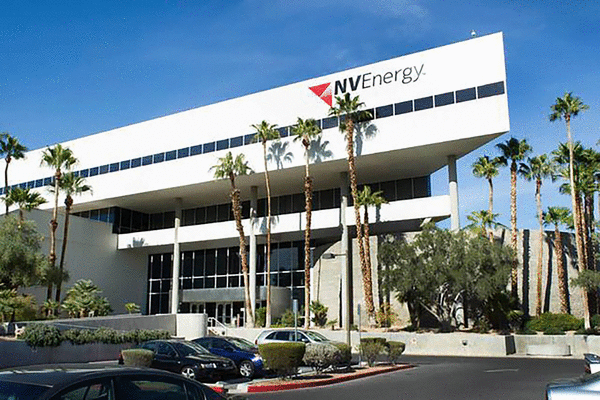
NV Energy projects data centers will drive a dramatic shift in Nevada’s energy landscape, growing from 5 percent of electricity sales today to 64 percent by 2046.
NV Energy is requesting $3.2 billion in transmission and substation upgrades, along with thousands of megawatts of new solar, battery storage and geothermal and natural gas generation from the Public Utilities Commission of Nevada for its newest and biggest customers.
NV Energy’s existing and approved systemwide capacity through 2050 is roughly 10 gigawatts. If projected data center demand materializes, that figure could exceed 20 gigawatts by 2050, effectively doubling the amount of power the utility must provide.
NV Energy filed its plan for load growth and demand and how the utility intends to meet it with the PUCN in May. The Integrated Resource Plan, or IRP, is required to be filed every three years, or more frequently if needed.
The current IRP has over 40 volumes and thousands of pages worth of data, providing a roadmap of load growth for the next approximately 20 years, including how to prepare for an influx of data center power demand.
”NV Energy does not advocate for or against data center development. We don’t pick and choose who we serve,” said NV Energy in a statement to the Review-Journal. “We are required to plan for and serve customers who choose to locate in our service territory, under terms approved by state regulators.”
How would this affect ratepayers?
An IRP does not adjust existing rates for ratepayers, but it could lead to one in the months ahead. And NV Energy is taking steps to have large energy users pay for the demand they will put on the power grid.
Without “risk mitigation controls,” or ways to minimize potential negative impacts of data centers, those infrastructure costs could be shifted to NV Energy consumers, which the utility recognized in its filings.
Brad Deken, chair of engineering and technology at Southeast Missouri State University, said rates could go up or even down for existing customers.
“If the existing infrastructure is underutilized, then it could help reduce rates if it gives the power companies better utilization,” said Deken. “However, that’s just not as likely as the other scenario — if the existing infrastructure needs upgrades, then that would be a substantial cost.”
In the end, it all depends on who is paying for the infrastructure upgrades.
To ensure the costs needed to upgrade infrastructure is not shifted to existing customers, NV Energy has
proposed agreements that would require large customers to make long-term service commitments and fund or support the infrastructure and generation needed to serve their load.
“(This agreement) is designed to protect existing customers by aligning the costs of new infrastructure with those driving the demand,” said NV Energy in the statement. “NV Energy’s approach is to plan proactively and ensure existing customers come first.”
But overall, Deken said the U.S. as a whole is in “somewhat unknown territory.”
“I’m hard-pressed to think of a time where we have talked about adding as much electrical load in as short a time as this,”said Deken.
How much demand, energy growth are data centers adding?
The unprecedented load growth is due to the size and volume of data center requests, said NV Energy.
“Nevada—and northern Nevada in particular—is a sought-after location for data centers due to the expanse of developable land, a favorable climate for efficient cooling and robust fiber connectivity,” said NV Energy in the IRP.
Currently, NV Energy has received requests from 39 prospective data center customers totaling approximately 16,530 megawatts, with 11,710 MW in Northern Nevada and 5,220 in Southern Nevada.
Additionally, 6 gigawatts of Rule 9 agreements, which requires companies connecting to the electric grid to pay for the cost of the connection, have been executed, with 84 percent, or around 5 gigawatts, of the current signed agreements in Northern Nevada. A Rule 9 agreement facilitates transmission and voltage distribution, but “does not address generation and supply,” according to the filing.
How will NV Energy keep up with growth?
To keep up with demand and energy growth from the data centers, NV Energy has outlined two plans, but mainly focuses on its preferred plan: the Obsidian Plan.
In the Obsidian Plan, the utility is requesting the approval of 23 power purchase agreements, or PPAs.
A PPA is when an energy generator or developer is given permission to build, maintain and operate on the power company’s land. Then, the company will purchase the power from the developer at a fixed rate.
It is requesting 4,370 megawatts of new solar PPAs and 5,405 megawatts of new battery energy storage —“the largest expansion of renewable energy and battery storage in the company’s history,” said NV Energy in its statement to the Review-Journal.
Additionally, it is requesting 180 megawatts of geothermal PPAs. If approved, all would be active by 2031.
It is also requesting to add over 1,200 megawatts to its Fort Churchill Generating Station in Yerington, Nevada. This includes 401 megawatts of aeroderivative gas turbines by 2030, another 401 megawatts of aeroderivative gas turbines by 2031 and 421 megawatts of gas turbines.
In comparison, NV Energy only requested three PPAs during its 2024 IRP, which added over 1,000 megawatts of battery storage and 1,000 megawatts of solar energy.
Aside from PPAs, NV Energy is also requesting approval to begin network upgrades associated with transmission projects, totalling over $3.2 billion at 68 substations.
In the current stage, the IRP is a proposal and the PUC has final say on what is approved. It will likely be the end of the year before the PUCN could approval the plan.
___
©2026 Las Vegas Review-Journal. Visit reviewjournal.com.. Distributed by Tribune Content Agency, LLC.






Comments