American Gothic thriller has Celtic roots
Published in Mom's Advice
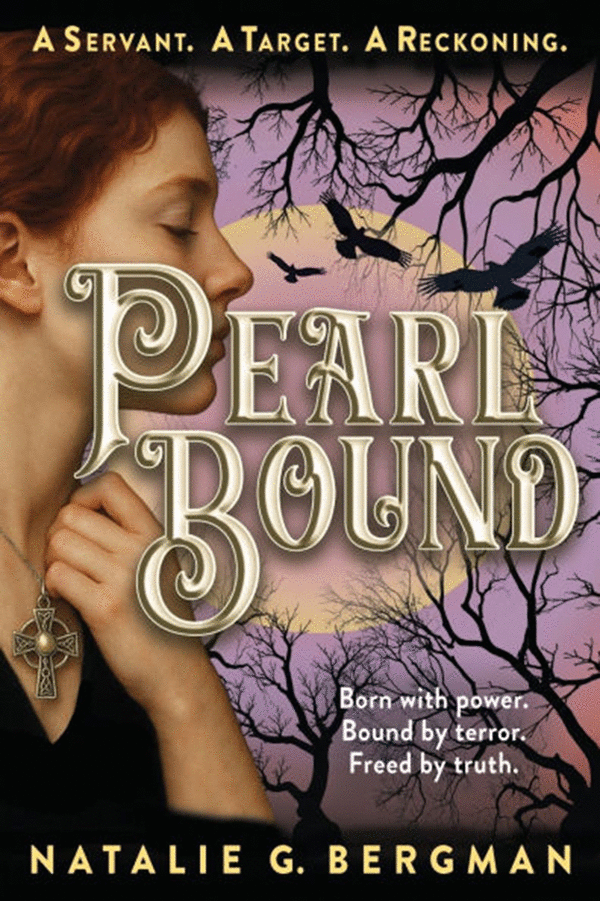
In a cabin in upstate New York’s frigid wilderness, a hungry woman waits for her husband to return from hunting. She remembers the tenement they left in Dublin, filled with friends and warmth. Now they struggle for survival alone.
Just as troubling to Moira Kelly is the strange behavior of her three-year-old daughter, Eve. Moira has seen Eve do strange things: move toys without touching them, control the house cat to do her bidding. When Moira’s husband, Sean returns with a string of rabbits, Moira tries to tell him of her fears. His eyes tell her he’s seen things, too.
As Moira prepares supper, she looks up to see Eve stare at the fire in the hearth, then move her hands as if conducting the flames to shoot higher. The mantel begins to burn and Sean reaches to rescue his child, but a blinding flash of light throws him back against the wall with such force that he dies.
All of the above transpire in just the first few pages of "Pearl Bound" by Natalie G. Bergman. Bergman is also a screenwriter and is skilled in building a need to know what happens next.
Born of Fire, Bound by Fate
After Sean’s funeral, Moira takes Eve to a neighbor with special powers. “It’s not the wee one’s fault,” explains Fiona. “The old powers choose their vessels, and we’ve naught to say about it.” She places Eve in the center of a pentagram outlined on the floor. Three ravens fly into the room from an open window, and Eve smiles as if greeting old friends.
“The Morrigan,” gasps Fiona, recognizing the power of the Phantom Queen, controller of fates and guardian of ancient Irish bloodlines. “The same force that drove ravens to guard our ancestors now flows through your daughter’s veins … The Celtic magic in Eve is linked to the Morrigan herself.”
Fifteen years later, Moira and Eve are working as servants in a grimy inn when an opportunity arises. The wealthy Rennard family agrees to hire them as housekeeper and maid for their posh Poughkeepsie mansion.
All the traditions of Gothic literature are here: A young woman striving to better herself, supernatural mysteries, family secrets, danger, and a spooky house. Greythorne, the Rennard residence is vast, dark and filled with taxidermied animals, the trophies of young Master Teddy Rennard.
Where Servitude Meets Something Sinister
Teddy’s sister, Saskia is a beautiful Gibson girl who keeps a pistol strapped to her thigh, she’d rather be riding, hunting and fishing than suffering through fancy balls with eligible bachelors. Upon meeting her, Eve is mesmerized. Saskia is intrigued by Eve’s red hair, green eyes and dreams of becoming a doctor. And then there’s Eve’s strange relationship with the ravens that appear at critical times …
Moira and Eve join the household staff and while all seems normal, Eve quickly senses something evil lurking beneath the opulence. (Those hanging carcasses of deer and boar in the basement larder…) Saskia, meanwhile, does her best to withstand the machinations of her father and aunt to marry her off to a rich steel magnate from Pittsburgh. It’s a juicy premise, but what begins as lesbian romantasy turns to terror as the sinister depths of the Rennard family’s generational depravity are revealed.
When Desire Turns Deadly
Most Gothic classics are set in England or Europe (where the genre began with "The Castle of Otranto" in 1764; "Jane Eyre" and "Rebecca" are just two more recent examples). Bergman does a fine job transposing "Pearl Bound" to late 19th century America, with its robber barons, marriages arranged for economic or social benefit, and opulent lifestyles made possible by the toil of Irish immigrants. Many of Greythorne’s servants are integral to the novel’s plot, adding an “upstairs, downstairs” dimension. Other characters hail from the Caribbean and contribute a frisson of voodoo.
Overall, "Pearl Bound" will hold you captive. (And could that little hint on its last page mean there will be more tales like this to come?)









Comments