
Eric's Autos: 2026 Honda Ridgeline
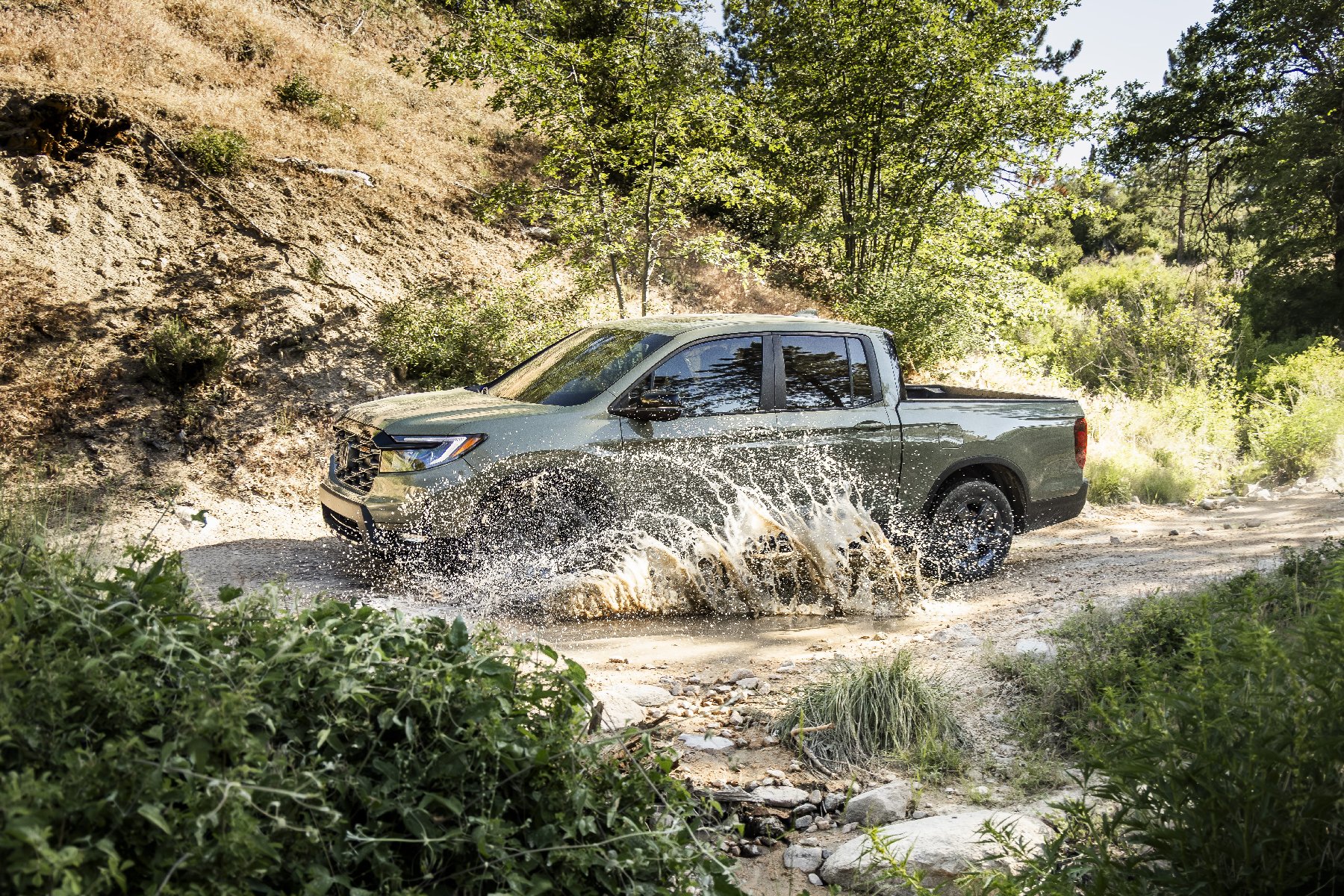
It's gotten so that you almost can't find a standard (or even optional) V6 engine in a new midsize pickup anymore.
The Honda Ridgeline is one of just two that still comes standard with one. The rest no longer even offer one. And the Ridgeline's not really a pickup. At least not by the usual standards.
But that's not necessarily a bad thing.
What It Is
The Ridgeline looks -- and functions -- like a midsize truck. It has a four-door crew cab and a standard 5-foot bed, like most of the other midsize trucks currently on the market, including the Ford Ranger, Toyota Tacoma, Chevy Colorado/GMC Canyon. The Nissan Frontier is the only currently available midsize truck that's still available with just two doors and a longer (6-foot) bed.
But unlike the Frontier and all the others, the Ridgeline isn't body on frame or rear-wheel drive, with four-wheel drive available -- i.e., the things that traditionally define what a "truck" is. Rather, it shares a platform with the Honda Pilot, which is a front-wheel drive/all-wheel drive crossover -- not that there's anything wrong with that.
Prices start at $40,795 for the base Sport trim, which comes standard with a 3.5-liter V6 paired with a nine-speed automatic, a class III hitch for towing and a 5-foot bed for hauling and standard AWD. The italics are to emphasize that 4WD costs extra in all the Ridgeline's midsize pickup rivals.
There are five other trims -- RTL ($43,595), TrailSport ($45,995), TrailSport with HPD wheels ($47,195), Black Edition ($47,395) and Black Two-Tone ($47,895) -- which all come standard with the 3.5-liter V6/AWD. The RTL gets a standard sunroof, leather seat covers and a power sliding rear window. The TrailSport gets upgrades such as skid plates and all-terrain tires to give it some additional off-road capability. This trim also gets special orange interior stitching and navigation, among other upgrades. The HPD has a set of special Honda Performance Division wheels.
Top-of-the-line Black Edition trims get special black-themed styling tweaks plus heated rear seats, an upgraded audio system and red interior accents.
What's New for 2026
Other than a two-tone paint option (Black Edition), the Ridgeline carries over unchanged from last year.
What's Good
-- Does most of the things a truck can, without actually being a truck.
-- Standard AWD gives a price (and traction) advantage over RWD pickups that cost extra with 4WD.
-- Standard V6 engine.
What's Not So Good
-- AWD isn't 4WD (no Low range gearing).
-- Can't pull as much as a Ford Ranger or Chevy Colorado.
-- Honda Sensing "driver assistance" tech is standard, including Lane Keep Assist -- which uses electric power steering to "correct" your steering when the system thinks it needs to be corrected. Some people understandably dislike this "assistance."
Under the Hood
Every Ridgeline comes standard with Honda's 3.5-liter V6, paired up with a nine-speed automatic and standard AWD. This V6 -- which touts 280 horsepower -- is considered one of the most reliable and durable engines of the past 25 years.
Interestingly, the Ridgeline -- and the Pilot it's related to -- is the only new Honda still even available with a V6.
Even more interesting is that most of the midsize trucks the Ridgeline competes with are also four-cylinder-only now, including the Ford Ranger, Chevy Colorado and Toyota Tacoma. These fours do make V6-comparable power but only because they are boosted (by a turbo), and that means they are under more pressure to make comparable power, which usually doesn't do a great deal for long-term durability. Honda's 3.5-liter V6 doesn't need boost -- a turbo -- to make the power that it does, so it is under less pressure, and that probably has a great deal to do with the reputation it has earned for being an engine that can be counted on to run reliably for 250,000-plus miles if you change the oil regularly and don't abuse it.
The only other vehicle in this class that also has a standard V6 is the Nissan Frontier. It's anyone's guess how much longer it will have it.
The Ridgeline rates to pull up to 5,000 pounds, which is not quite as much as the 7,500 pounds other midsize pickups such as the Ranger can pull -- but it's comparable to the maximum tow rating of the compact trucks you can't buy anymore (because no one makes them anymore) and sufficient to pull a medium-sized camper and so on.
On the Road
What makes the Ridgeline unique in the class is not that it's the only one that isn't really truck. It is that it doesn't drive like one.
Much progress has been made toward getting a body-on-frame pickup to ride and handle more like a passenger car, but so long as they are body on frame, they will likely always feel beefier, which of course has both good and bad aspects -- functionally too.
The reason why the Ford Ranger can tow as much as 7,500 pounds is because what's being pulled is hooked to a girder-like steel frame that is much harder to pull out of shape than a welded-together body and frame (i.e., a unibody). But body-on-frame vehicles are more prone to body movement when stressed -- because the body rides on biscuits that sit on the frame as opposed to being a welded-together unit.
Truck suspensions are also truck suspensions. The Ridgeline's is more crossover-like, and that's just another way of saying more car-like. It has struts up front rather than shocks and coils; there are also coil springs in back rather than leaf springs and a solid rear axle, which allows the Honda's rear wheels to articulate individually and also isolates pothole shock to the wheel that hits the pothole.
The downside -- if it is one -- is that the Ridge is not as sturdy as the body-on-frame/solid-axle trucks it competes with. This doesn't mean it's fragile. It just means it's not as hypothetically capable of absorbing extreme conditions, such as off-roading. If you don't need to crawl up boulder-strewn fire roads, it's not an actual weakness.
Arguably, the Honda's only real-world weakness is its unavoidable (because standard) suite of "driver assistance" tech, especially Lane Keep Assist. This system is meant to keep the vehicle from wandering out of its travel lane, perhaps because the driver isn't paying attention. But if you are paying attention, it can get annoying to feel the steering wheel regularly pulling against you when the system thinks you're getting too close to a painted line -- or because you didn't signal before you began to turn off the road (or attempted to pass a slowpoke).
At the Curb
In at least one way, the Ridgeline is more truck than most of the others in the class: It has a larger, more useful bed. Not so much because of its length but because of its width and because of what's under it.
That being additional (hidden) storage.
Because it is not a truck, it does not have the usual humps on both sides of the bed that "real" trucks" have, to accommodate the rear tires -- because it does not have the solid rear axle that "real" trucks have. These humps are why you cannot lay cargo as wide as the bed is flat in the bed of "real" trucks. But you can lay them flat in the Ridgeline's bed, which makes it possible to carry more stacked things in the Ridgeline's bed.
The bed walls are also lower than the bed walls of other trucks, making it easier to load and unload the bed.
And the bed covers another bed, which can hold additional cargo out of sight -- and out of the weather. The spare is also in there, where it's easier to get to. No need to crawl around on the dirt underneath the bed to get to the spare after lowering it down to the ground -- as you have to do with trucks that have their spared mounted underneath the bed.
The Ridgeline's cab is similar to other trucks in that there are four full-size doors, and there's a similarity to older trucks in that there's still a dashboard with round gauges (speedometer and tach) rather than an LCD display, as all the newer-design trucks now have. It's not as fancy, but that's arguably what's appropriate in a truck.
Also bucking the trend is the Ridgeline's face. It's not trying to look like Mount Rushmore bearing down on whatever's in its path. People who are perhaps weary of the over-macho'd big and bold look that has become common may prefer the Ridgeline's less steroidal styling.
The Rest
The Ridgeline's secondary touch screen is more user-friendly than many because the icons are very large, and that makes them easier to tap while you're driving.
The other nice thing about this truck in all but fact is that Honda includes not just AWD as standard but also most of the features most people want -- including a wireless phone charger and multiple USB power points -- so it's not necessary to pay extra for a more expensive trim to get them.
However, if you want navigation, you have to buy the TrailSport -- along with all the additional off-road features (such as skid plates, off-road suspension tuning) and all-terrain tires that you may have no use for.
The Bottom Line
It's not really a truck, but in some ways it's a better truck than the ones that are.
========
Eric's latest book, "Doomed: Good Cars Gone Wrong!" will be available soon. To find out more about Eric and read his past columns, please visit the Creators Syndicate webpage at www.creators.com.
Copyright 2026 Creators Syndicate, Inc.






Comments