As EV rush fades, automakers pivot to multi-energy platforms
Published in Automotive News
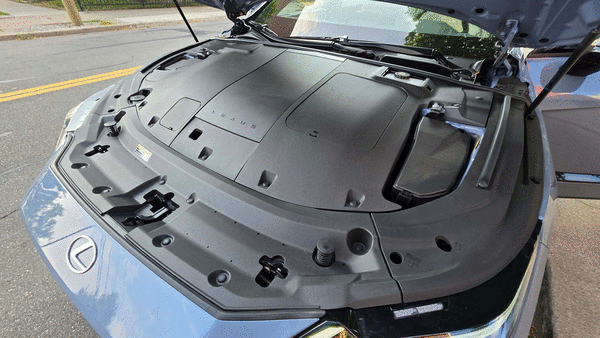
ANN ARBOR, Michigan — The eighth-generation Lexus ES is one of the oldest models in the lineup of Toyota Motor Corp.’s luxury brand. For 2026, the sedan adopts one of the newest innovations in the industry: the multi-energy platform.
Using a common vehicle architecture, the ES offers customers a choice of all-electric and gas-electric hybrid powertrains. With the ES, Lexus joins Stellantis NV, BMW AG and Mercedes-Benz AG in moving to multi-energy platforms (Lexus uses the term “multi-pathway”) as global automakers plan for an unpredictable future of government regulations and diverse global markets.
“Our multi-pathway approach with this vehicle gives us a little bit more flexibility in addressing what the customer is looking for in a vehicle,” said Chicago-based Darryl Hurlow, Lexus digital and product field manager for the central area, in an interview at the ES’s media test in Ann Arbor. “We want to be in the electric vehicle space, and we want to be in the hybrid space as well. Because we have that multi-pathway approach, we can address both those needs and shift our production as demand goes.”
Indeed, the eighth-generation ES was originally planned as an electric model as U.S. and California regulations pushed automakers toward EVs — and as Lexus targeted the Chinese market in addition to its traditional U.S. and Japanese markets.
Despite the government mandates, however, U.S. EV demand plateaued around 8% of the market in 2025. When a new Republican administration in Washington relaxed federal-and-state-imposed regulations and EV demand fell, Lexus shifted gears.
“The original intent was for the ES to be predominantly a battery-electric vehicle. But when we were given more flexibility and listened to our customers and what they were asking for, we made the shift into being more of a 80% hybrid, 20% BEV” mix, continued Hurlow. “(We were) able to make that shift as the market shifted on us. That's the flexibility the multi-pathway approach (gives us).”
The 2026 Lexus ES is offered as a $51,095-$57,295, front-or-all-wheel-drive, battery-assisted 4-cylinder ES350h hybrid or as a $48,895-$60,295, FWD-or-AWD, battery-powered ES 350e or ES500e EV. The hybrid boasts about 700 miles of range, more than double that of the EV model.
The strategy is a contrast to manufacturers like General Motors Co., Honda Motor Co., and Volkswagen AG that developed separate, so-called skateboard platforms for their EVs. GM CEO Mary Barra, for example, announced in 2021 that the company was exiting the internal combustion engine market for all EVs by 2035 as part of its “zero emissions, zero crashes, zero congestion” strategy.
Other automakers followed, investing billions in so-called skateboard BEV platforms like Tesla Inc. builds for its successful battery-powered lineup.
“Five years ago, everybody was convinced the whole world was going electric,” said John McElroy, auto analyst with Autoline. “It was going to be electric everywhere. You had countries and cities saying they were going to ban the internal combustion engine by 2030 or 2035. It hasn't played out that way, especially in the United States. Even in Europe, where EV sales are stronger, (sales) are not where everyone thought they would be.”
Despite intense political pushback, automakers like Toyota, Stellantis, Mercedes and BMW avoided the transition to BEV-only platforms.
“If you have a dedicated platform for only an electric vehicle, you're really stuck,” continued McElroy. “You're just never going to get the sales to get a return on the money that you invested. So now the smart thinking is: let's come out with platforms that can be ICE, hybrid, PHEV (Plug-in Hybrid Electric Vehicle) or pure electric. Invest in one platform, and now you can flex whichever way the market goes.”
BMW resisted the skateboard trend and updated its so-called CLAR ICE architecture as a multi-energy platform for RWD/AWD vehicles. The BMW i4, for example, debuted in 2022 as the electric doppelganger to the iconic, gas-powered BMW 3-and-4 series models.
For its forthcoming 2027 iX3 SUV, BMW is committing to a multi-energy platform future with the updated, so-called Neue Klasse platform. The Neue Klasse follows learnings from the 2022 iX SUV — an EV riding on a dedicated architecture — that was discontinued this year after poor sales.
Stellantis' Dodge brand, staggered by hundreds of millions in federal fines for building powerful gas engines, debuted it multi-energy STLA LARGE platform in 2024. STLA LARGE now supports the V6-engine-powered Challenger coupe and sedan and poor-selling EV, with a V8-powered model expected soon.
Mercedes developed its dedicated EVA2 electric platform to underpin its all-electric EQ lineup that included the EQS sedan, EQS SUV, EQE Sedan and EQE SUV. Sales disappointed, however, with models also suffering high depreciation. The brand debuted its multi-energy platform this year with the 2026 CLA that ditches the separate EQ EV nameplate for a lineup of identical-looking electric, hybrid and gas models.
Ironically, automakers adopted modified ICE platforms a decade ago as the market expressed interest in EVs. Analyst McElroy said that Tesla’s explosive success with its Model 3/Y EVs convinced many automakers to develop separate EV platforms.
“Tesla came along with a dedicated EV platform and everybody realized — that's the way to go because, if you have a dedicated EV platform, you do not have what engineers called ‘scar mass,’” he said. Multiple propulsion systems for a platform ... need extra brackets and stampings, so you end up with something that's heavier.”
He continued: “The idea came (for) dedicated EV platforms, but sales didn't materialize. The automotive industry has written off close to $100 billion in EV investments ... so we're back to (flexible platforms).”
Lexus builds the ES hybrid and electric models on the same assembly line with the same dimensions and interiors. Only the powertrain differs.
“The cars are virtually identical, other than the powertrain and the floor pan,” said Lexus’s Hurlow. “What we've been arguing (from the dealership perspective) is it makes it more approachable for our customers. Folks that are maybe considering an EV, they don't want to have to go into a vehicle where they need to relearn everything.”
Over its 36-year lifespan, the Lexus ES has reflected multiple industry trends.
Introduced to the U.S. for the 1990 model year, it offered a manual transmission until 1993 — a feature virtually nonexistent in the industry today. Early powertrains were V6-powered with a 4-cylinder hybrid not arriving until 2012. Lexus arrived four decades ago as a sedan brand, but today its best-sellers are SUVs. The ES is now one of only two sedans the brand offers in the US.
Now ES pioneers a new era of multi-energy-based models for an international audience.
“This eighth-generation has been designed for the global market, and not just the North American market, which is really where the Lexus brand first launched,” said Hurlow. “The biggest influence comes from the Chinese market, and ... the fact that (luxury buyers) in Asian countries are usually being chauffeur-driven.”
©2026 www.detroitnews.com. Visit at detroitnews.com. Distributed by Tribune Content Agency, LLC.







Comments