Larry Printz: Acura's next act is a rebellion against automotive overkill
Published in Automotive News



Acura has always occupied an unusual place inside the Honda family. It was created to give the company something the Japanese auto industry largely lacked at the time: a performance-minded luxury brand for buyers outside Japan.
And, for a while, Acura understood something that many luxury automakers have since forgotten. Design did not necessarily require more. The first NSX, the Legend and the original Integra were distinctive precisely because they were restrained. Their proportions were clear. Their surfaces were clean. They looked as if someone had decided what to leave out.
As Acura approaches its 40th anniversary, the company is taking another look at that idea.
The Nexera Vision concept, the first major expression of Acura’s new design direction under Yasutake Tsuchida, the company’s creative director and vice president of auto design, is less a preview of a particular production car than a statement about what Acura wants to become. Tsuchida replaced Dave Marek in April 2025.
The design distinction matters. Nexera isn’t an exercise in nostalgia, nor is it simply a catalog of new styling cues. It is an argument about the brand. Tsuchida reduces that argument to three ideas: emotional surface design, a new Acura lighting signature and driver-centric performance.
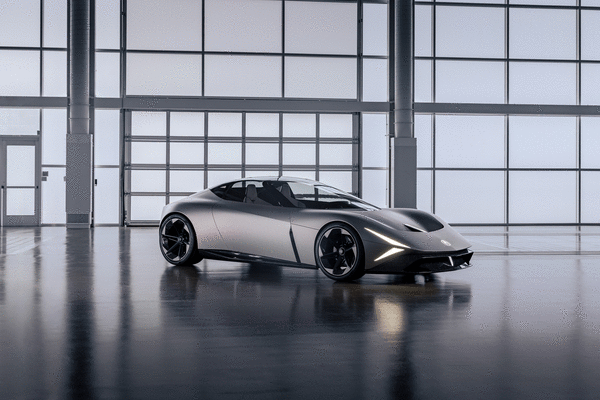
The first may be the hardest to articulate and the easiest to recognize. Nexera uses sculpted, uninterrupted surfaces instead of piling on creases and decorative details. Its low hood, long dash-to-axle ratio, wide stance and single-motion cabin create a sense of movement without the visual noise that has become common in modern automotive design.
“We are not simply shaping a path,” Tsuchida says. “We are creating to connect people with emotion.”
There is an obvious historical reference here. Ben Davidson, Acura’s exterior design lead, sees something of the original NSX in the concept’s simplicity, purity and restraint.
Tsuchida’s own history points in the same direction. After roughly 25 years at Mazda, he says the first-generation Miata helped persuade him to become a designer. What attracted him was its simplicity and lightness, the sense that a car could be beautiful without being complicated.
“Why don’t we go back to more beauty and simple, cool design?” he asks.
That may sound like an easy design brief. It isn’t. Adding detail is easy. Knowing what not to add is considerably harder.
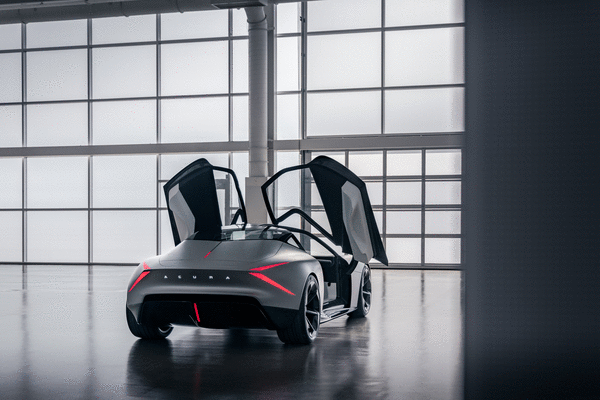
Nexera’s second defining idea is its lighting. Inspired by Acura’s A-shaped caliper logo, ultra-sleek lamps are embedded within the bodywork in what the company calls “phantom lighting.” With the lights off, they effectively disappear into the body color. Turn them on and they seem to materialize. More important, Acura says this idea will not remain confined to a concept car. The new lighting signature is expected to reach production, beginning with the next-generation RDX Hybrid.
For all its restraint, Nexera is hardly timid. Butterfly doors, active aerodynamics, 22-inch centerlock wheels, carbon-ceramic Brembo brakes and extensive forged-carbon components make sure the concept has the hardware to substantiate its performance credentials. But that may be the point. The technology is there. It just isn't being asked to do all the talking.
The same philosophy carries into the cabin.
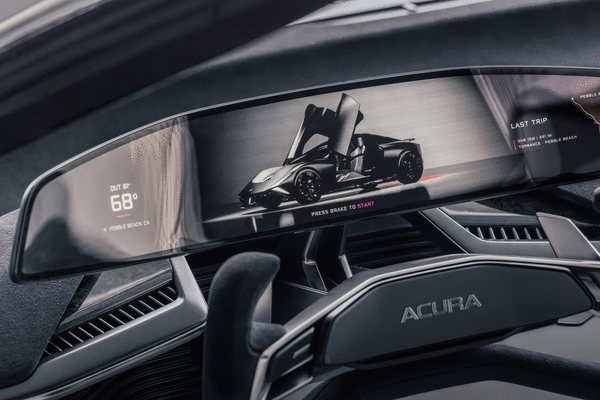
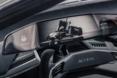
At a moment when much of the auto industry seems determined to turn the dashboard into a computer monitor, Acura removed the center display entirely. Information is concentrated in front of the driver. Physical controls remain. AI voice control is intended to reduce the need to look away from the road. Even the air vents are positioned to direct heat or cooling toward the driver’s hands.
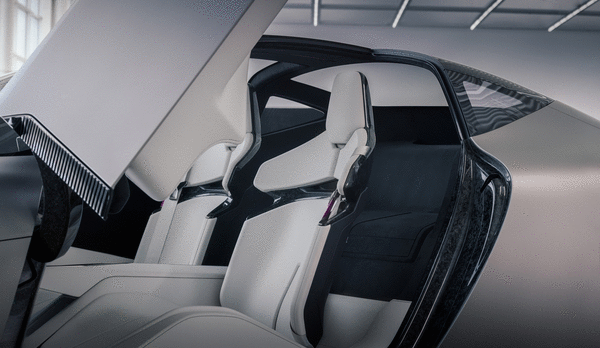
The front seats are fixed into the floor, lowering the driver, while the steering wheel and pedals move toward the driver. Lisa Lee, the lead interior designer, describes the objective as “spacious yet tight.” It’s a useful description of Nexera more broadly: intimate without being cramped, technological without looking like a technology demonstration, clean without becoming sterile.
The materials make a similar argument. Forged carbon is paired with recycled aluminum, Alcantara incorporating certified post-consumer recycled polyester and leather. Sustainability is treated not as a separate marketing exercise but as part of the definition of premium.
That is an increasingly important distinction for luxury brands. The question is no longer simply how much technology or material can be packed into a car. It’s whether all of it serves a coherent idea. For Acura, the harder question will come next: What happens when these ideas have to leave the auto-show floor?
The company’s SUVs will not simply inherit Nexera’s styling motifs, Tsuchida says. Instead, Acura plans to carry forward the underlying principles: the stance, the emotional surfacing, the lighting signature and the driver-focused interior. This makes Nexera less a blueprint than a North Star.
Concept cars have a privilege that production cars do not. They can indulge. They can use butterfly doors, 22-inch wheels and expensive materials without having to answer every question about manufacturing, cost, durability and regulatory requirements. The real test for Acura is therefore not whether Nexera survives intact. It’s how much of its discipline survives the journey from concept to showroom.
And that is why the most interesting parts of Nexera may not be the butterfly doors or the wheels.
The more consequential idea is that Acura may be rediscovering something it once understood instinctively: Technology should support the automobile, not become the automobile.
Put the driver at the center. Let the surfaces do more with less. Make lighting a signature rather than decoration. Introduce enough technical surprise to make the car feel new, but enough restraint to keep it beautiful.
Tsuchida says he wants Acura to create cars that move people. The Nexera is an attempt to make that phrase mean something again.
©2026 Tribune Content Agency, LLC






Comments