Car destination fees keep going up. These automakers have the highest
Published in Automotive News
WASHINGTON — The Detroit Three automakers dominate a new list tracking the highest non-negotiable vehicle destination fees imposed on buyers across the U.S. auto market.
The list, compiled by the watchdog and advocacy group Consumer Reports, shares the most and least expensive automaker charges for transportation of their vehicles to dealer lots. A series of trucks and SUVs from Ford Motor Co., General Motors Co. and Stellantis NV captured nine of the top 10 spots.
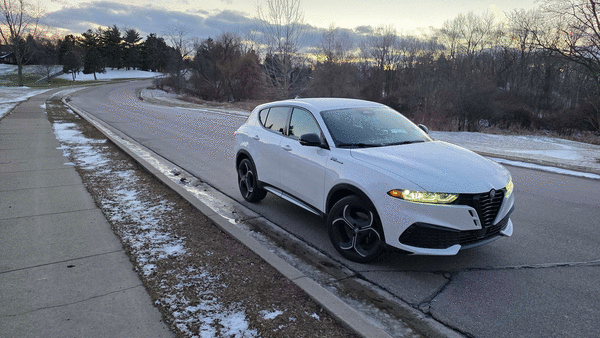
The only cars on that list — holding the No. 1 spot — were models from Italian luxury brand Alfa Romeo, which is also part of the Stellantis corporate umbrella.
"Recent market trends have caused prices to go up on vehicles themselves, but with additional expense of tariffs and other inflationary prices, it's impractical to load it all into the price of the vehicle for competitive reasons," said Sam Fiorani, vice president of global vehicle forecasting at AutoForecast Solutions LLC.
"Advertised prices do not typically include destination, which makes that a good place to offset the additional costs of the vehicle," he added.
A Consumer Reports investigation in 2021 found that destination fees often "far exceed the actual cost of transporting a vehicle" and suggested that automakers could be using the charges to pad their margins. The report also noted that the fees have been rising above the overall pace of inflation.
Separate data from automotive information hub Edmunds.com Inc. indicates that average vehicle destination fees in the United States have risen from $952 in 2015 to $1,592 in 2026 — an increase of about 67%.
"The auto industry’s relative silence on the rise of destination charges is a bit deafening,” David Friedman, CR’s vice president of advocacy, said in the group's earlier investigation. “If they had a valid reason beyond just driving up the price, they would actually be able to point us toward specific examples of costs that have gone up within the shipping process.”
Manufacturers are required by law — namely the Automobile Information Disclosure Act of 1958 — to disclose "the amount charged, if any, to such dealer for the transportation of such automobile to the location at which it is delivered to such dealer."
Automakers, according to CR, have standardized those charges to ensure that consumers see the same charge regardless of where they shop in the contiguous United States. For example, a Cadillac Escalade IQ purchased near GM's manufacturing hub in Metro Detroit fetches the same fee as one purchased in Nevada.
The latest CR roundup on destination fees offered this advice to shoppers: "Destination charges are now a major cost when buying a car. Be sure to look past the sticker price to understand average transaction prices in your area, destination charges, and taxes for budgeting."
The Detroit News reached out to Ford, GM and Stellantis to ask why their vehicles filled the top 10 list of most expensive fees.
"Stellantis’ vehicle destination charges are competitive with other automakers that sell a full line of vehicles," company spokesperson Jodi Tinson said in a statement.
Ford spokesperson Said Deep wrote in an email: "These charges, which reflect factory to dealer vehicle shipping costs, are reviewed and adjusted as necessary to keep consistent with the industry. We average the charge so no matter where a customer lives in America the destination and delivery is the same."
Deep added that prices do vary by vehicle type. For instance, he said, Lincoln Corsair and Ford Escape destination and delivery fees are $1,495.
"We review and adjust destination and freight charges in relation to market conditions and costs,” GM said in an emailed statement.
The list of 10 least-expensive delivery charges was populated entirely by foreign competitors to the Detroit Three. Some of the vehicles listed are built in the United States, though many are imported from Japan, Germany and elsewhere.
Toyota Motor Corp., which finished second to GM in total U.S. sales last year, did not immediately provide a comment on why it's able to keep relatively low destination charges.
Fiorani, of AutoForecast Solutions LLC, noted that it makes sense why the vehicles included in the most expensive list would cost more to transport.
Apart from the Alfa Romeo models, "the rest of that list is large, heavy vehicles, and in a perfect world, should cost more to ship," he explained. "These are the large, full-size trucks, and they range from 6,000 to almost 10,000 pounds."
Fiorani added: "Nobody else really sells anything that heavy. The Hummer EV and Cadillac IQ are likely 10,000-pound vehicles. These are among the heaviest mainstream light-duty products that you can buy. When you get to a Ram 3500 HD or Silverado 3500 HD, those are equally heavy, but they're more commercial vehicles. The Cadillac and the Hummer are consumer vehicles, and they weigh — quite literally — four to five tons.
"In a perfect world, these would be more expensive than everything else, simply because of their weight. But it is very likely that manufacturers are putting other costs into there because destination charges are not itemized ... It's a nice catch-all for any cost that the manufacturer wants to put in."
Tu Le, managing director of automotive consultancy Sino Auto Insights, said the fees are "like your phone, medical or cable bill. I think most people can’t explain to you what it actually is or how it’s actually calculated."
Le, who previously worked in sourcing for GM and Lear Corp., said he's sure that vehicle weight is part of why the Detroit Three have such high destination fees on the models listed in the CR report.
"But I also think this is a place the OEMs can hide margins," he added. "Bottom line is that this tracks with why there’s backlash on new car pricing."
©2026 www.detroitnews.com. Visit at detroitnews.com. Distributed by Tribune Content Agency, LLC.







Comments