Minnesota clergy take their mission to the polls
Published in Religious News
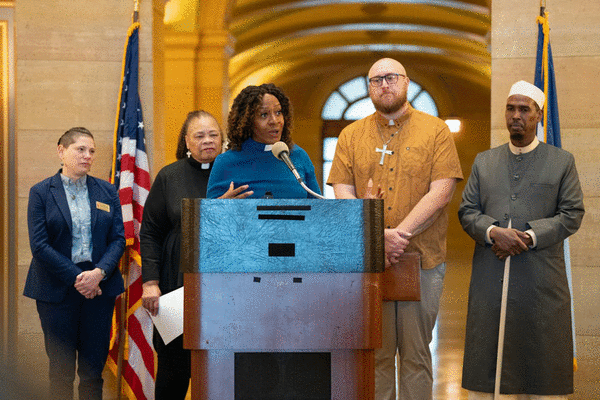
Come Election Day, voters may see an unusual presence outside their polling place: clergy and other faith leaders.
Wearing fluorescent vests labeled “poll chaplain,” hundreds of trained volunteers plan to fan out across Minnesota on Nov. 3, offering a calm, nonpartisan presence as concerns grow about voter intimidation, misinformation and distrust in elections.
The local initiative, called Healing Democracy, has trained poll chaplains for the last five years, but this year is the first they’ve also trained “digital chaplains” to monitor online spaces like social media to provide a calming voice and direct people to trustworthy information. That role is critical this season, organizers say, but is meant to be distinctly different from poll workers.
“Election workers care for the voting process. Our chaplains care for the people moving through it,” said Rev. Kelly Sherman-Conroy, a pastor at All Nations Indian Church in Minneapolis and a board member of Interfaith Movement Chaplains Network, which teamed up with two other groups on the initiative.
Poll chaplains, who can be trained lay people as well as clergy from many faiths, are not election officials, poll watchers or legal observers. They remain outside polling places (many of which are houses of worship), supporting voters without interfering with election workers or telling people how to vote.
Organizers hope the effort will also bolster relationships among community members, helping them respond together if tensions escalate, now or later. The work builds on networks formed during Operation Metro Surge, when congregations delivered groceries to immigrant families, organized vigils and joined protests against federal immigration enforcement. Since the surge in immigration enforcement last winter, some faith communities and congregations are also on heightened alert about federal surveillance.
The approach also reflects a broader tradition of movement chaplaincy in Minnesota, where people from different faiths and spiritual practices have offered care during public demonstrations, moments of grief and periods of social upheaval.
Typically, the more vocal leaders lean more politically progressive but this year, leaders and organizations of many faiths, including some that are historically more conservative, are encouraging members to get informed and vote. For instance, the Minnesota Family Council, a Christian advocacy group, organizes volunteers to door knock with get out the vote materials and has a “church ambassador network” with pastors who go to the State Capitol to meet with legislators.
In July, before the primary election, Bishop Patrick Neary of the Diocese of St. Cloud and the Minnesota Catholic Conference also encouraged Catholics to vote. The Minnesota Catholic Conference’s 2026 election guide encourages Catholics to participate in the election and view voting as an important part of their civic and moral responsibility. It offers resources to help voters prepare for the election and evaluate candidates through the lens of Catholic social teaching.
The Evangelical Lutheran Church in America (ELCA) is also encouraging civic participation, offering an election-season toolkit that urges congregations to help people register, find accurate voting information, get to the polls and counter misinformation.
The poll chaplain initiative, organized by Minnesota Interfaith Power & Light, the Interfaith Movement Chaplains Network and Multifaith Antiracism, Change & Healing, will offer community care teams to host events where neighbors can share food, talk and find emotional and spiritual support the day before the election, during and after the election.
In September, a group of hundreds of clergy gathered at the State Capitol to “commit efforts to protect the votes of Minnesotans and our state’s constitutionally administered midterm election from ongoing federal sabotage,” according to ISAIAH, a nonpartisan group of faith communities in Minnesota working toward racial and economic justice.
Just like during the August primary, the U.S. Department of Justice will be sending monitors to Minnesota for the Nov. 3 election.
JaNaé Bates, a minister and executive director of ISAIAH, said the recent election effort grows out of what faith leaders learned over the last year in Minnesota: that showing up publicly for neighbors can be a form of protection. Now, clergy are applying those lessons to concerns about voter intimidation and misinformation.
“We are taking the skills, the roles, the acumen, the wisdom that we got during that and really thinking about how do we leverage this to protect our democracy and our elections in this season,” Bates said at the September gathering.
That work can mean encouraging people to register to vote and vote, helping them find reliable information and reassuring them that they belong in their communities.
Rev. Quinlan Koch, a Lutheran pastor, said faith leaders cannot stand by when misinformation portrays neighbors as dangerous or casts doubt on their right to participate in civic life.
“Our response cannot simply be to watch this happen,” Koch said. “We have to organize.”
A caring presence may be especially important after the polls close, organizers said, since election results can bring disappointment, grief or uncertainty for some.
“We know that elections are a time when our neighbors, or even ourselves, will need space to breathe, to grieve, to celebrate, to care for each other,” said Jim Bear Jacobs, co-executive director of Minnesota Interfaith Power & Light during a recent training session for poll chaplains.
Ben Connolly, a Buddhist priest and guiding teacher at the Minnesota Zen Meditation Center, said the effort asks communities of all faiths to put their interdependence into practice.
“We know that we depend on each other,” Connolly said at an October event. “So the question is: Will we act like it?”
©2026 The Minnesota Star Tribune. Visit at startribune.com. Distributed by Tribune Content Agency, LLC.



Comments