'Ordinary white kid' or 'neo-Nazi'? Court records offer new insight into alleged plot to attack Hindu temple in Illinois
Published in Religious News
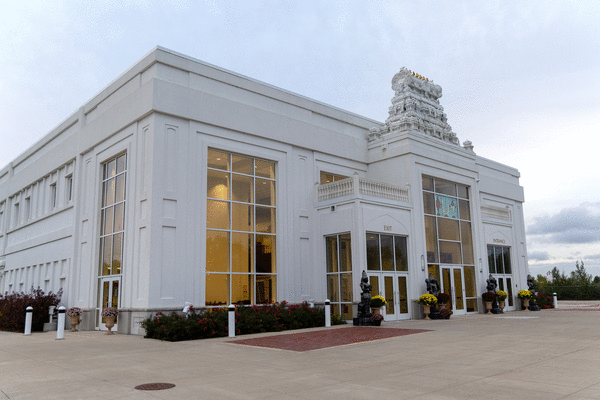
AURORA, Ill. — Weeks before his gun jammed outside a Hindu temple in Aurora, Alexandros Paporakis, 19, of Palatine, etched his name at the bottom of a guardianship petition filed by a close family friend. At the same time, prosecutors say, the self-identified white supremacist’s rhetoric toward Indian people was growing more frequent and vicious.
Paporakis’ signature — a mark of endorsement, or at least acquiescence, to a petition rooted in allegations of parental neglect and mistreatment — offers new insight into the life of a teenager who prosecutors say spent years plotting to kill as many people of color as possible. A teenager who, by his own account, was “filled with hatred, fantasizing about mass murder nearly every day,” according to prosecutors.
“I decided to target something that would give me pleasure to destroy,” Paporakis wrote of his planned attack on Sri Venkateswara Swami Balaji Temple in an eight-page manifesto, according to prosecutors.The teenager intended to open fire at the western suburb temple Sunday afternoon, according to prosecutors, but his modified semiautomatic rifle jammed. He called a co-worker to say he was fleeing the scene, but planned to fix the weapon and try again. Around 1:30 p.m., the co-worker called 911 to alert police.
He was charged Wednesday with making a terrorist threat and unlawful possession of weapons.
Paporakis, an enrolled student at Harper College, was allegedly living with his mother at the time of the planned attack and had been for about a year, Palatine police Chief William Nord said Wednesday. But a guardianship petition filed in Cook County last month alleges that his mother was unable to provide a stable home and that his father had abused and abandoned him. Those circumstances, the petition states, left the teenager unable to return to his home country.
The Chicago Tribune could not independently verify which country the petition referred to as Paporakis’ home country. The teenager’s own writings, according to court documents, suggest a hatred rooted less in national origin than in race and religion.
“The shooter hated Indians, but his hate did not discriminate,” U.S. Rep. Raja Krishnamoorthi said at a news conference Friday, as he appeared to hold back tears. “According to court documents, the manifesto that he wrote described Indians, Jews, Black people and other minorities as ‘subhuman.’”
Krishnamoorthi, a Democrat, and his family were inside the Aurora Temple that day celebrating the start of Navaratri, a nine-day Hindi celebration. Unbeknownst to them, Krishnamoorthi told reporters Friday, Paporakis was sitting in the parking lot with an AR-15-style rifle.
“I don’t know how my family and others escaped,” Krishnamoorthi said, stopping intermittently to steady his voice. “I don’t know how I happened to be there, but I believe that one purpose was so I could be here to speak out about hate. That has become one of my life’s missions.”
The congressman, who represents Illinois’ 8th District, pointed to a lack of accountability for hate speech on social media as a root cause of the radicalization that can lead to acts of terrorism. Paporakis’ alleged plot Sunday, court documents show, was not the first indication of his hatred toward people of color.
At the Taco Bell in Arlington Heights where he worked as a cashier, Paporakis frequently talked about Nazis and spent time writing a manifesto on his phone, co-workers told prosecutors. In the days leading up to the planned shooting, his rhetoric intensified.
On the surface, Paporakis described himself as “an ordinary white kid going to college and working.” But beneath that facade, he wrote, was “a sociopathic white supremacist neo-Nazi,” according to prosecutors.
“Babies are not born to hate,” Krishnamoorthi said. “Children are not born to hate; they are taught to hate.” This shooter was radicalized by his environment. He was radicalized by social media until he told a co-worker, ‘he could not wait to kill Indians.'”
Prosecutors say Paporakis had been plotting a mass shooting for about two years, spending the final two months studying the Aurora temple through YouTube videos and Google Street View. In an eight-page manifesto, he used racial slurs to describe people of Indian ancestry, Jewish and Black people, calling them “subhumans” and writing that he wanted to kill as many as possible.
Krishnamoorthi was joined by a dozen local, state and federal leaders Friday in calling on the Federal Bureau of Investigation to investigate Sunday’s foiled terrorist attack as a hate crime and for greater accountability for social media companies, which are shielded from certain legal liabilities under the Communications Decency Act of 1996.
“There are various pieces of legislation trying to curtail that loophole before Congress,” Krishnamoorthi said. “But Big Tech is able to kill them off one at a time. Now I think we’re kind of at that stage where if we don’t do more to close that loophole, if we don’t curtail their ability to be insulated from the consequences of this hate existing on their platforms, more of it’s going to happen.”
That provision generally shields social media platforms from legal liability for content posted by their users. But there’s little immediate protection against hateful posts for Chicago-area temples and other places of worship.
Several leaders spoke of growing hostility toward South Asian immigrants, including U.S. Rep. Mike Quigley, a Democrat, who cited a social media post by Bo French, a Republican candidate for statewide office in Texas. The post showed students who appeared to be of South Asian descent cheering at a University of Texas football game, which French suggested was a problem.
“Far-right commentators and white supremacists have sought a new scapegoat for national problems,” Quigley said. “We have to call out this hateful language when we see it because bigotry always inspires violence.”
Quigley pointed to the unprovoked stabbing of a Sikh truck driver at a Wyoming rest stop last month and the July stabbing of a Muslim kiosk worker in Utah as evidence of that cycle. Such attacks leave people afraid to enter places of worship, he said, threatening a fundamental right.
That fear has driven many religious institutions to bolster security, U.S. Rep. Brad Schneider said, a stark reminder of threats facing communities of faith.
“There are armed guards at the Hindu temple. There are armed guards at the mosque,” said Schneider, a Democrat. “We need to change the dynamic where hate is allowed to fester in a nation to try to divide us as communities.”
Anita Puri, executive director for the Indo-American Center, said she’s exploring new security solutions for the West Ridge nonprofit.
“We have clients coming through our doors every day; we have staff that need to be in a safe and secure environment,” she said. “I don’t want them to be worried or scared about what’s happening when they walk through those doors.”
_____
©2026 Chicago Tribune. Visit chicagotribune.com. Distributed by Tribune Content Agency, LLC.




Comments