Chicago clergy set to visit Pope Leo to advocate for immigrant detainees: 'This is a mission from Christ'
Published in Religious News
CHICAGO -- The handwriting is messy, the spelling faulty. Some cried as they wrote. Others were so excited that they struggled with what to say. Some did not know how to write at all, and, in those letters, only a few words are legible.
But, still, the messages are all the same.
“Today they detained me, and I’ve been here for hours. I’m not afraid of what will happen to me; I’m afraid of not being with my family,” one immigrant detainee wrote to Pope Leo. “Please pray for them and for the families of all the other detainees. It saddens me that simply going out to work has brought me to this moment.”
A group of Chicago-area clergy are behind last month’s letter campaign to the pope, written from detainees who had passed through the U.S. Immigration and Customs Enforcement processing center in west suburban Broadview.
In September, Michael N. Okińczyc-Cruz, executive director of the Coalition for Spiritual and Public Leadership, traveled to Rome and hand-delivered the nearly dozen letters to Pope Leo. He also presented the pope with a yellow stole bearing images of Our Lady of Guadalupe and signed by some of the detainees. The exchange was brief, Okińczyc-Cruz said, but Pope Leo “mentioned he was grateful for the work that we’re doing.”
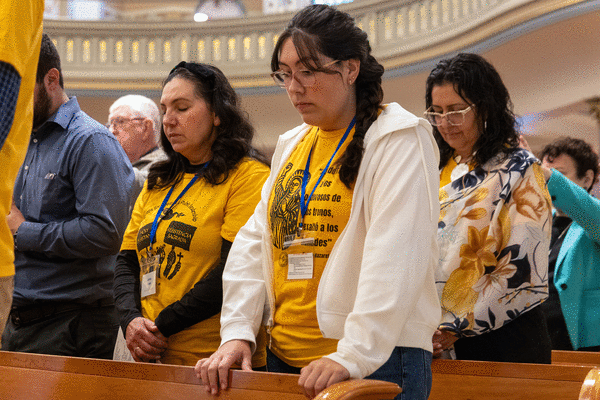
Now, Okińczyc-Cruz and 24 Catholic clergy, women religious leaders and laypeople are scheduled to make a pilgrimage to Rome later this month to meet with the pope and continue their advocacy for immigrant detainees. The delegation, which was blessed by Cardinal Blase Cupich at a recent Mass, is scheduled to meet with the Vatican’s Dicastery for Promoting Integral Human Development on Oct. 27.
The invitation to bring the delegation, said Sister Christine Tomy, signals that the global Catholic Church recognizes the people processed through Broadview.
“There’s something profoundly symbolic about this visit,” she said. She hopes it will provide another way to amplify the voices and experiences of those detained.
Their goal is for Pope Leo to amplify the stories of detainees, including their pain, struggles and hopes. They hope the pope will humanize people who are often stripped of due process and urge the government to establish lasting protections ensuring that clergy can continue entering the facility to provide pastoral care, regardless of changes in administration.
“This is a mission from Christ,” said Maximino Montalvo, a deacon who is also part of the pilgrimage.
The group intends to draw attention to enforcement operations targeting working people, including those with no criminal backgrounds who are arrested and held under harsh conditions, Okińczyc-Cruz said.
For many immigrants, the processing center in Broadview is a cold, empty and lonely place where they face either months in an out-of-state detention center fighting deportation or the prospect of leaving the country — and their loved ones — behind.
Few people from the public have been allowed inside the ICE facility, the first stop for immigrants detained in the Chicago area. Even fewer are permitted to speak with those arrested.
The Coalition for Spiritual and Public Leadership challenged the Trump administration in court to ensure ministers could provide pastoral care to detainees inside the facility. After the judge granted them access in May, Montalvo and other ministers have entered the facility daily.
The letters were part of the coalition’s ongoing Pastoral Care for Immigrant Detainees Campaign, which seeks to ensure immigrants held at Broadview have access to pastoral care while raising awareness of the lives affected by immigration enforcement under the Trump administration.
“These are my people and they are a part of me,” said Montalvo, who prayed the rosary daily outside the facility during Operation Midway Blitz, the militarized immigration enforcement operation that took place in the Chicago area last fall. “I know that going in there, there’s no way we can change any legal process but I’ve seen it brings (the) benefit to their emotional situation, at least for the moment.”
Last month, Montalvo helped the detainees write letters to Pope Leo, offering them an outlet to express their hope amid uncertainty, he said. In the letters, the men and women, many of them their families’ breadwinners, expressed their pain and asked for prayers for their protection and that of their families.
Montalvo, an immigrant himself from Mexico, said the letters tell the stories of people detained while dropping off their children at school, working at job sites in their uniforms or heading home.
“In some way it was interesting to see that they were like children writing something down in the back corner,” Montalvo said.
On yellow notepad paper, in black ink, detainees expressed gratitude but also pleaded for mercy.
“They are separating me from my two daughters. … I know God has His will, but it is unfair; I haven’t done anything to anyone,” another detainee wrote.
For Montalvo, the pilgrimage feels almost unimaginable. He recalled watching Pope John Paul II on a black-and-white television when the pontiff visited his home state of Zacatecas, Mexico, while Montalvo was about two hours away.
Montalvo said his family history also motivates his ministry. His father participated in the Bracero Program and experienced labor exploitation, including working for weeks without pay and facing threats of being reported to immigration authorities.
“These are sons and daughters of God. They’re my brothers and my sisters,” Montalvo said of the people he visits at Broadview.
He described many of the detainees as parents, grandparents and workers arrested while going about their daily lives. Some were picked up on their way to work, while collecting their children from school, visiting a barbershop or buying groceries. Others arrived from construction jobs still wearing work clothes stained with paint and dirt.
“They’re just trying to live their daily lives and trying to bring some bread to the house,” he said.
Language is not necessarily a barrier to pastoral care, Montalvo said, recalling a young Venezuelan man who was crying as a minister comforted him.
“Love and caring is the main language,” he said.
Tomy regularly visits detainees at Broadview. Although immigration arrests are less visible than during Operation Midway Blitz, they continue daily, she said. Since she began visiting the facility in May, the number of immigrants passing through has remained largely unchanged.
The way the administration is now conducting arrests more quietly, but at the same rate, she said
Tomy began the work in response to what she described as the dehumanizing approach to immigration enforcement and the events surrounding Operation Midway Blitz in Chicago in fall 2025.
“Every time we go, I feel like just a profound mix of gratitude and heartbreak,” she said.
The coalition’s work at Broadview began in response to the immigration enforcement operations launched during Operation Midway Blitz. Nearly a year later, it has secured access for ministers to provide pastoral care, but its legal fight for permanent access continues.
On Oct. 11, 2025, the coalition led a Eucharistic procession in response to immigration enforcement and the lack of pastoral and religious care for detainees at Broadview. A small delegation asked to enter the facility to provide religious services, but the request was denied.
The coalition and Catholic priests subsequently sued the government, arguing that blocking access to the sacraments violated the First Amendment and the Religious Freedom Restoration Act. Federal Judge Robert Gettleman ruled in favor of the plaintiffs, issuing injunctions that required the facility to allow religious services.
On May 15, the coalition reached an agreement with the Department of Homeland Security allowing up to five ministers to enter Broadview daily, seven days a week, to provide pastoral care. The arrangement remains in place under a preliminary injunction while litigation continues.
“This protocol is working and we want to make sure that we have permanent access,” said Okińczyc-Cruz.
While the letters are handwritten pleas from people separated from their families, the coalition hopes to carry their stories further, using its pilgrimage to Rome to draw attention to the people behind the immigration enforcement numbers.
____
©2026 Chicago Tribune. Visit at chicagotribune.com. Distributed by Tribune Content Agency, LLC.





Comments