On day of double executions, Florida Catholic leaders call for end to death penalty
Published in Religious News
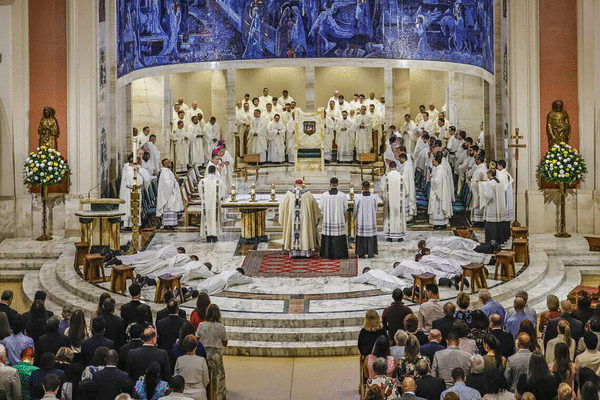
As Florida continues state executions at a record-setting pace, Catholic leaders are encouraging the public to oppose the death penalty and instead promote a “culture of life.”
On Monday, the Florida Conference of Catholic Bishops released a pastoral letter urging Florida elected officials to end capital punishment, arguing that the practice is against the teachings of the Catholic Church.
Signed by the state’s top Catholic clergy including Miami’s Archbishop Thomas Wenski and Deacon Edgardo Farias, the letter calls Florida’s record 19 executions in 2025 “alarming.” The rapid pace in which executions are being carried out this year — 11, soon-to-be 12 for 2026 — warrant a “response” from the church, according to the letter.
“In this letter, we wish to remind Catholics of the teaching of our Church against the use of the death penalty in situations —like our own— where bloodless means are sufficient to punish offenders and protect public safety,” the Florida bishops wrote.
In the past 18 months, Florida has executed almost as many people as all the other states combined, according to the Associated Press. Florida has executed 30 people since the beginning of 2025, while the rest of the U.S. carried out 35 over the same time frame.
The Catholic letter was released on the eve of a back-to-back execution. James Aren Duckett, 68, an ex-police officer convicted of a young girl’s rape and murder, was executed midday on Tuesday by means of lethal injections. Dominick Anthony Occhicone, 80, who was convicted of killing his ex-girlfriend’s parents in 1986, is scheduled to be executed Tuesday evening, barring any last minute appeals. At 80, he would be the second-oldest inmate put to death in modern U.S. history. The rare event makes Florida the first state in nearly a decade to carry out two executions on the same day.
Deacon Farias called it “a deeply sorrowful and troubling moment for the people of Florida.”
Farias, the director of detention ministry for the Archdiocese of Miami, said in this situation, it’s important to first acknowledge the victims of the crimes at hand.
“They deserve our compassion, our prayers, and our continued accompaniment,” he told the Miami Herald.
However, “taking another human life cannot restore the lives that were lost, heal the wounds left by violence, or bring true peace to grieving hearts,” Farias said, adding that justice “does not require execution.”
‘Appropriate punishment’
Gov. Ron DeSantis, who oversaw 19 executions in 2025, has pushed for state laws expanding the use of the death penalty.
In 2023 DeSantis signed a law that allows juries to recommend a death sentence with an 8-4 vote instead of unanimously. DeSantis pushed for the change after the Parkland school shooter, who killed 17 students and faculty members at Marjory Stoneman Douglas High in 2018, was spared from the death penalty in 2022.
When asked about his response to the Catholic Church’s new letter, DeSantis’ press office pointed to prior statements the governor made last year regarding the death penalty.
“My view is it’s an appropriate punishment for the worst offenders,” said DeSantis, who is Catholic, at a press conference in November 2025 in Jacksonville.
DeSantis said some cases got “backed up” during the COVID-19 pandemic and that his goal was to bring “justice to the victims’ families,” which in many cases takes too long.
“I do think the death penalty could be a strong deterrent if you had the stuff happen quicker,” he said. “I still have a responsibility to look at these cases and be sure that the person’s guilty. And if I honestly thought someone wasn’t, I would not pull the trigger on it.”
Why do Catholics oppose capital punishment?
Miami’s top Catholic leader seems to disagree with the governor on the point about families receiving justice.
In a statement to the Miami Herald, Archbishop Thomas Wenski said the executions “bring no real closure to the families of the victims and represent vengeance rather than justice.”
Wenski went on: “The execution of two elderly men violates human dignity, ours, and the dignity of the condemned. Only China, Iran, North Korea and US still insist on capital punishment.”
In the letter, Catholic leaders make a case for why the death penalty, in their view, is both morally unjust and impractical to society.
The leaders point to the teachings of Jesus Christ, which emphasized giving mercy to sinners "who do not deserve it,” and offering them opportunities for “redemption and reconciliation.” Drawing from the Bible, Catholics believe that the act of repentance should be prioritized over “violent retribution,” which only contributes to a “culture of death” and violence.
The letter also states that Catholics believe human life has intrinsic value, and that the state should not be able to take that life from anyone — even if they are guilty.
Citing past papal statements including those from Pope Benedict XVI and Pope Francis, the letter also makes the case that in modern society, there is no longer a need to punish the guilty by way of the death penalty.
The leaders point to an array of practical arguments as well — from wrongful convictions to the expensive nature of executions.
The letter concludes by invoking leaders to remember that “not even a murderer loses his personal dignity.”
______
(This story was produced with financial support from Trish and Dan Bell and donors in South Florida’s Jewish and Muslim communities, including Khalid and Diana Mirza and the Mohsin and Fauzia Jaffer Foundation, in partnership with Journalism Funding Partners. The Miami Herald maintains full editorial control of this work.)
©2026 Miami Herald. Visit at miamiherald.com. Distributed by Tribune Content Agency, LLC.






Comments