Minnesotans turned to faith communities to help during the ICE surge. Some stayed for Sunday worship
Published in Religious News
MINNEAPOLIS -- During Operation Metro Surge, Anoka United Church of Christ became a hub for neighbors helping neighbors.
Six months after the surge in immigration enforcement spurred fresh civic engagement in Minnesota, some of the people who first came through the church’s doors to help are still walking in — now for Sunday worship.
Rev. Chris McArdle estimates at least 100 new-to-the-church worshipers came in the midst or wake of the surge. About half have stayed, craving a sense of community and bringing the congregation to more than 300 people. The church also now houses an office for Parents for Good, the organization it partnered with to provide groceries and supplies to immigrant families in hiding.
At a time when more Minnesotans have shifted away from organized religion — prompting hard decisions for congregations like recent widespread Catholic Church closures — the wave of immigration enforcement helped some faith leaders reengage with residents looking to be more involved in their community and lure some parishioners back to Sunday worship for good.
The wave of immigration enforcement put Minnesota in the national spotlight and left many communities shaken, but faith leaders across the Twin Cities say the period also reaffirmed the role religious communities have long played connecting neighbors and quickly mobilizing around people in need.
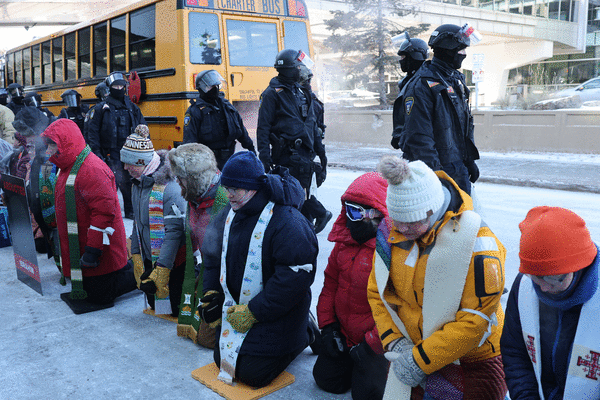
Churches, synagogues and other gathering spaces for people of faith became hubs for food, financial assistance, safety efforts and community organizing. Clergy also joined public demonstrations against immigration enforcement.
Many church leaders hope that visibility may have helped repair some distrust in religious institutions and reminded new worshipers of the central role churches play in the civic fabric of a community and combatting social isolation.
“Almost all of them say they’re looking for community, they’re looking for a place to belong, and they found it with us,” McArdle said of new worshipers who have attended the Anoka church since the surge.
While some congregations were vocal about their outreach work during the immigration crackdown, others offered help more quietly, wary of dividing their members over the political issues of immigration or drawing unwanted attention. Even many evangelical Christians in Minnesota, most of whom voted for Donald Trump, were split on the immigration crackdown.
“What was transformational about the way communities came together around the Twin Cities was that you saw a range of religious communities. It wasn’t just ones that may have had historically a more progressive agenda,” said Najeeba Syeed, executive director of interfaith at Augsburg University, the private liberal arts college that started as a Lutheran seminary. “Catholic parishes and Mormon communities also had people that were taken during the surge and they too started to organize around mutual aid.”
Now, as the urgency fades, faith leaders are trying to sustain those connections.
Seeking a sense of community
McArdle said Anoka United Church of Christ has long been a visibly progressive congregation, including through its public support for LGBTQ people. Still, many of the newcomers first found out about the church through the grassroots community organizing during the surge.
Many had been away from church for years or had left versions of Christianity that no longer fit them.
Carrie Bonde hadn’t regularly attended church for about 20 years even though she was baptized Methodist and attended a Catholic high school and college. But when she started helping with Parents for Good’s food drives in January at Anoka United Church of Christ, she decided to start attending services with her family in the spring, largely because it offered the sense of community she’d been craving.
“I had parted ways with church,” Bonde said. “I was just kind of ‘over it.’ But [Anoka United Church of Christ] felt really welcoming and accepting and was not the experience of religion I had in high school and college.”
Rabbi Jill Avrin, the director of campus affairs for the Jewish Community Relations Council of Minnesota and the Dakotas, said Jewish leaders also reported seeing new or newly-engaged worshipers. And interfaith collaborations grew stronger, she said.
Avrin said she hopes those partnerships lead to deeper collaboration and coalition-building. Those connections, she and other faith leaders said, reinforced what became a recurring lesson of the surge: Congregations could often accomplish more in partnership than on their own.
At St. Alphonsus Catholic Church in Brooklyn Center, the crisis made an issue often debated in political terms intensely personal. Even people who agreed with immigration enforcement knew and felt connected to the parishioners who were suddenly absent from the pews out of fear, Father John Schmidt said. And they had visible and tangible ways to help.
“I think people felt more bonded together,” Schmidt said. “They saw this as impacting our church family and we responded as a family.”
With Operation Metro Surge having a lingering impact on the Democratic primary earlier this month, faith leaders said one likely effect on the midterm election in November is greater political engagement.
Avrin said Jewish communities are already putting more emphasis on voter turnout and preparing for possible intimidation at the polls, while leaders at the Minnesota Council of Churches said congregations are also thinking about how to reduce polarization before the election.
“I know that [immigration enforcement] is a huge debate for some parts of the political spectrum,” Schmidt said. But, he said, for the sake of his congregants — many of whom are immigrants — he wants to hear from politicians about what’s next for these families.
“I think a lot of us are wondering ‘What’s the future for these families that still might hang in the balance?,’” Schmidt said, adding that he wants faith leaders to engage with each other and politicians to help answer that question.
Rallying the community
Six months after Operation Metro Surge, Schmidt said attendance at his parish has largely returned to normal, but families who missed work are still struggling to pay rent and other bills. Schmidt said the experience has made him want stronger relationships with neighboring churches and more conversations about issues affecting their communities.
Jerad Morey, the director of strategic relationships at the Minnesota Council of Churches, said faith communities already had many of the skills needed for an emergency response.
“It turns out that organizing mutual aid is only a degree and a half away from organizing a church potluck,” Morey said. “We realized there were ways that people who were active with their faith communities came in already with the skills that they needed to support their neighbors in this broader zoomed-out fashion.”
At St. Alphonsus, members collected and delivered food, brought Communion to people afraid to leave home, helped families pay bills and hosted workshops about immigration status and legal resources.
In Minneapolis, groups from Augsburg University helped distribute food in Cedar-Riverside when Somali elders feared leaving their apartments.
“People were showing up for each other in so many ways,” Syeed said.
Suddenly, grandmothers were driving immigrant children to school or dropping off groceries for neighbors they had maybe never met. Syeed said groups of Christian neighbors also stopped by a mosque during Friday prayer to serve tea and share a message of welcome and community.
“It seems simple but there’s power in that visible message of ‘we’re Christian and we are doing this because of our faith,’” Syeed said, adding that she thinks those interfaith relationships will continue.
Paul Pribbenow, Augsburg’s president, said that the period of heightened immigration enforcement underscored how much a congregation’s role extends beyond Sunday worship. Pribbenow said that can mean serving people who may never formally join as members.
In the north metro, Faith United Methodist Church opened its building for community meetings and trainings and managed finances for community aid efforts in St. Anthony, Columbia Heights and nearby communities that witnessed high-profile detainments of several students.
Rev. Jeff Ozanne, Faith United’s senior pastor, said continuing to grow the relationships built during that time will take ongoing commitment and dialogue.
That’s part of the reason Faith United hosted a conversation this month about Operation Metro Surge. Arranged by the Council of Churches, the discussion is meant to help residents process what happened, hear from neighbors with different experiences and talk about elections and democracy across divides.
The next phase for faith communities should be, Morey said, strengthening relationships and identifying needs before another election, crisis or political fight tests them.
“We’re helping to lay a foundation and building the scaffolding to sustain our communities in the face of future conflict,” he said.
©2026 The Minnesota Star Tribune. Visit at startribune.com. Distributed by Tribune Content Agency, LLC.






Comments