Rebuilding underway at Michigan's Temple Israel after attack, but impact lingers
Published in Religious News
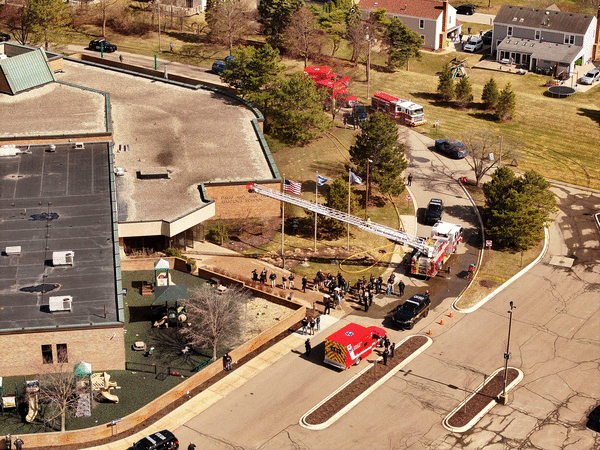
WEST BLOOMFIELD TOWNSHIP, Mich. — Except for the stained-glass windows, much of the inside of Temple Israel is now unrecognizable.
Flooring that was once inside the large West Bloomfield synagogue has been removed, revealing the building's concrete foundation. The seats inside the sanctuary are gone, too. And pipes usually hidden in the ceiling are now exposed. So are the beams that once held the walls.
A new chapter is beginning for the synagogue on Walnut Lake Road, west of Farmington Road, as renovations move forward almost three months after a gunman terrorized it, slamming his explosive-and-gasoline-laden Ford F-150 through the temple's doors on March 12. Ayman Ghazali of Dearborn Heights then engaged in gunfire with security guards before shooting himself in the head.
Ghazali launched his attack on the synagogue while more than 100 children were attending preschool and below in the building. Within minutes after the attack, more than 600 members of law enforcement swarmed the synagogue from agencies across Metro Detroit.
Even though no one in the synagogue was killed, the congregation still carries the weight of what could've happened, said Rabbi Jen Lader.
"We’re all traumatized," said Lader. "This was an act of mass violence against our community, and we’re not going to be OK and fine for a really long time."
While security guards contained the attack to the southeast end of the synagogue, the truck and its explosives produced "thick, black, toxic smoke" that made its way through the entire 150,000-square-foot building, said Lader, speaking from the nearby Jewish Community Center in West Bloomfield.
The smoke settled and then began to rot when it was hit with water from the synagogue's sprinkler system, she said.
The exterior walls are still standing, but "every inch of the building has to be taken down and built back up, because we can’t have a building that’s toxic," said Lader.
Congregants, meanwhile, are attending Temple Israel's synagogue services at other local religious congregations.
“We’re reminded every day of the attack because we’re still not in the building," said Steven Ingber, CEO of the Jewish Federation of Detroit.
But the building isn't the only thing that changed after March 12. Like the smoke that made its way through the synagogue, the lingering impact of the attack continues to permeate life in Metro Detroit.
At the Jewish Federation of Detroit, an organization that aims to address the needs of Jews "in Detroit, Israel and around the world," according to its website, they're doling out more funds to boost security in Michigan.
Ingber, the federation's CEO, said the amount of money the federation has given to Jewish organizations for security since March 12 has "gone up dramatically" to unprecedented levels, and "will continue to increase," though he wouldn't specify an exact dollar figure.
And at local police agencies, they've boosted training for local religious leaders about how to improve security, and now have a greater focus on patrols at all kinds of houses of worship. Nearly every day since the March attack at Temple Israel, a West Bloomfield police patrol car has been parking in the synagogue's driveway.
Even as rebuilding moves forward, in West Bloomfield, the township's significant Jewish population still feels the weight of the attack.
"West Bloomfield is home to one of the largest Jewish populations in the state, so for many of our residents, it wasn’t an event that occurred somewhere else," said Township Supervisor Jonathan Warshay, a member of Temple Israel. "It was very personal."
Tying attack to Israel 'a bridge way too far'
When it's not serving as a school, Temple Israel serves as a house of worship for just over 3,100 households. It's also home to a museum featuring Jewish art, ritual objects and historical artifacts. It's the largest reform synagogue in North America.
Before he attacked it, Ghazali, a naturalized citizen from Lebanon, had been consuming Hezbollah-related media for at least two months leading up to the attack, according to the FBI. He'd posted several violent Facebook messages, including one that said "the oppressors will soon know what kind of end they will meet," and "we will avenge their blood," according to the bureau.
Ghazali bought a gun and fireworks used in the March 12 attack after two of his brothers were killed in an Israeli airstrike on March 5, said FBI Special Agent In Charge Jennifer Runyan.
The morning of the attack, sitting in the Temple Israel parking lot, he sent 19 photos and messages to his sister overseas that Runyan said “reiterated his intent to commit a mass terrorist attack and his Hezbollah ideology. … His sister asked him to stop sending these photos, but he continued.”
And while support for the Israeli government has been a contentious topic in the United States since the start of the Israel-Hamas war — supporters say military actions Israel has taken against groups such as Hamas and Hezbollah are justified, while critics say the government and its military have gone too far — when it comes to the safety of schoolchildren, Ingber says Israel's actions, and people's opinions of them, shouldn't matter at all.
"We don’t hold every Russian in America responsible for the Russian aggression. We don’t hold someone of Iranian descent (responsible) for what’s going on in Iran right now. So to link anything to people who are just trying to live a free life in America with something that’s happening in a foreign country, I think, is a very dangerous endeavor," Ingber said.
“You can be critical of the Israeli government. You can be critical of Israeli policy. But you cannot link those to 104 children in a daycare. That is a bridge way too far," he said.
Reexamining safety, fighting antisemitism
Even before the attack on Temple Israel, the Jewish Federation of Detroit had given out millions of dollars annually for the organizations it serves to boost security, Ingber said.
"Those are all dollars that are keeping kids from going to school, keeping kids from camp, keeping a senior in their home, feeding somebody. Those dollars would be much better spent on anything other than security," Ingber said.
Outside the walls of synagogues, the Oakland County Sheriff's Office and West Bloomfield police, meanwhile, have increased patrols around all houses of worship regardless of religion since the attack. Sheriff Mike Bouchard said his deputies have also focused their efforts on schools and special events at Jewish centers throughout the county.
“Any time you have a situation like this, especially when it’s in your area, it causes everyone to reexamine what they’re doing and how they’re doing it," Bouchard said.
Bouchard says his deputies' investigative work has also changed after the attack. He said at the end of May that there "have been some situations" potentially tied to antisemitism that they cannot comment on yet because they're still investigating them.
Bouchard also said he's noticed a spike in antisemitism that doesn't necessarily rise to a criminal level. Ingber agrees.
"We’re getting calls on it almost daily from different school districts not sure how to deal with it, municipalities, some private companies have reached out to us on how to deal with it," said Ingber.
Bouchard and Ingber both encouraged people to call out antisemitism if they see people exhibiting it in their lives. Ingber said Jews need "everybody's help" to combat it.
On a legislative level, Lader has advocated for the Jewish-American Security Act in Congress. Introduced in May, the bipartisan bill aims to combat antisemitism on college campuses and on social media platforms.
The Jewish-American Security Act would also include $1 billion for at-risk houses of worship and nonprofits — something Lader, the Temple Israel rabbi, says ties to the rebuilding of her own synagogue.
"I’m really hopeful about the future and grateful that our government sees the need to protect its citizens in a more impactful and tangible way," said Lader.
'We're not a people that let terrorists win'
Lader said the vast majority of replacement costs for Temple Israel were covered because they were insured in the case of an active shooter. But there are still a lot of security modifications to the building that won't be covered by insurance but are needed after the attack, she said.
Some of the security features, such as a vestibule-style entrance and offices for security guards, were in the works before the synagogue was attacked. Others existed before the attack, like bulletproof glass and emergency exits.
Other features will be new, like additional bollards outside entrances — sturdy vertical posts to create a type of barrier — and a license plate reader in the parking lot, Lader said.
“Hopefully, we’ll be able to figure out where that money is coming from, but we’ve had a really generous response, not only from our own community, but the nationwide and worldwide Jewish community, to help us rebuild. So we’re grateful that those people are going to help us make sure our building is safe," said Lader.
After the attack, classes were moved to other temporary locations. Lader says synagogue staff is aiming to reopen the temple's preschool area by Sept. 1, when school is back in session. They also hope to have their sanctuary open for the High Holidays this fall.
“We’re not a people that let terrorists win, and so every day, we’re trying to fill our days with joy and with hope and with gratitude that we’re looking forward to being back together and being back in our home space," Lader said.
An interfaith bond
Until they're back in Temple Israel, rabbis and congregants are "sort of nomadic," Lader said. But through that, Lader says she's seen generosity through Metro Detroit's Jewish community.
Temple Israel has held preschool, life cycle events, programming and services at multiple other locations in Metro Detroit since March 12. The same goes for celebrations like bar mitzvahs and weddings, Lader said.
Lader first noticed this generosity immediately after the attack, when synagogue staff had to move one of their bar mitzvahs to Shir Shalom, also in West Bloomfield. She said they were greeted with a sign that read, "Welcome to Temple Israel East."
"While tragic that we don’t have a home and we’ve been displaced, it’s been amazing to be able to pray in all these different synagogues around the city, because we don’t usually get to do those things," said Lader.
Lader also noted how other faith communities have helped Temple Israel. She specifically mentioned the Chaldean community, which volunteered Shenandoah Country Club as a reunification area after the attack. One day after the attack, the club hosted Temple Israel's Shabbat service.
Warshay, the West Bloomfield Township supervisor, said the community has strengthened its relationships with all faiths — Jewish, Christian, Muslim, Chaldean, Hindu and Sikh — following the attack. He said communication between groups is key to violence prevention and public safety.
"An incident like this reminds us that vigilance matters, but so does community," Warshay said. "Our strongest safeguard against hatred and violence is a community where people know one another, communicate openly, and are willing to stand together even when they come from different backgrounds or perspectives."
_____
©2026 The Detroit News. Visit detroitnews.com. Distributed by Tribune Content Agency, LLC.





Comments