Mayor Brandon Johnson predicts revival of faith in Chicago following Vatican trip
Published in Religious News
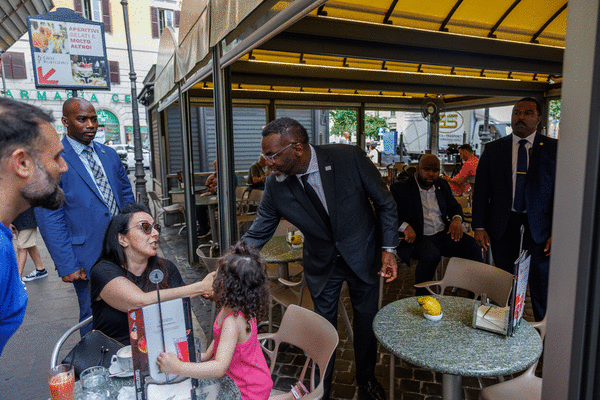
ROME — Before Brandon Johnson was mayor of Chicago, he was a pastor’s kid.
That was a label he once again applied following his much-hyped meeting with Pope Leo XIV last week, one that he has played up to fortify how constituents connect his spiritual roots with his progressive politics.
“Who would have thought that a middle school teacher, the son of a pastor, would be in the Vatican, talking to the pope who has his roots in the city of Chicago?” Johnson told reporters on Thursday after exiting the Vatican. “Our conversation was centered around how his pulpit and my pen can come together to defend humanity.”
He’s hardly the only Chicagoan eager to accentuate his common ground with Leo, who swiftly caught fire as one of the city’s most famous and locally popular native sons when he was chosen as the 267th pope a year ago.
Johnson’s close affinity to the Black church has remained a dominant theme of his time in office and will surely play a major political role as he seeks to connect with churchgoing Chicagoans in a potential reelection bid, though aldermen who have thwarted or curtailed many of the pillars of his progressive agenda might take exception to the mayor’s characterization of his policies as defending humanity.
As American religious affiliation of all types has been declining over the decades, Johnson and other allies say a “revival” of faith is overdue in Chicago, and Leo could be the catalyst. They also point to churches as important ways to get out the vote.
“In the church, you start to see less membership, you start to see older membership, because the youth aren’t coming, but sometimes we need a push — a revival of sorts — to drive people back to Christ,” said Ald. Jason Ervin, who joined the Chicago delegation to Rome. “I believe when the pope comes to Chicago, and I believe that he will make his way to Chicago, you’ll see a great revival in our city.”
Johnson, who dropped the phrase “the pulpit and the pen” throughout the past week, concurred on a forthcoming surge of interest in religion during a sit-down interview with the Tribune following his papal summit.
“As far as reaching young people and even church attendance, the real encouraging thing right now is what we’re experiencing with Pope Leo the XIV, is that there are folks who are coming back into the faith,” Johnson said. “I’m hopeful that as the church continues to emerge, as our communities continue to cry out for justice, that you’ll see a revival of sorts.”
The mayor’s grandfather was pastor at Church of God in Christ, one of the largest Black Pentecostal denominations in the U.S. Johnson’s father, Andrew Johnson, and mother, Wilma Jean Johnson, eventually left to start their own church, which Johnson’s sister has since taken over as senior pastor.
Johnson instead went into politics. But at the mayor’s podium, he is apt to recount biblical verses and parables, his voice at times revving up with the cadence of someone delivering a sermon when he’s fired up. That’s exasperated some critics who say his rhetoric veers toward preachy instead of conciliatory during moments when he needs to build a coalition.
Growing up as the middle child of 10 in a modest Elgin home, Johnson sometimes leans on childhood stories of mediating arguments among his siblings as proof the political fights within the rough-and-tumble walls of City Council don’t faze him. He touted on Friday that all three annual city budgets have passed during his tenure — though he omitted that the 2026 spending package was engineered by aldermanic opponents against his will.
The final weeks of the most recent budget fight were some of the most unforgiving for the freshman mayor, as critics argued he lost control of the council and painted him as weak.
At the same time, the relentless attacks helped Johnson’s remaining allies, particularly those steeped in the Bible, contend that he is following a moral, if not always popular, path. It has not made subsequent votes on issues where a majority of aldermen have bucked him any easier for him, however.
“He’s persecuted for righteousness’ sake,” Ald. William Hall, 6th, said. “That’s beyond politics, and for him to unapologetically live these tenets, chair meetings in which hate is being spewed, votes of bigotry and division are at the root of some of these ordinances, and there he is? The crossroads of our city was led, in my opinion, by Jesus’ work.”
Willie Wilson, another pastor-politician and potential 2027 mayoral contender, said that “church is all we got in particularly the African American community that one can go.”
“That’s why the people congregate every Sunday in the Black community at the churches,” Wilson said.
But the three-time candidate for mayor had no love to spare for Johnson, including his spending on migrants and loyalty to the Chicago Teachers Union.
“I think the mayor did so many things that have not been right to the community,” Wilson said.
In Chicago, the old Democratic machine chugged along for decades in the Southwest Side Bridgeport neighborhood, one of the centers of Irish Catholic life in the city. After Richard M. Daley stepped down from the mayor’s seat, the city saw its first Jewish leader in Rahm Emanuel and then two Protestant mayors in Lori Lightfoot and Johnson.
For the latter two, neither won the Black vote during the first round of their elections in 2019 and 2023, respectively. Johnson ultimately knocked Lightfoot out of the running in her 2023 reelection bid, despite her sweeping the South and West Side wards, thanks to his strong numbers within progressive neighborhoods.
During Lightfoot’s 2019 runoff against Toni Preckwinkle as well as Johnson’s in 2023 against Paul Vallas, however, the two decisively won the South and West sides. And similarly, facing tough reelection paths ahead, the two each focused their final years on shoring up a Black base in the most reliable institution to curry favor with such voters: the church.
However, Black church membership has plunged 19% from the turn of the century to 2020, a Gallup poll found. That could have far-reaching implications for Chicago politics, given the eminence of Sunday congregations as not just houses of worship but also organizing tools.
Similar drop-offs are seen across race in America, with Gen Z adults believed to be the least religious in history — though some argue they remain spiritual, just skeptical about institutions.
Hall, also the pastor at St. James Church, said he isn’t convinced religion is declining among the youth.
“The church is still the number one organizing tool in city government, in the city of Chicago,” Hall said. “Political candidates know that the same person that has an audience for two hours 52 weeks in a row can literally say or inspire that audience to go in a direction politically that can hurt or help them.”
Meanwhile, the Chicago metro area dropped from 34% Catholic in 2014 to 29% a decade later, according to Pew Research. But this Easter, the Archdiocese of Chicago marked a 52% increase of catechumens and candidates to join the Catholic Church versus 2025.
William Cavanaugh, a Catholic studies professor at DePaul University, said he won’t be surprised if younger Americans have a literal “come to Jesus moment” because their generation is living through the “post-WWII order” crumbling. And Leo’s strident stances against the Trump administration’s mass deportations and wars could also revive interest in Gen Z liberals turned off by modern Christianity’s association with conservative causes, Cavanaugh added.
“I do think that there is a sense amongst young people that the world order is being shaken in really profound ways,” he said. “Things seem to be getting scrambled, and I think there is a sense in which the church provides a different vision of what life might look like with meaning and a God who loves the world and isn’t just trying to profit off of it.”
At Johnson’s congregation, Lawndale Christian Community Church, the mayor often silently observes from the pews with his chin perched on his hands — when he isn’t reminding his three children to pay attention to the service.
That’s according to his pastor for the past six years, the Rev. Jonathan Brooks.
On some weeks, Brooks said, members will come up and pray for Johnson or offer a hug while reassuring him, “I saw that thing in the newspaper, man, don’t let that bother you. We know who you are.”
Johnson also still participates in a Bible study attended by men recovering from addiction, called “Kingdom Men.” And he seeks regular one-on-one spiritual counsel in Brooks’ office, across the street from a barbershop that Johnson frequents and is owned by a member of the congregation.
The two will shut their phones off, kick their shoes off to unwind and sometimes pray or even cry together, Brooks said.
“Mayor Johnson, the son of a Black preacher, right, grew up in a historic Black church, but then also someone who’s made the decision to live in the Austin neighborhood … it resonates because of the life that matches it,” Brooks said.
Then he read aloud one of Johnson’s favorite Bible verses: Ephesians 6:11, “Put on the full armor of God, so that you can take your stand against the devil’s schemes.”
“That’s been one that I’ve also tried to help him recognize, that he needs to continue to gird himself up,” Brooks said. “That’s why he needs to stay around this faith community.”
_____
©2026 Chicago Tribune. Visit chicagotribune.com. Distributed by Tribune Content Agency, LLC.




Comments