Penn helped test a promising mRNA cancer vaccine. Here's what the trial means for the field
Published in Health & Fitness
PHILADELPHIA -- Denise Fitzsimmons knew that removing the fast-growing lump above her eyebrow in 2024 didn’t eliminate the possibility that her melanoma could return.
But a clinical trial at Penn Medicine offered the 63-year-old grandmother from Birdsboro, Pennsylvania, hope of a more enduring remission. It tested a novel vaccine, based on Penn’s groundbreaking mRNA research, that trains the patient’s immune system to find and kill cancer cells.
That technology has become the first mRNA cancer vaccine to succeed in a late-stage clinical trial, according to preliminary findings released last month by Merck and Moderna, the pharmaceutical giants developing it.
The vaccine extended the time a patient survived without their cancer returning or spreading, according to the companies, which announced Monday that they will share the full trial results next month at the 2026 European Society for Medical Oncology meeting in Spain.
The drugmakers merely said that the results were positive. Without knowing the exact numbers involved, or how long the benefit lasted, it’s still unknown if the results will prove clinically meaningful for patients. The companies also have not announced a commercial price tag for the therapy, called intismeran autogene, though similar immunotherapies can cost hundreds of thousands of dollars.
The trial could mark a turning point for mRNA technology, which has proven useful against infectious diseases but hadn’t had the same success in cancer.
Melanomas typically contain thousands of genetic mutations due to sun damage, making them an ideal target for the approach, which teaches the immune system to respond to unique markers on cancer cells.
“It’s a very big step forward after many negative studies in the last few years,” said Ravi Amaravadi, the lead investigator of the Penn trial site, one of more than 100 around the globe.
mRNA vaccines gained widespread attention in 2020 when used to develop the first immunizations for COVID-19. These shots used the mRNA platform developed by Nobel Prize winners Katalin Karikó and Drew Weissman, a University of Pennsylvania professor. Since then, mRNA vaccines for RSV and the flu have gained approval.
“This was kind of the wake-up call that RNA vaccines in cancer have an enormous future,” said Weissman, who was not involved in the trial and has no financial stake in Merck or Moderna.
How the vaccine works
Melanoma is a serious type of skin cancer that develops when melanocytes — the cells that give skin its color — grow out of control.
This trial tested the vaccine in patients whose melanomas had already been removed through surgery. The goal was to destroy any remaining cancer cells and prevent the disease from returning or spreading to other parts of the body.
“It’s the deadliest form of skin cancer because it can metastasize,” Amaravadi said.
Penn’s site was one of the first trial locations to open in the United States.
Scientists personalized the vaccine for each patient by analyzing their tumor samples for unique genetic mutations. That enabled them to design mRNA — a molecule that carries genetic instructions — that would encode bits of protein that look like the tumor.
When the immune system encounters those proteins, it learns to recognize the cancer and attack it.
It’s similar to vaccines for the flu or COVID-19, which train the body to identify and fight off specific viruses.
If the immune system is trained in this way, it could produce a long-lasting memory against the cancer, Amaravadi said.
“We are now able to train the immune system to look for the tumor, arguably for the first time, in the most effective way,” Amaravadi said, referring to the mRNA platform.
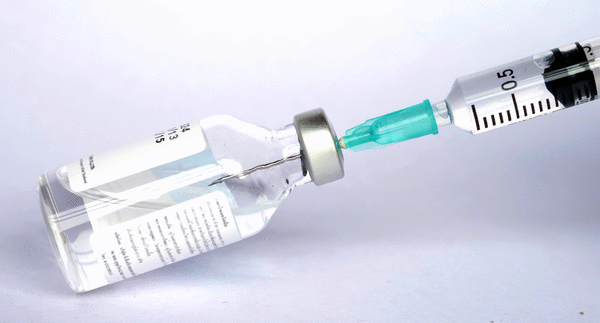
That mRNA was loaded into a nanoparticle (which acted like a delivery truck hauling cargo) and injected into the arm as a shot.
Two-thirds of the 1,137 participants were randomly chosen to receive the vaccine in combination with Keytruda, a standard-of-care immunotherapy, while the remaining third received Keytruda alone.
The trial
Trial participants who received the vaccine had fewer metastases compared to patients who got the immunotherapy alone, Amaravadi said.
However, the company has only announced that the results were positive. Without knowing the data, it is hard to say whether the results are also clinically meaningful, Amaravadi said.
“We are hopeful we’re going to see the same absolute benefit when we see the data published,” he said.
Amaravadi also wants to see whether there were any unexpected side effects that patients should consider before taking the therapy.
Another data point of interest: How many patients agreed to receive the treatment but ultimately couldn’t receive it. In some cases, patients’ tumor samples were too small, didn’t contain enough usable genetic material, or were of too poor quality to actually make the treatment.
If this were a consistent problem, the technology used to analyze tumors’ genetic makeup would need to improve.
“It’s still a little bit of a bottleneck for some patients to get access to the treatment,” he said.
Fitzsimmons, a grandmother living in the small Berks County town of Birdsboro, participated through Penn’s site. She doesn’t know whether she received the treatment or a placebo (that information is kept secret from both patients and researchers to avoid bias.)
But she recalls feeling flulike symptoms the day after each shot — including body aches and sweats — making her speculate that she may have received the vaccine. COVID-19 mRNA shots often prompt similar reactions.
Fitzsimmons has been cancer-free for the last two years.
“My fifth granddaughter is on her way,” she said. “So I have a lot to live for.”
The future of mRNA
RNA offers a few key advantages as a treatment.
Its effects are transient and controllable. The material lasts only a couple of days in the body before it degrades and disappears.
It’s also relatively easy to make.
“We made billions of doses of the COVID vaccine within a year. No other vaccine or therapeutic can be expanded that quickly,” Weissman said.
He believes RNA vaccines could benefit people with genetic mutations that put them at higher risk of cancer, such as BRCA carriers.
If people receive the vaccine before their tumors form, it could kill off any early cancer cells that arise.
“That way you prevent the cancer from ever forming, instead of trying to treat it after it’s already there,” Weissman said.
Conversely, he doesn’t think RNA vaccines would work well in someone whose advanced cancer cannot be removed. The immune system has a hard time killing large tumors, he explained.
This trial tested the vaccine as a follow-up to surgery, targeting leftover tumor cells.
Other ongoing trials are testing mRNA vaccines in pancreatic, breast, colon, lung, prostate, and other cancer types.
Outside of cancer, clinical trials are testing mRNA vaccines for herpes viruses, malaria, tuberculosis, Zika, chikungunya, and norovirus. Scientists are also exploring whether mRNA technology could be used to treat allergic and autoimmune diseases.
This work has continued to advance, even as Health and Human Services Secretary Robert F. Kennedy Jr. last year slashed $500 million designated for mRNA vaccine development.
“The potential for RNA to treat many different diseases can’t be ignored,” Weissman said.
©2026 The Philadelphia Inquirer, LLC. Visit at inquirer.com. Distributed by Tribune Content Agency, LLC.









Comments