Pennsylvania reports 2 measles deaths in Lancaster County, state's first in decades
Published in Health & Fitness
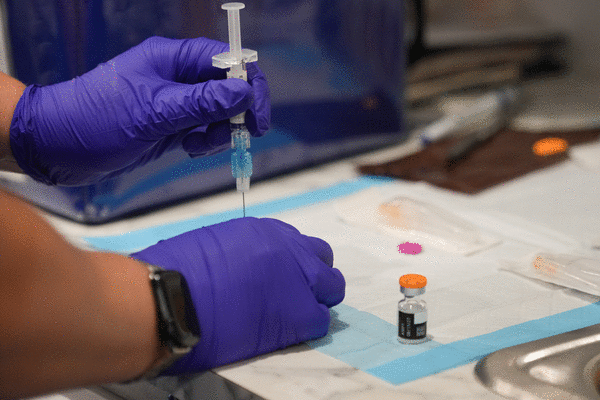
PHILADELPHIA — Two people have died from measles in Pennsylvania, state officials said Tuesday, marking the first fatalities involving the highly contagious disease in the state in 35 years and the only measles-related deaths reported nationally so far this year.
Both were unvaccinated residents of Lancaster County, the center of a major measles outbreak that has sickened nearly 400 people this year. Officials did not release their ages or information about underlying health conditions.
Gov. Josh Shapiro said the deaths reflected “the consequences of a lack of immunization” during a news conference at Lancaster General Health’s Women and Babies Hospital.
“We hope, and we pray, that those deaths will be the last,” he said. He added: “This illness and death from measles is completely preventable.”
He urged Pennsylvanians to get vaccinated against the disease, which can linger in the air for up to two hours and infect nine in 10 unvaccinated people exposed to it.
State officials would not provide additional details about the two people or their families to protect their privacy.
Most cases resolve after mild illness and a telltale rash, but measles can cause serious complications that include pneumonia and brain swelling. Lancaster physicians have treated patients with these symptoms in recent months.
Nearly one in five of the people diagnosed with measles this year in Pennsylvania has been hospitalized. Deaths are rare, occurring in about one to three people in every 1,000 cases. Three people died of measles nationwide in 2025.
Pennsylvania has reported the third-highest number of measles cases in the country for 2026, behind Utah and South Carolina, according to the Centers for Disease Control and Prevention’s latest data. The CDC’s website had recorded no other measles deaths this year as of last week.
Shapiro said he had talked to U.S. Health and Human Services Secretary Robert F. Kennedy Jr., a prominent anti-vaccine activist, about the deaths.
Shapiro, a Democrat who has opposed Kennedy’s efforts to upend federal vaccine policy, said federal officials were contributing to the spread of misinformation about measles vaccine safety that “in some cases isn’t driven by facts and by science.”
“I was very, very blunt with him, and I made very clear that his actions and the rhetoric that’s coming from this administration are having a negative impact on communities across America, particularly right here in Pennsylvania,” he said.
“There’s real-life consequences to spreading misinformation,” Shapiro said. “There’s real-life consequences to scaring people.”
The state health department is working with CDC staff as they report testing and confirm measles cases, Shapiro administration representatives said.
Kennedy had checked in Tuesday, asking if the state needed additional help, the governor’s representatives said. Shapiro told him the state “has what we need at this time,” they said.
In a statement, HHS officials offered condolences to families and communities affected by the deaths and said they will “continue to follow Pennsylvania’s lead” with “resources to support the state’s response.”
“The MMR vaccine provides the most effective protection against measles and helps prevent its spread,” a spokesperson said.
In Pennsylvania, children made up about one-third of the 393 patients diagnosed with measles in two separate outbreaks so far this year, state officials say. None of the patients diagnosed with measles this year have been fully vaccinated.
Shapiro noted that philosophical and religious exemptions for state-mandated vaccinations have tripled in the last decade. Pennsylvania has among the most permissive exemption laws in the country. “It’s dramatically reduced community immunity in different areas of our Commonwealth,” Shapiro said.
Just under 88% of kindergarteners in Lancaster were vaccinated against measles in the 2025-2026 school year.
The spreading outbreak may have some parents reevaluating. Shapiro said healthcare providers across the state have given out 35,000 doses of MMR vaccines in the last month; typically, they give out 25,000 in a month.
Grappling with an outbreak
For months, Pennsylvania has grappled with a spiraling outbreak unprecedented since the early 1990s, when nine children died from the virus in Philadelphia.
In the decades since, robust vaccination efforts effectively eradicated the disease in the United States. In recent years, Pennsylvania has seen only sporadic cases, and many physicians here have never treated measles cases before.
Nearly half of the cases reported in Pennsylvania this year were diagnosed in Lancaster County residents, followed by Chester County with 41 cases as of Monday.
And health officials have said they believe there are far more cases circulating than have been officially reported in a state that recorded a total of 16 measles cases all year in 2025.
Delaware has reported 22 cases this year, the first time in a decade that measles has been diagnosed in state residents. New Jersey has confirmed just one case.
So far, the bulk of Pennsylvania’s cases this year have been diagnosed in the summer months. With students now returning to classrooms, many physicians and health officials are concerned about increasing risks for spread.
Overall, Pennsylvania reports high vaccination rates among school-age children, with about 93% of kindergarteners immunized against measles.
Philadelphia-area counties, despite slight drops in vaccination rates in 2025, generally hover close to the 95% “herd immunity” threshold, the rate at which a population must be vaccinated to prevent the spread of the disease.
But hundreds of schools across the state report vaccination rates below herd immunity, pockets of vulnerability in otherwise highly protected communities.
At Tuesday’s news conference, state Secretary of Health Debra Bogen said the deaths will not change the department’s focus on increasing vaccination efforts and informing health providers and schools about the threat of measles.
All schools received letters from the health department ahead of the school year informing administrators about how to spot measles and report cases.
“We are in contact with school nurses across the state, so the schools are prepared and have all the tools they need. We will support them if there’s a case,” Bogen said.
State officials said that the outbreak is not limited to religious communities in Lancaster County, home to a high population of Amish and Mennonite residents. Some members of the Christian denominations avoid vaccination, but attitudes vary.
“Measles has now been traced to 28 different counties, counties that have really different makeups, both from a religious perspective and from a broader community perspective,” Shapiro said. “It would not be fair for anyone here to conclude that this is just a problem in a particular community.”
Lancaster doctors and leaders have called on residents to get vaccinated to protect themselves and others, saying that helping neighbors is in keeping with the area’s spirit.
“We show up for one another in times of need. We deliver meals. We support each other during times of illness. Vaccinations are another way we care for each other,” said Jeffrey Martin, the chair of Lancaster General Hospital’s Department of Community and Family Medicine.
Martin also urged Lancaster residents who suspect that they have measles to call ahead to hospitals or urgent cares before seeking help there, so staff can prepare to isolate them from other patients.
“This simple step can significantly reduce the risk of spread,” he said.
_____
©2026 The Philadelphia Inquirer. Visit inquirer.com. Distributed by Tribune Content Agency, LLC.







Comments