Ebola health workers strike in hardest-hit Congo towns as outbreak intensifies
Published in Health & Fitness


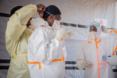

Ebola responders in eastern Democratic Republic of Congo’s hardest-hit areas have been striking this week over unpaid benefits and deteriorating working conditions, complicating efforts to contain a virus that’s infected more than 1,700 people and killed at least 580.
The industrial action took place in Bunia, the capital of Ituri province, and the neighboring town of Rwampara, the National Institute of Public Health said in a report Tuesday. The health zones have recorded a combined 829 confirmed Ebola infections — almost half the country’s total.
Rwampara has been at the center of the outbreak since its early days. Facilities were set on fire during unrest over infection-control measures in May, and a French doctor who worked at its treatment center later became the first person diagnosed with the virus outside the affected region.
Before Ebola emerged, eastern Congo’s health system was already buckling under the combined weight of conflict, displacement, chronic neglect and aid cuts. Médecins Sans Frontières warned in December that almost 40% of health workers had left their posts, more than half the facilities it assessed had closed or been damaged, and as many as 85% faced critical drug shortages.
“Continuity of essential services” has been compromised, the institute said, warning of increased indirect mortality unrelated to Ebola.
The walkout came as treatment centers reached what the World Health Organization described as “saturation point.” Facilities admitted 102 patients on Monday after taking in 104 the previous day, almost double the average daily admissions during June, according to Bloomberg’s analysis of government situation reports.
“We would like to say it is stabilizing, but frankly, we cannot say it yet,” the WHO’s representative in Congo, Anne Ancia, told reporters. Ancia said she’d visited treatment centers across Ituri and North Kivu provinces and “witnessed firsthand the dedication of staff who continue to serve their communities despite enormous challenges.”
Some health workers had gone unpaid since the epidemic began and lacked adequate protective equipment and other supplies, the Associated Press reported Monday.
Health workers in Ituri met with the military governor and top local public health officials on Sunday to discuss concerns about payments, bonuses and the pressure of working away from their homes in a remote region, government spokesman Patrick Muyaya told United Nations-backed Radio Okapi Tuesday.
“We want to reassure that their interests are guaranteed and it’s a very important question that we’re addressing,” Muyaya said. He said some of the payment problems were related to technical issues around bank transfers and were being sorted out.
Muyaya said in a text message to Bloomberg on Wednesday that he believed the strike had ended.
Wider Spread
The workload continues to grow. Health officials on Tuesday reported that Ebola had spread to Boga in southern Ituri, while more than 12,400 contacts were under daily monitoring across 37 affected health zones.
Community health workers spend their days walking from house to house tracing contacts, checking on families under observation, explaining why Ebola victims must be buried safely and persuading skeptical communities the virus is real. Unicef alone aims to reach about 900,000 households through door-to-door visits as part of the response, said Douglas Noble, the agency’s global incident manager for Ebola.
Yet treating Ebola has become only one part of their job.
The same workers are also trying to keep childhood vaccination programs operating, maintain nutrition services, encourage pregnant women to attend antenatal appointments and persuade families not to avoid clinics because of fears of infection.
When Noble visited Rwampara, the second-hardest-hit health zone after Bunia, he found many patients were avoiding hospitals altogether unless they feared they had Ebola. Measles vaccinations, nutrition programs and antenatal care were all suffering, he said.
Direct Relief, an American aid group, is shipping more than 170 pallets of intravenous fluids into the region because severe dehydration from vomiting and diarrhea remains one of the leading causes of death in Ebola patients. The organization is also supplying insulin and other medicines in an effort to keep routine medical services functioning as the outbreak stretches the health system.
“We know what to do, but we are not able to deliver it at scale and at the speed that is required,” said Rose Tchwenko, Mercy Corps’ country director in Congo.
Malaria Deaths
Aid agencies are trying to avoid repeating one of the biggest lessons from the 2013-16 West Africa Ebola epidemic. Researchers estimated that the collapse of malaria diagnosis and treatment alone may have caused about 10,900 additional deaths, almost as many as the 11,325 people killed directly by Ebola.
The challenges have complicated discussions about launching a mass administration of antimalarial drugs, a strategy experts said could save lives by reducing the number of fever cases mistaken for Ebola.
While the evidence for the approach is strong, responders say it would rely on the same community health workers already stretched by contact tracing, surveillance and public education.
“Who’s going to distribute these drugs?” said Jean-Paul Mangion, an emergency coordinator with MSF. “It’s the same people who are being used for different activities” in the Ebola response, he said.
The pressure carries personal risks. At least 96 health workers have been infected and 19 have died during the outbreak, many after treating patients in ordinary clinics before anyone realized they had Ebola. Bundibugyo, the Ebola strain behind the outbreak, initially resembles malaria and other common illnesses, exposing nurses and doctors before strict infection-control measures can be put in place.
The fear has changed how some health workers practice medicine. Doctors and nurses in some areas have begun making house calls because patients are too frightened to attend clinics, exposing themselves to Ebola in environments where infection-control measures are almost impossible to maintain, Mangion said.
The dangers extend beyond infection. An Ebola treatment center in Kitatumba in North Kivu was the target of a criminal arson attack Monday, highlighting the security risks facing responders, patients and the broader community.
“If you’re seeing damage and insecurity at the unit itself, you’re going to run away from that, and clearly it’s going to spread into other areas,” said Jeffrey Samuel, Direct Relief’s regional director for Africa.
Sign up here for the daily Next Africa newsletter and subscribe to the Next Africa podcast on Apple, Spotify or anywhere you listen.
____
—With assistance from Michael J. Kavanagh and Monique Vanek.
©2026 Bloomberg L.P. Visit bloomberg.com. Distributed by Tribune Content Agency, LLC.







Comments