Ask the Pediatrician: Healthy meals for children
Published in Health & Fitness
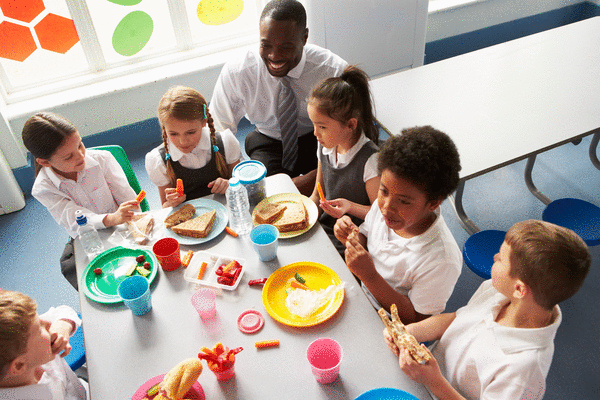
Having healthy meals at school, during breaks and at childcare/after-school programs sets kids up for success so they can learn, grow and stay active. Healthy meals are an important tool to help children learn, just as much as textbooks and technology. Research shows that school meals are positive influences in kids' health as they ensure that all children can get the fuel they need.
The National School Breakfast and Lunch Program has been part of the United States school day since 1946. Any child can get meals if their school takes part and what your child pays will depend on your household income. Some children can get free- and reduced-price meals.
Families may be looking for ways to make sure their child gets nutritious food at school, during breaks or at childcare. If your children are eligible for meals, parents or caregivers can apply or sign up at any time of the year. Just let your school or district know that you want to fill out an application.
There are a variety of factors that can make children eligible for these kinds of programs. Children may be eligible if they live in a household that receives benefits through the Supplemental Nutrition Assistance Program, the Temporary Assistance for Needy Families program, the Food Distribution on Indian Reservations, Head Start and Early Head Start, and others. Children in foster care, experiencing homelessness, or in a family with migrant workers may also qualify.
Additionally, in certain communities with a high number of students who are at risk of not having enough to eat, the schools provide breakfast and lunch at no charge
Once the school year ends, parents and guardians may be concerned about their children getting enough food without the help of regular school meals. Luckily, meals are available through the USDA Summer Nutrition Programs for Kids, also called SUN Programs.
The program – which is open to all children aged 18 years and under – provides on-site meals and snacks, and is held at schools, parks and other locations. You can find a summer meal site near home at the USDA’s webpage on Summer Meal programs.
One such program, the Summer Meals To-Go program, is open to all children aged 18 years and under in some rural communities where SUN Meals are more difficult to access. These summer meals can be picked up or delivered to your home at no cost. In addition, many states have approved the Summer EBT program called SUN Bucks, allowing families additional money to purchase food for school-age children during the summer.
If you need help getting to your local meal site, ask if free transportation is available. Programs may provide free bus passes or other ways to and from the location. There may also be mobile feeding sites.
For children that spend time in childcare and Head Start programs that are part of the Child and Adult Care Food Program, nutritious meals and snacks are provided.
What if families are struggling to feed children on the weekends or school breaks when classes aren’t in session? This is where school backpack programs come into play. These programs offer free grocery staples for children to be supported when they are home on short breaks from school.
The backpacks include healthy, easy-to-make food for kid-friendly meals. Most backpacks include enough food to make a few healthy meals so that kids can return to school ready to learn. Schools, after-school programs and community centers partner with food banks to distribute the backpacks to families. Most programs give backpacks every week on Fridays or the day before school break except for the summer.
You can search online to find a local backpack program.
If you are in need of further resources, your pediatrician can connect you to options in your community, including programs that provide access to food, safe housing, transportation, quality childcare and other supports. That is why your pediatrician asks all families that come into their care if they have enough food. It's OK to answer honestly; the questions are not to single you out. They are an opportunity for the health care team to provide resources for your family. Your pediatrician knows you try to be the best parent possible and wants to help!
If your family does not qualify for school meal benefits or your school does not participate in the Community Eligibility Provision and you are looking for other ways to feed your family, ask your pediatrician. They can connect you with food banks, food pantries and emergency food locations.
____
Kimberly Montez, MD, MPH, FAAP, is a Professor of General Academic Pediatrics and Social Sciences & Health Policy at the Wake Forest University School of Medicine. As a health services researcher and child health advocate, Dr. Montez has expertise in the social drivers of health, including food insecurity, community engagement and health equity. She is a co-author for the American Academy of Pediatrics (AAP) and Food Research & Action Center Food Insecurity Toolkit for Pediatricians. Dr. Montez serves as an official spokesperson for the AAP and as an associate editor for the journal Pediatrics.
Kofi D. Essel, MD, MPH, FAAP, is a community pediatrician at Children's National Hospital (CNH) and Clinical Associate Professor of Pediatrics at the George Washington University (GWU) School of Medicine & Health Sciences in Washington, D.C. Dr. Essel has dedicated his career to advocacy/research around health care and public health workforce training, health disparities and community engagement, with expertise and national recognition in the areas of addressing diet-related chronic disease and food insecurity with patients and families. He is a co-author of the American Academy of Pediatrics (AAP) and Food Research & Action Center Food Insecurity Toolkit for Pediatricians and previously served as a member on the AAP Section on Obesity Executive Committee.
©2026 Tribune Content Agency, LLC.







Comments