Google-backed initiative seeks to release 32 million mosquitoes in 2 states for disease control
Published in Health & Fitness
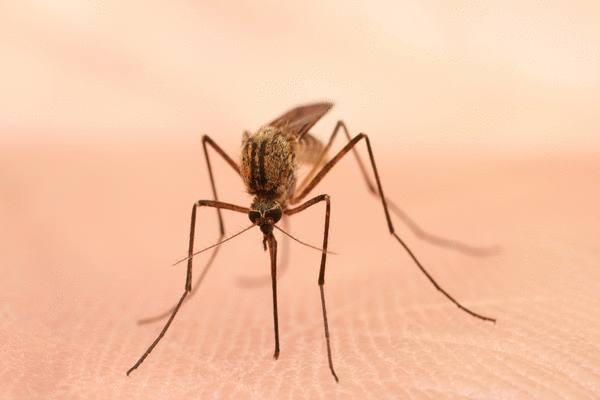
What’s the best way to combat mosquito-borne diseases? Apparently, releasing more of the bloodsuckers, according to a Google-backed initiative.
The Debug project is seeking permission from the Environmental Protection Agency to release up to 32 million sterilized mosquitoes in both Florida and California over two years, according to a May 6 EPA notice.
Often carrying diseases like malaria, Zika and dengue, mosquitoes kill more people compared to other species, according to the Centers for Disease Control and Prevention.
Debug uses the naturally occurring bacteria Wolbachia to sterilize male mosquitoes, which cannot bite and do not transmit diseases. The eggs produced from wild female mosquitoes’ singular mating with sterilized male mosquitoes do not hatch, therefore slowing the reproduction of the “bad bugs.”
“This is a new way of approaching an old strategy,” Raymond St. Leger, a University of Maryland distinguished entomology professor, said regarding similar methods that use genetically modified pests.
Google employees started looking into ways to combat mosquito-borne diseases in 2014, around the same time Verily, initially Google Life Sciences, was created. Debug’s founders met with worldwide experts and finally created the project in 2016.
Many mosquito-borne diseases do not have effective vaccines or treatments, St. Leger said. Ways to reduce mosquito populations, like insecticides, are often unproductive and can be toxic to other species, he said.
Debug is specifically targeting the Aedes aegypti mosquito species, which transmits the most cases of dengue, Zika and yellow fever, according to Google.
The Aedes aegypti can be found in Southern and Southwestern U.S. states, according to the CDC. The species is dark brown with white stripes on its legs and white spots on its body.
The Aedes aegypti mosquito is uncommon in Maryland but the Debug project can still benefit Marylanders.
Controlling Aedes aegypti’s population can prevent diseases from being transmitted from Aedes aegypti to Maryland’s resident mosquito species, in turn protecting people from diseases as well.
Other pests, like fruit flies, screwworms and codling moths, have had their populations reduced through the same method, referred to as the “sterile insect technique,” according to Debug.
The U.S. project is based on a successful Debug application focused on urban and residential areas of Singapore.
Project Wolbachia-Singapore, a project operated by the National Environment Agency and supported by Debug, has shown an 80-90% suppression of the Aedes aegypti mosquito and more than a 70% reduction in dengue cases, according to a May 12 Debug press release.
The Federal Register, where the notice is posted, held a public comment period regarding Debug’s permit request until June 5. Many of the comments raised concerns about potential ecosystem disruptions and community impacts, with commenters saying that they would not want these released mosquitoes in their backyards.
Most mosquitoes are invasive to the U.S. and have a human-focused lifestyle, meaning a decline in their population would not have a large impact on the ecosystem, St. Leger, who researches Wolbachia and mosquitoes, said.
He said that researchers must develop multiple methods of mosquito control in case the pests develop resistance and should stay informed to prepare for any future outbreaks.
Releasing sterilized mosquitoes also may not be a permanent solution — the mosquito population will bounce back if the sterilized mosquitoes are no longer released, he added.
“We have to plan very carefully for the future,” he said. “We have to be very vigilant.”
-----------
©2026 The Baltimore Sun. Visit at baltimoresun.com. Distributed by Tribune Content Agency, LLC.









Comments