Lilly goes on $20 billion buying spree as company seeks next act
Published in Health & Fitness
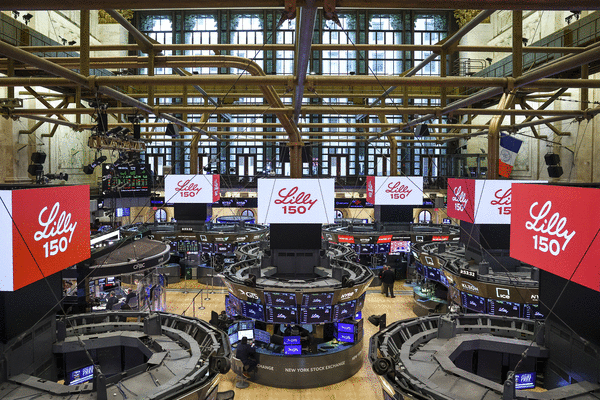
Eli Lilly & Co. is on a record spending spree, announcing acquisitions worth more than $20 billion so far in 2026 as the drugmaker expands beyond its blockbuster obesity franchise.
In recent weeks, Lilly has pledged to shell out up to $7.8 billion for sleep drugmaker Centessa Pharmaceuticals Plc and up to $7 billion for cancer drug developer Kelonia Therapeutics — two of its most expensive deals ever. On Tuesday, it agreed to buy three vaccine developers for as much as $3.8 billion.
The value of Lilly’s deals is its highest ever in a year, according to data compiled by Bloomberg. The $20 billion figure includes milestone payments.
There could be much more to come.
“We are making more offers than you can possibly imagine,” Jake Van Naarden, Lilly’s head of oncology and business development, said at a recent conference. “What’s interesting is how many of the multibillion dollar deals we are attempting to do and getting rebuffed with some frequency.”
Van Naarden and his team evaluate “at least” 10 potential deals a week.
The flurry of agreements shows how the world’s largest pharmaceutical company is using the windfall from its weight-loss and diabetes shots to diversify its pipeline — mainly by targeting medicines in earlier stages rather than existing blockbusters. The company is already seeking its next act — and hoping to learn from past mistakes of not doing so sooner.
With a market capitalization around $1 trillion, investors still have high expectations for Lilly. That means it needs to avoid the pitfalls that have long plagued companies fortunate enough to have a wildly profitable drug. Lilly itself has fallen victim to that trap: In the early 2000s, the loss of patent protections on its blockbuster depression drug Prozac sent the company into a tailspin as it struggled for a decade to find its footing.
Lilly still has about a decade of patent protection left on its best-selling diabetes and obesity drugs Mounjaro and Zepbound. However, executives say they don’t want to rest on their laurels.
Deals have become a key part of that strategy, helping Lilly grow quickly in areas like cancer and gene therapy where it wasn’t as big of a player.
In some cases, the company is placing bets in areas where others have struggled. It’s investing heavily in gene therapy, an area of medicine that some drugmakers have abandoned because of its high costs and uncertain sales prospects. And Lilly’s agreement with three vaccine makers is happening as Robert F. Kennedy Jr., a longtime vaccine critic, leads the US Department of Health and Human Services.
“These acquisitions reflect a deliberate strategy to prevent disease at its source rather than treat its consequences,” Dan Skovronsky, Lilly’s chief scientific and product officer, said in a statement about the vaccine deals.
Early Stage Drugs
Under Chief Executive Officer Dave Ricks, Lilly is investing earlier in a drug’s life cycle, when medicines are typically cheaper than those that have completed large-scale clinical studies.
While the company has continued to target drugs in earlier stages of development, recent deals have shown a new willingness to spend more on later-stage medicines that could give it a competitive edge in markets outside of obesity.
About a third of Lilly’s pipeline is now genetic medicines, most of which are still in the early stages of development. That includes a $1.1 billion deal with German biotech Seamless Therapeutics GmbH that Lilly inked in January to develop gene therapies for hearing loss.
Hearing loss is one of the cornerstones of Lilly’s genetic medicines portfolio. The company bought Akouos Inc. for about $487 million in 2022, gaining access to a treatment for hearing loss caused by genetic mutations. Two years later, an early stage trial of the medicine was hailed as a success when it allowed an 11-year-old boy to hear for the first time. That drug has now advanced to the next phase of testing.
Immunology and neuroscience are two other areas where Lilly is hunting for deals to bolster existing businesses.
The company tends to look for promising platforms or technologies in each area, rather than paying a premium for one specific drug. It’s also investing heavily in artificial intelligence to develop novel treatments, inking a collaboration worth up to $2.25 billion with Profluent Inc. in April and another with Insilico Medicine Cayman TopCo in March worth up $2.75 billion.
Lilly’s intent is “to aggressively reinvest obesity cash flows to enhance its pipeline,” said Leerink Partners analyst David Risinger.
____
—With assistance from Fareed Sahloul and Michelle F. Davis.
©2026 Bloomberg L.P. Visit bloomberg.com. Distributed by Tribune Content Agency, LLC.








Comments