'It'll be a while' before doctors can confirm if measles has spread
Published in Health & Fitness
BALTIMORE — A new case of measles reported in Maryland last week could become an outbreak if gone unnoticed in under-vaccinated, susceptible areas, doctors told The Baltimore Sun. As a highly contagious disease starting with less dramatic symptoms, measles can fly under the radar, complicating efforts to track its spread.
Unlike many airborne illnesses, such as the common cold, measles could take three weeks or more after infection for someone to realize they’re sick. Even then, the first signs aren’t as prominent as the rash commonly associated with the disease.
The costs of an outbreak — a term applied after confirming at least three cases — “can be huge,” Dr. James Campbell, an infectious disease pediatrician with the University of Maryland Golisano Children’s Hospital, said in an interview Monday. But the measles’s more covert qualities increase the time needed to track a new case’s impact.
“It’ll be a while before we’re confident whether or not this is actually spreading or not,” said Campbell, who’s also a professor at the University of Maryland School of Medicine. “That’s why people who are potentially exposed or definitely exposed need to reach out to public health authorities — or public health authorities reach out to them — to make sure that they’re protected and/or in quarantine.”
On Sunday, Maryland health officials reported the state’s first case of measles in 2026 after a Baltimore area resident contracted the illness while traveling internationally.
In a news release, the health department said anyone who spent time at the following places at certain times may have been exposed:
—The Baltimore/Washington International Thurgood Marshall Airport customs inspection area, international arrivals section and lower level international bag claim area: April 12 from 7:50 p.m. to 10:30 p.m.
—FastMed Urgent Care at 2827 Smith Avenue: April 14 from 5 p.m. to 8 p.m. and April 17 from noon to 3:30 p.m.
—Sinai Hospital’s emergency room and pediatric emergency department: April 17 from 3:30 p.m. to 7:10 p.m.
The Maryland Department of Health recommends that people who may have been exposed this past week check their vaccination status or determine whether they’ve had the disease before.
Although it is not clear when the person was infected, the seven-day window between their return to the United States and Sunday’s announcement is consistent with how the infection targets patients, Campbell said.
In most cases of measles, symptoms appear more than a week after infection but generally less than two weeks, he said. However, the incubation period could last up to 21 days, significantly longer than that of COVID-19.
One of the reasons measles spreads so well is that its earliest symptoms are similar to those of a cold or flu, common diseases that many people continue working or going to school through, Campbell said. At the same time, they are highly contagious. Measles germs can remain in the air for up to two hours after an infected person leaves a space, and can spread the illness to people without them even knowing they were exposed.
“Measles, as far as we know, is the most contagious virus for humans,” Campbell said.
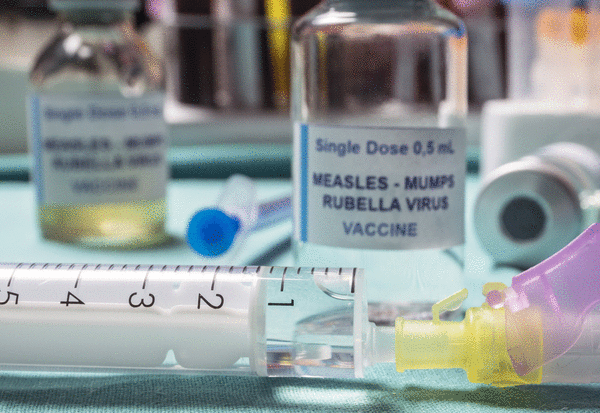
The measles vaccine, rather than being its own entity, is generally included in an MMR shot that also protects against mumps and rubella.
Dr. Eric Wargotz, president of the Maryland State Medical Society, told The Sun on Monday that the MMR vaccine is generally administered twice: once as an infant and again between the ages of 4 and 6 years old. Two doses of a measles-containing vaccine, he said, are considered strong enough to protect a person for life.
“The measles vaccine’s tried and true,” Wargotz said. “And we shouldn’t take the recommendations lightly.”
Advances in medical science and the proliferation of vaccines led the World Health Organization to declare measles “eliminated” from the United States in 2000. Eliminations are often confused with eradications — whereas the former involves no cases in a country, the latter is global. The only human disease that has been eradicated is smallpox.
But despite decades of sustained resistance, measles has popped up in the United States multiple times, mostly among unvaccinated Americans who travel to other countries. When infected people go into communities where others are unvaccinated, the disease can spread rapidly. Wargotz said more than 90% of people who are unvaccinated and come into contact with measles will become infected by it.
According to the Johns Hopkins Bloomberg School of Public Health, there have been more than 1,850 confirmed cases of measles in the U.S. this year — with large outbreaks in South Carolina, Florida, Utah and Texas.
Campbell said the concern is not as big in Maryland, where more than 96% of kindergartners were reported as vaccinated last year.
However, because the statewide average doesn’t represent every area equally — meaning the 96% figure does not equate to 96% of schoolchildren being vaccinated in each county — there are potentially places in Maryland where the risk is much higher.
When there are places that are under-vaccinated, Campbell said, “it doesn’t really matter about the rest of the community.”
_____
©2026 Baltimore Sun. Visit baltimoresun.com. Distributed by Tribune Content Agency, LLC.









Comments