Toxic mushrooms sicken 35, kill 3 in California outbreak. 'This hasn't stopped'
Published in Health & Fitness
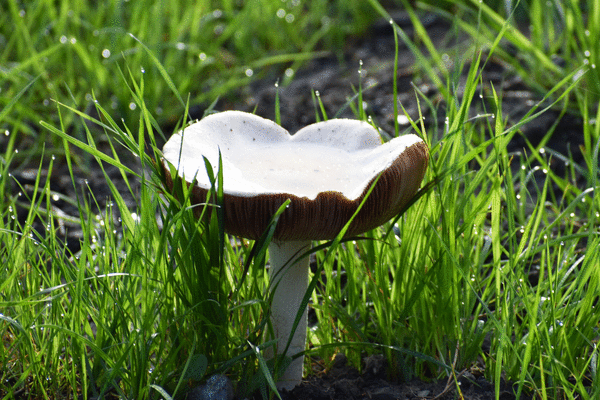
A total of 35 children and adults have fallen ill in California in the largest outbreak of mushroom poisonings in years, according to the California Poison Control Service.
The sickened Californians apparently ate foraged poisonous death cap mushrooms — scientific name Amanita phalloides — after mistaking them for “familiar edible varieties,” officials said.
“This hasn’t stopped,” said Dr. Rita Nguyen, assistant state public health officer at the California Department of Public Health, at a press briefing Wednesday. “This is an ongoing outbreak.”
Three people have died from eating a deadly variety of mushroom, officials said. Patients who have fallen ill from eating poison mushrooms range in age from 19 months to 67 years.
It’s the largest reported outbreak in California in at least the past 26 years. It’s probably the largest such outbreak in state history and in the United States, experts said.
Fourteen people were sickened in a 2016 outbreak in California. The poison control service normally sees zero to five cases a year of poisoning from consuming death cap mushrooms, experts said.
Mushroom poisoning outbreaks have occurred in Monterey and San Francisco areas since Nov. 18, according to the California Department of Publish Health.
The most recent case occurred Jan. 4, Dr. Craig Smollin, California Poison Control Service medical director for San Francisco, said during the briefing.
People have been hospitalized in Alameda, Contra Costa, Monterey, San Francisco, San Luis Obispo, San Mateo, Santa Clara, Santa Cruz and Sonoma counties, though they may not have originally found or eaten the mushrooms in those counties.
But experts said the risk is statewide.
“The mushrooms can grow all over the state,” Smollin said. “There is no ‘safe’ area where these mushrooms are not known to grow.’
Death camp mushrooms also grow in Oregon and Washington, and as far south as Los Angeles and San Diego.
Officials speculated that heavy rains this winter are producing more death cap mushrooms than normal, particularly in Northern California.
The mushrooms can cause severe liver damage, potentially requiring transplants or causing death. Three patients have required liver transplants in the current outbreak.
“There is no amount of Amanita Phalloides that would be considered ‘safe,’” Smollin said. “A single bite of the mushroom could cause significant liver injury and potentially death.”
What are death cap mushrooms?
Death cap mushrooms are easily mistaken for safe, edible varieties, since they share a similar appearance, the California Department of Public Health said.
Cooking, boiling, drying or freezing do not make the mushrooms safe to eat.
“There’s no cooking of the mushroom or freezing of the mushroom that would detoxify it,” Smollin said.
Death cap mushrooms also don’t give any warnings when eaten, and the first symptoms may not develop for 12 to 24 hours after they’re ingested, he said.
“You’re not going to be able to taste it and say ‘oh that tastes terrible, it must be poison,’” Smollin said.
Should you eat wild mushrooms?
The experts say no.
“People can be fooled,” Dr. Rais Vohra, medical director of the Fresno/Madera Division of the California Poison Control Service, said. “They do look like other edible mushrooms, which gets people into trouble.”
He advised people to buy their mushrooms at grocery stores and farmer’s markets rather than foraging for them.
“It can be very hard even for experts to tell the difference between poison mushrooms and not,” Nguyen said..
What are common symptoms of mushroom poisoning?
According to the state poison control system, symptoms of mushroom poisoning include:
• Abdominal pain
• Cramping
• Diarrhea
• Death
• Liver damage
• Vomiting
Who is at risk of getting sick?
If you eat foraged mushrooms, you’re at risk, experts say.
Officials also warn being poisoned by foraged mushrooms is common among immigrant communities in the United States. Death cap mushrooms may resemble edible mushrooms found in Central America, experts said.
“The mushrooms here are different from the ones at home,” Nguyen said.
Death cap mushrooms also may be found growing among edible mushrooms, Dr. Cyrus Rangan, a pediatrician and medical toxicologist with the California Poison Control Service, said.
“They can look alike and taste alike,” he warned. “If you don’t have formal training, don’t go out foraging for mushrooms, because you never know what you’re going to find.”
What to do if you eat poison mushrooms
If you’re concerned that you or another person has eaten a poisonous mushroom, call the poison control hotline at 1-800-222-1222 or 911.
Symptoms may not appear for 12 to 24 hours, but can become severe quickly, leading to liver damage or death.
____
©2026 The Sacramento Bee. Visit at sacbee.com. Distributed by Tribune Content Agency, LLC.









Comments