Reductions in federally recommended childhood vaccines put Minnesota health officials in a bind
Published in Health & Fitness
Federal health care officials on Monday cut the number of vaccines recommended for every child, reaffirming the need to immunize children against 11 infectious diseases such as measles but leaving families to decide whether to pursue flu shots and others.
Physician groups reacted negatively, calling the change a scientifically unsupported decision that would put children’s health at risk. The unprecedented reduction, coming without formal guidance from a panel of federal vaccine advisers, puts Minnesota in a bind. State health authorities must decide whether to break with federal guidance and offer conflicting advice to Minnesota families about which vaccines their children need and which ones are required before starting school.
U.S. Deputy Health Secretary Jim O’Neill signed a memo reducing the nation’s pediatric vaccine schedule based on what he described as a “comprehensive scientific assessment,” bringing the U.S. in line with 20 other developed nations such as Denmark. President Trump had ordered the review in December, and the results matched the long-standing skepticism that Health Secretary Robert F. Kennedy Jr. had expressed over vaccine safety.
“This decision protects children, respects families, and rebuilds trust in public health,” Kennedy said in a statement.
The Minnesota Department of Health can issue contradictory recommendations, as it did last fall when its top doctor issued a standing order allowing pharmacists to offer unrestricted access to COVID-19 shots to all people six month of age and older. Federal authorities at the time had withdrawn a formal recommendation and advised families to talk with their doctors about COVID-19 vaccinations.
Dr. Brooke Cunningham, Minnesota’s health commissioner, said the old pediatric schedule was based on “decades of rigorous scientific evidence” and that the federal switch was “highly concerning.” She added that Minnesota will assess the impact of the federal changes and offer next steps regarding its vaccine recommendations.
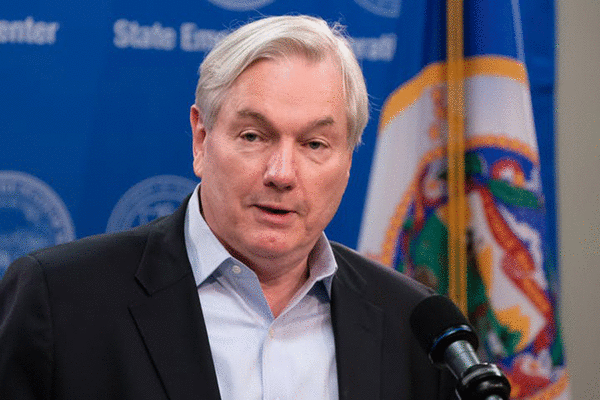
Minnesota should continue to follow the advice of professional medical groups such as the American Academy of Pediatrics that recommend vaccines based on scientific research, said Michael Osterholm, director of the University of Minnesota’s Center for Infectious Disease Research and Policy.
Osterholm called the federal reduction “radical and dangerous” and said it was made without a transparent review of scientific data. About 280 children died in the U.S. during the last influenza season, he noted.
“This wildly irresponsible decision will sow further doubt and confusion among parents and put children’s lives at risk,” he said.
Osterholm last year co-founded the privately funded Vaccine Integrity Project to counter any vaccine messaging coming from Kennedy’s federal health agency that was based on ideology rather than scientific data. Critics counter that the old U.S. vaccine schedule was overly broad, exposing children to even mild side-effect risks, and the new schedule only recommends shots deemed essential.
The new federal schedule recommends pediatric vaccinations against: diphtheria, tetanus, pertussis (whooping cough), Haemophilus influenzae type b, pneumococcal disease, polio, measles, mumps, rubella, human papillomavirus (HPV) and varicella (chicken pox).
However, it cuts the recommended doses of HPV vaccine from two to one, and urges families to talk with their doctors and decide on their own whether to immunize their children against rotavirus, COVID-19, influenza, meningococcal disease, hepatitis A, and hepatitis B.
O’Neill’s memo said the switch maintains insurance coverage for the entire group of vaccines.
The Minnesota Medical Association said in a written statement that it is “deeply concerned” by the federal change and its potential to “add unnecessary confusion and uncertainty around vaccines that have been shown to be both safe and effective.” The organization is the largest advocacy group for Minnesota’s doctors.
Already, Minnesota’s vaccination shield has weakened. While the measles vaccine is still recommended, unproven concerns about autism risks have resulted in more families seeking exemptions. Minnesota once had one of the highest measles vaccination rates for children in the U.S., but its rate has slipped to one of the lowest.
The current influenza season is hitting children harder, contributing to 176 school outbreaks in which at least 10% of students are out sick. But only about one in five Minnesota children and teenagers have received flu shots this winter.
Minnesota has its own vaccination schedule, requiring families to immunize their children against 13 infectious diseases or receive formal exemptions to the shots before they can attend public, private or even online schools.
The state’s current ready-for-school schedule breaks with the new federal guidance in requiring children to be vaccinated for hepatitis B and most forms of meningococcal disease. The schedule recommends other shots, including to protect against influenza and COVID-19, but does not require them for children attending school.
________
©2026 The Minnesota Star Tribune. Visit at startribune.com. Distributed by Tribune Content Agency, LLC.







Comments