
Review: 'EPiC - Elvis Presley in Concert' is the real return of the King
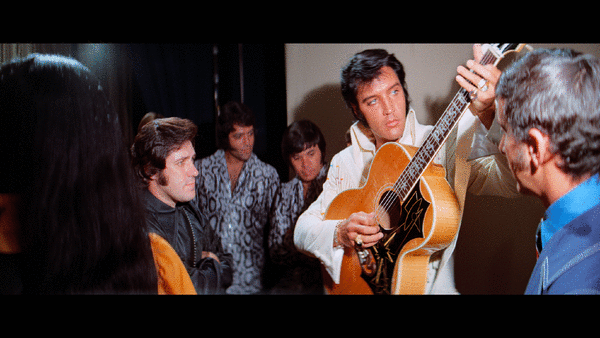
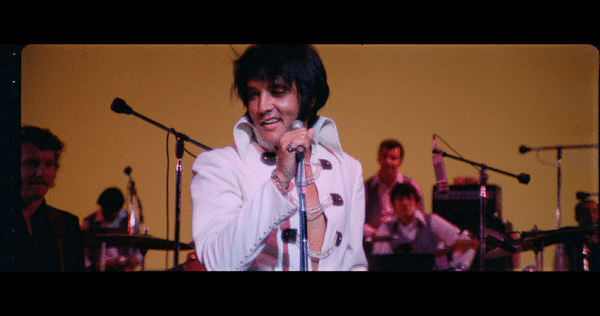


It's true that gods once walked among us -- sometimes, as we now know, in Las Vegas. By 1969, one such exalted being, Elvis Presley, had enjoyed a cloudburst of early stardom on Sun Records and world-conquering renown on RCA-Victor; then he did a hitch in the Army and endured a yearslong sojourn in Hollywood, where he was compelled to appear in movies that ranged from not-bad to quite bad indeed. Then, in 1968, he made a resounding return to music with a celebrated comeback TV special. This led to his manager, the devious Colonel Tom Parker, steering him into a seven-year residency contract with the International Hotel in Las Vegas -- a document that required Elvis to play two shows every day for two months of the year, for a fee of $100,000 a week. (This exhausting gig was one of the Parker-engineered things that prevented Elvis from ever performing overseas -- one of his dreams -- because Parker, a Dutch illegal immigrant, feared that if he went out on an international tour with his client, he wouldn't be able to reenter the U.S.)
Elvis' Vegas years have long been a target of critical scorn among casual Elvis watchers. Everything about them -- the tinted shades, the gaudy jumpsuits, the spangled capes, and overabundance of rings and bracelets -- was pure rube. There was also the dyed hair and the monster sideburns, and, as the years rolled on, an unmistakable weight problem and what clearly seemed to be a serious drug addiction as well.
But as director Baz Luhrmann shows us with the new documentary, "EPiC: Elvis Presley in Concert," in his early Vegas years, before the rot set in, Elvis was a masterful performer, deploying his supple baritone to captivating effect and radiating star power with every blue-eyed smile and air-punching karate chop. (The back-in-the-day Presley fans we see in the film, then staring down middle age, were still in high spirits, too -- at one point we watch Elvis lifting up a bra that's been tossed onstage and draping it over his head.)
The movie is a painstakingly restored and edited distillation of outtakes -- most of them previously unseen -- from two vintage Presley documentaries, "Elvis: That's the Way it Is" (1970) and "Elvis on Tour" (1972), plus an assortment of 8mm and 16mm footage, and nearly an hour of audio from early in his career when he was peppered with media insults (newspaper headline: "Elvis Presley Is a No-Talent Performer") and ritual humiliations (one TV variety show manipulated him into singing his hit "Hound Dog" to an actual basset hound). Asked by a reporter if he's learned anything from the critical drubbing he so often receives from the mainstream press. Elvis' reply is: "No, I haven't."
Luhrmann, who also cowrote and directed the scintillating 2022 biopic "Elvis," starring Austin Butler, has done a phenomenal job of cleaning up and color-correcting the footage he exhumed (with the help of Peter Jackson, who worked similar wonders in his sprawling Beatles doc "Get Back"). Luhrmann's images look as if they might have been shot yesterday, not 50 years ago. And he's polished the audio so expertly that the many concert and rehearsal sequences sound as if we're taking them in at a table in the big room at the International Hotel or in a crowded backstage band run-through. Elvis' crack backup group -- which includes the godlike James Burton on guitar, Ron Tutt on rock-solid drums, and various horn and string players as well as two groups of backup singers -- highlight Elvis' extraordinary ability to settle comfortably into virtually any genre of music. He's completely at home with Black R&B ("That's All Right," his first single), pure gospel ("How Great Thou Art"), country, of course ("I Can't Stop Loving You"), and folk music, too ("All My Trials"). Also included in the song lineup are as many of the indelible Elvis hits ("Burning Love," "In the Ghetto," "Suspicious Minds") as can be fit into a fast-moving 90-minute film.
"EPiC" does an admirable job of burnishing the legacy of a key American musician, a man who changed the world in substantial ways. Luhrmann's film allows us a glimpse of what lay beyond the tabloid trappings that have sometimes obscured his art. "An image is one thing," he says here. "A human being is another."
To find out more about Kurt Loder and read features by other Creators writers and cartoonists, visit the Creators website at www.creators.com.
----
Copyright 2026 Creators Syndicate, Inc.










Comments