'Mixed Marriage Project' charts decades of Black-white marital unions in Chicago
Published in Books News
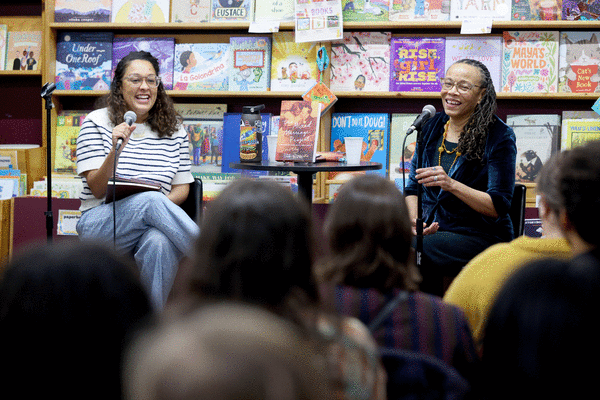
CHICAGO — As the year moves us closer to the months that we pay homage on Mother’s and Father’s Day to those who birthed us, nostalgic memories inevitably arise.
In Dorothy Roberts’ latest book, “The Mixed Marriage Project: A Memoir of Love, Race and Family,” readers glimpse nostalgic moments from the sociologist and law professor’s family, with her parents at the center. An academic at the University of Pennsylvania who directs the Penn Program on Race, Science and Society, Roberts takes us through her childhood growing up in Kenwood as a biracial child of a white father, the son of Welsh and German immigrants, and a Jamaican-born mother turned Liberia citizen and student at Roosevelt University working toward her Ph.D.
The couple conducted decades-long research on Black people married to white people — research that began when Robert Roberts was a sociology student at the University of Chicago and would become the focus of his career at Roosevelt University as an anthropologist. Nearly 500 interviews with couples from 1937 through the 1980s, the breadth of which daughter Dorothy sorts through over a season, her father’s life’s work encapsulated in 25 large cardboard boxes. Through that material, Dorothy shines a light on the lives of interracial coupledom — those “who had dared to cross Chicago’s racial boundaries at the turn of the 20th century … through the start of the Great Migration, the aftermath of WWII, and the seismic changes of the Civil Rights Movement.”
By following the interviews in her late father’s unpublished work through the years, she learns more about herself and her family. Roberts said her father had book contracts to publish his work, but that goal never materialized. Roberts, with several published books to her name, said if it wasn’t for her dad’s research left to her and her twin siblings, she never would have thought to write a memoir. She said her father’s work grounded her to do the task.
“I didn’t probe it (his research) for almost a decade… so many boxes and they’re filled with all sorts of papers from a professor’s whole career— teaching notes, newspaper articles and drafts — it’s a big task,” she said. “When I discovered the interviews, everything became more exciting.”
Over the course of the book, Dorothy Roberts gives us data and statistics to contextualize the details revealed in the relationships that were documented. We see how, while the research continues, Robert Roberts finds a community of Black and white couples and then builds his own coalition of them as friends to him and his family. St. Clair Drake, co-author of “Black Metropolis: A Study of Negro Life in a Northern City,” was a close friend of Robert Roberts.
We learn stories of individuals who had non-monogamous open marriages; others who had to keep their unions secret for fear that a colleague would snitch to their employer and they’d lose a good-paying job; and if illness led to hospitalization, their spouse couldn’t visit for fear they would not be treated well. Robert Roberts and his wife Iris White chronicle much, including Black servicemen who came back from the war with European brides.
“When I go out with my husband, people stare at us. They also stare in Germany, but that is only out of curiosity. In the United States, it is out of hate,” an interviewee named Mrs. Elroy said.
Dorothy Roberts goes on to write, “I recall reading that the federal government censored magazine stories about Black troops dating white women while stationed in Europe, fearing that photos of interracial socializing would spark an uproar back home.”
Dorothy Roberts spoke with the Tribune about the details of her father’s project, which was investigating interracial marriage as a potential means to dismantle Chicago’s racial caste system. The interview has been edited for length and clarity.
Q: What does it mean to put this book out now, when narratives are being erased and white supremacy is in the fore?
A: To tell that history of racism and white supremacy in America is so important — all the barriers to opportunity, violence against Black people, I talk about in the book. The response to the Black migration into Chicago from the South was vicious. If we don’t know that history, then it looks to children and people who want to believe that they’re superior to Black people, that it’s natural for Black people to have a lower status. That’s the lie of race from the very beginning. The impact is still continuing to this day. What are we going to do about it? This is the question my father had: What are we going to do to end this racial caste system in America? He felt that maybe more interracial marriages would end it. I disagree with that, but reading his notes, I realized that there is this important question of how do we love each other as equal human beings in a racist society? I do think love has something to do with it, but those interviews show nobody transcended it. You were caught up in it. That’s one reason why I think studying interracial relationships helps us understand racism. We’re living now where racial hatred is so extreme. When people are standing up and applauding racist statements, it’s terrifying.
Q: Had your dad not been doing this research, would you and your sisters have had the lives you had?
A: My father, being an anthropology professor, would tell us about his research, bring it to our home. We were very much enmeshed in his project. That was very influential, but also influential was their perspective on humanity. They emphasized that we have a common humanity. There is only one human race. We’re equal human beings. We should be respected equally. That was a message my parents taught my sisters and me very deliberately. We weren’t to believe the lies about racial divisions and racial hierarchy. We should be aware of it, that there was white supremacy and racism in America, but we were to contest that view of any race being superior to another and we were citizens of the world. My father influenced me a lot to be a scholar and an activist against racism. So he definitely contributed to the Black woman I am.
Q: If no one takes anything else from the book, but one thing, what would it be?
A: The important task of figuring out what it will take to love each other as equal human beings in a racist society. I think that’s a question that I’ve asked throughout my entire career, that my father was asking, that comes up in the interviews.
©2026 Chicago Tribune. Visit at chicagotribune.com. Distributed by Tribune Content Agency, LLC.








Comments