Why Olivier Norek's 'Winter Warriors' is a 'timely' book, says its translator
Published in Books News
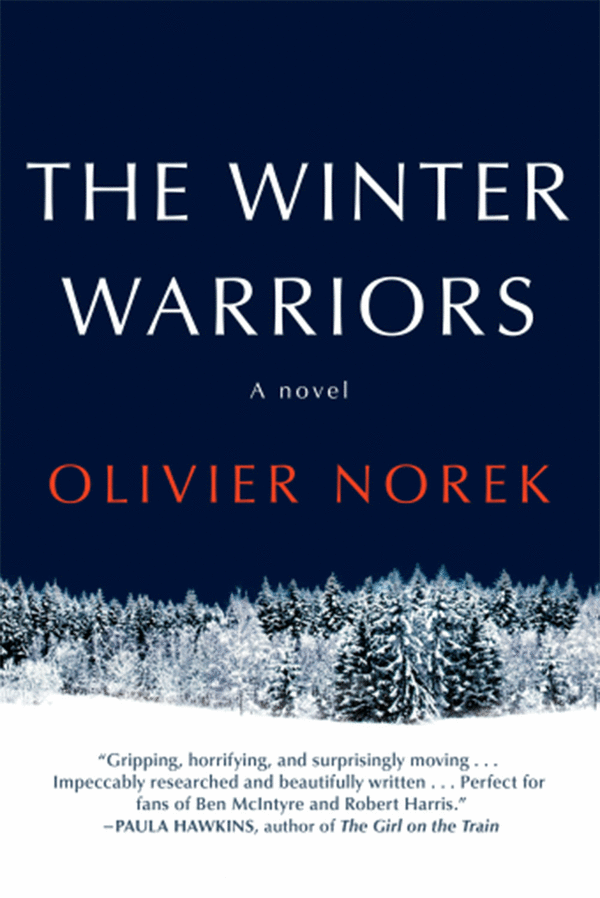
In the midst of a brutally cold winter, an unwelcome armed force invades a peaceful community, bringing panic, turmoil and brutal violence. And despite overwhelming odds and unconscionable cruelty, the locals surprise the world with their resilience and refusal to bow to injustice.
The above description might sound like current events, but it’s referring to a book in stores this week about a real-life battle that took place more than 85 years ago.
Set in 1939, “The Winter Warriors,” a novel by author Olivier Norek and translated from the French by Nick Caistor, tells the story of the Soviet Union’s invasion of Finland, an event known now as the Winter War.
A small country that had only achieved independence 22 years earlier, Finland was pounded by 20 million artillery shells over 100 days by a massive Red Army force that came with columns of tanks and much greater firepower. The tiny nation’s entire supply of artillery shells only equaled the number the Soviets could fire in a single day, according to Norek.
The Finns, scrambling to assemble a defense despite not having enough guns or uniforms for the men they could muster, met a vastly larger Soviet force no one thought could be stopped, much less held back for months. During that time, a self-effacing marksman named Simo Häyhä, a sniper so grimly effective he was known and feared as the White Death, would prove invaluable to the Finns’ ability to hold off the Soviet advance.
Drawing upon archival materials, interviews and histories to provide an accurate accounting of what happened, Norek, a former French police officer turned crime writer, aims to tell this powerful story with clarity, simplicity and accuracy. Or as the introductory author’s note states, “None of the battle scenes has been invented. No act of bravery has been exaggerated.”
When I first read an early copy in October, the story had strong echoes of Russia’s 2022 invasion of Ukraine. But there’s also a timelessness to David vs. Goliath stories, and that may account for some of the book’s understated power.
Interested to learn more, I reached out to the book’s translator, Nick Caistor. Located in the U.K., he responded to my questions via email.
Q. Would you share your impressions of Olivier Norek’s novel?
I had translated four of his books previously, but was impressed here by Olivier’s adventure into very different territory, and the depth of his research into such a unique story. Translating it was a real pleasure.
Q. What were the challenges of translating this book?
Olivier tried successfully to get the reader to understand how a gentle, pacific young man could come to kill more than a thousand people, and so capturing the tone and empathetic portrayal not only of Simo Häyhä and his colleagues but also of the often-bewildered Russian soldiers was essential.
Q. Your translation feels both accurate to its time and contemporary, too. How did you achieve that?
Yes, I made a great effort to keep the English as neutral as possible – this was greatly helped by the fantastic precision of Olivier’s original French.
Q. What’s something about the book and your translation you’d like people to know?
The book, of course, is a very timely reminder of what we are witnessing right now – the dreadful consequences of the blind belief that might is right, however many people’s lives are destroyed.
Q. What are some other books you’ve translated that you suggest to readers?
Of course, I very much enjoyed Olivier’s Captain Coste trilogy: police thrillers set in the tough, violent outskirts of Paris. And before that, I translated a thriller trilogy by the Spanish writer Juan Gomez Jurado that has been made into a TV series in Spain. Among the historical novels I’ve done recently, I admired both the Argentine writer Andres Neuman’s “Traveller of the Century,” and Isabel Allende’s “A Long Petal of the Sea.”
Q. What are you reading now?
I always have several books on the go: Currently, “The Magician” by Colm Tóibín, and because of that, “The Confessions of Felix Krull, Confidence Man” by Thomas Mann; Georges Simenon’s “The Cat” in a new translation by a friend; and in non-fiction, “Paris 1919” by Margaret MacMillan—a description of how the powerful nations carved up the world that seems very pertinent today.
Q. What’s something – a fact, a bit of dialogue or something else – that has stayed with you from a recent reading?
In “The Magician,” the wonderful way Tóibín imagines the effect that listening to a piece of music had on his imagined Thomas Mann: a brilliant description of the effect a non-verbal art form can have.
Q. Do you have a favorite bookstore or bookstore experience?
In Norwich, England where I live, there’s an independent bookstore that has everything: knowledgeable and friendly staff, lots of readings and other events, and even a small publishing house for books by local authors.
Q. If you could ask your readers something, what would it be?
To enjoy reading as many different kinds of books as possible—especially translations, which can open up new worlds for you.
©2026 MediaNews Group, Inc. Visit ocregister.com. Distributed by Tribune Content Agency, LLC.











Comments