What's like got to do with it? Sara Levine on the art of 'difficult' women
Published in Books News
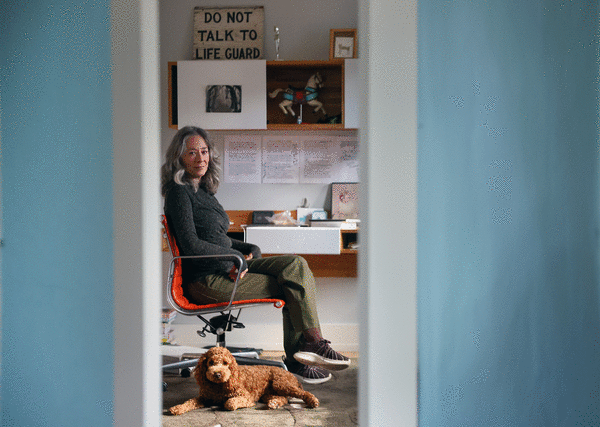
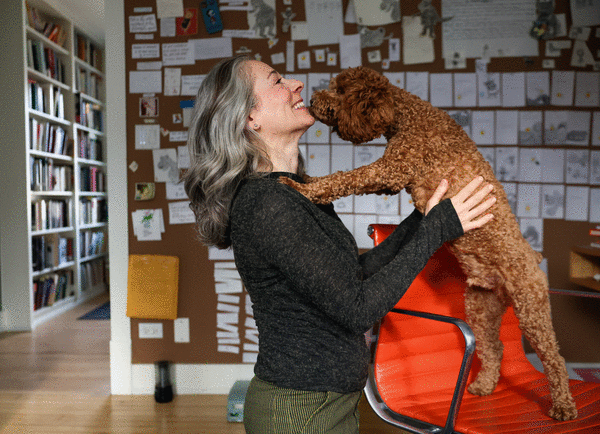




CHICAGO — The other day the author Sara Levine asked me to meet her at a dog beach in Evanston. I didn’t have a hard time finding her. She said she would be wearing an orange cap and she was. The problem — and here is where I felt as though I slipped suddenly into a Sara Levine novel — was that the beach was padlocked and Levine arrived without her dog. Also, at the very moment we met, Northwestern University’s Emergency Notification System began to boom out a test, which sounds like a tornado siren with the addition of a deep male voice imploring you to stay calm, no emergency is occurring.
In a Sara Levine novel — and so far, she’s only written two in 25 years — the heroine would likely take that as a sign, like some kind of cosmic irony that an emergency was definitely occurring.
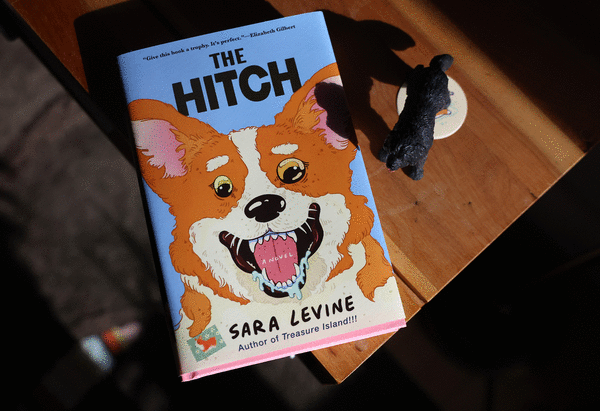
Levine suggested we meet at a dog beach because “The Hitch,” her new novel — her first since “Treasure Island!!!,” Levine’s beloved 2012 cult classic — centers on a dog attack in Evanston that leaves a corgi dead and a 6-year-old boy certain he’s possessed by the dead dog’s soul. But like “Treasure Island!!!,” it’s also funny and unhinged and so relatable you wonder if Levine, who chairs the writing department at the School of the Art Institute of Chicago, has been slowly making a case for the lost art of the literary comedy novel.
Indeed, Levine’s characters are so queasily recognizable, this wasn’t even the first time in recent months that I felt as if I had stepped unwittingly into a Sara Levine story. By some twist of completely off-the-wall fate, the same week I was reading an early copy of “The Hitch,” I was bitten several times by a dog. Seriously. It was bonkers. I was walking through a restaurant patio on the North Shore and a dog launched itself onto my calf like I was sirloin. My first thought: Why me? I felt like that guy in a movie who hasn’t yet become a werewolf but all of the neighborhood dogs know he’s a werewolf and start barking. And yet, it wasn’t even the dog attack that reminded me of Levine — it was the way diners glared at me, as if I interrupted their burgers. I felt a weird shame.
When I told Levine this — and that I was not that excited to hang out at a dog beach anyway, considering — she told me about the attack in Evanston that led to “The Hitch.”
“So I was walking my dog by (Evanston Township High School) and he’s a little goldendoodle and this dog — no leash, but with a pink collar — suddenly appears in the alley. It’s a pit bull. I’m not anti-pit bull and I don’t mean to stereotype. She’s a little pit, but pits do have strong jaws and she attacks my dog. This was 2020. I have these horrible voice memos with my dog wailing. Anyway, now I’m in a crisis, and what am I doing to do? I’m terrible in a crisis. I also don’t want to hurt the other dog. If I let my dog off the leash he might get hit by car, so I’m frozen there, and I’m also trying to separate them, but I’m also thinking I can’t kick this dog — even with what’s happening in front of me, I couldn’t do it. The house on the corner has a Newfoundland standing in the yard, and the woman at the house sees me. She tells me to run for her car, but it’s actually a truck with a flatbed. She grabs a shovel and starts swinging at the dog, and my legs at this point are jelly but we make it into the flatbed and the pitbull is just launching itself at us, just like Cujo. My first thought was, Did I make this happen? I had started writing about a dog, so: Did I bring this on? That’s nutty, but it’s how you feel at times when things happen.”
Levine’s novels feel right for early January, for this gray period when we’re all expected to reassess our lives, make changes and emerge in the spring with clearer heads. The way certain works of fiction can do, her books could double as perverse self-help, starring heroines who go out of their ways to show how not to conduct your life. Her writing voice, sardonic, breezy, chimes with Joy Williams and Donald Barthelme, but it’s hard not to hear “Curb Your Enthusiasm” and even “The Office” — that nexus where unraveling people lacking self-awareness stumble across empathy.
The heroine of “Treasure Island!!!” — a 25-year old clerk of a “pet library” — reads Robert Louis Stevenson’s legendary adventure and quickly reassess her narrow timid life, deciding there and then to live by a credo culled from Stevenson: Boldness, Resolution, Independence, Horn-blowing. But by the end, she kills a parrot and is so obsessed with “Treasure Island,” family and friends stage an intervention between her and the novel. The heroine of “The Hitch” could be related, if only tangentially: Her name is Rose Cutler and she is an Evanston yogurt company CEO (as well as “antiracist, secular Jewish feminist eco-warrior”). Rose is also perilously up her own keister. She does not want children (“not for one atom-spitting second”) but she is never so shy with opinions about the way her brother and sister-in-law raise their own kid. When they go on vacation, Rose jumps at the chance to play aunt for a week — which is when the dog attack occurs, her nephew decides (cheerfully) the dog’s soul leapt bodies, and worse.
Rose is a micromanager, and lousy in a crisis. It spoils nothing to say the closest she gets to enlightenment is a brief ah-ha: “Sometimes my mind gets active as a prairie dog and I build elaborate tunnels underground, room after room of judgement and justification.”
The writer Roxane Gay— who once included Levine’s work in an essay on unlikeable women characters (“Not Here to Make Friends”) — said that just after she landed her own imprint (Roxane Gay Books) at Grove Atlantic, she sought out Levine and asked what she was working on: “It had been some time since ‘Treasure Island!!!’ and Sara did not disappoint. The writing voice I fell in love with was still there, but she had grown, and though this Rose character was older, you’re reminded that sometimes we don’t really outgrow our lesser selves — that sometimes we just learn to live with them, you know?”
Levine told Gay that not every reader is a fan of unlikeable woman characters. She told Gay about the (smallish) subset of Goodreads reviewers who describe her women as “utterly unlikeable” and “irredeemable.” Gay told me, “I don’t know why writers are so willing to expose themselves to Goodreads. Some people have a parasocial relationship with book characters, and it meets a puritanical streak where people decide they don’t like a character who is a ‘bad person,’ forgetting flawed people exist. Rose is convinced she knows the right way to do things and her ethics are in the right place — bless her heart.”
Levine’s sweet spot is what literary scholars have long called “unreliable narration” — she even taught a class at Brown University (where she got her Ph.D. in English) on the topic. Levine said: “My father’s a psychiatrist and he tells me we’re all unreliable narrators. But in a novel, it means there’s a deficit of comprehension from the character telling the story and that deficit is part of the story. But when I hear from people who hated ‘Treasure Island!!!,’ often they think I’m the narrator. My feelings get hurt. But maybe they don’t understand that gap. It took me a long time to realize it.
“Or maybe ‘unreliable’ is the wrong term for this. Should I just refer to my characters as ‘difficult women’? No, maybe not — I was at a party recently and told someone I write about ‘difficult women’ and this person said, ‘OK, wait, what do you mean by difficult…?’”
Horror novelist Paul Tremblay — whom Levine consulted to get a sense of how to handle the possession part of “The Hitch” — is a big fan of Levine, and included “Treasure Island!!!” on his ballot for the New York Times poll of the best books of the 21st century. Part of that appreciation, he said, is “how she is reviving an old tradition of first-person a-hole narrators. Think of ‘Confederacy of Dunes,’ or the novels of Sam Lipsyte, except publishers don’t like books by women who go there. Readers are getting more literal, I think. It can feel like a risk to just include any moral uncertainty in a novel now. I hear this especially from younger readers, who want to know what the moral is, and the thing is we are not writing to bestow morals but explain what it means to be human, which can be dark and uncomfortable — all words I would use to describe Sara’s books.”
You could also argue the long afterlife of “Treasure Island!!” — a perpetual word-of-mouth bookseller favorite, handed down to friends who can relate to spiraling exhaustion — is a mirror of contemporary America. Or at least indie culture: Rose Byrne is likely to grab an Oscar nomination soon for “If I Had Legs I’d Kick You,” as a stressed mother who makes a series of bad decisions; she’d slide neatly into Levine’s books. Levine is one of your favorite literary writers’ best-kept secrets: Blurbs for “The Hitch” came from Elizabeth Gilbert, Rumaan Alam, Adam Levin and Chicagoan Michael Zapata, who told me: “Blurbs can be blurby, but the one I wrote was truly sincere.” “Treasure Island!!!,” which has yet to be adapted to TV or film (but probably will be one day), has already been developed (and dropped) by Natalie Portman and James Franco.
Levine sounds almost naive about the depth of this love.
She told me another established screenwriter got pretty far with “Treasure Island!!!” but then appeared to bail and never signed their contract; Levine never heard from the woman again. One day, during a class at SAIC, she projected an email exchange between her and the writer as an illustration of professional etiquette. “I had to explain how she opted out of the project, and as students do, one took out his phone and googled the woman’s name and a minute later replied, ‘Oh, Sara, no — that woman had died. That’s probably why she never got back to you.’”
Sounds like a Sara Levine story, I said.
“It does?” she asked.
To be frank, the biggest disappointment about Sara Levine is that she’s not nuts. I anticipated erratic and flighty and I got calm and rational. James McManus, author of the poker memoir “Positively Fifth Street,” who taught alongside Levine for 25 years, said: “She is as sane and responsible an adult as they come. In fact, (SAIC) wanted her to move into even more active leadership roles, but that can be a time suck, creatively.”
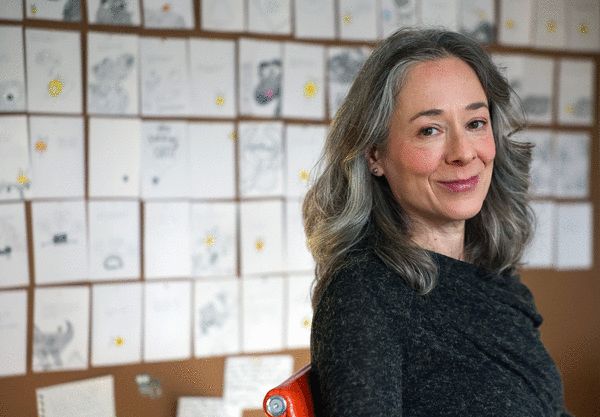
She has long gray hair and large cartoon eyes and comes across as naturally funny. She said people do expect her to be a wacko. “Someone introduced me at a party recently as ‘one of the most sane people’ at the Art Institute, or maybe it was ‘the least insane.’”
Levine, who is 55, grew up outside Cleveland and wrote a couple of plays that were produced when she was still a teenager (one professionally, for a Cleveland theater group). She went to Northwestern for theater only to find her way to creative writing. She then bounced from Brown to the Writers’ Workshop at the University of Iowa to SAIC, which she joined in 2000. She describes herself as “ornery” that entire time. She threatened to drop out of Brown, refused to start a novel, moved to Iowa to teach non-fiction, only to decide, “‘I don’t want to live here, I don’t want to teach this my whole life’ — it was like looking into my coffin.”
She found she was more interested in “‘hysterical’ voices, the more obstreperous personalities of fiction.” “Treasure Island!!!,” which she began to see if she could write a novel after years of short stories and nonfiction academia, took a decade, but she found that she was more ambitious than she knew. She also learned she had a knack for describing everyday suburbia with cutting precision: “The Hitch” is filled with Evanston parents who over-schedule kids so much you wonder if they “can’t sit still in a room” with children. Doctor’s offices offer “six televisions playing six different channels.” Vast expanses of Illinois contain “a strip of road that featured an abandoned movie theatre, a discount shoe store, and a cemetery bordered by a six-foot high metal fence capped with snow,” as well as a hospital “founded in affiliation with the Evangelical Lutheran Church and rooted in the belief that all persons were created in the image of God, a hospital that had not in the past five years received higher than a two-star Yelp review.”
After “Treasure Island!!!,” she wrote a big sprawling novel titled “Leave It,” a more lyrical and somber kaleidoscope of Evanston characters; she didn’t want to follow one “difficult woman” with a second. She gave it to her agent, but then soon after, she pulled it back and shelved it.
“I was worried I was reinforcing the ‘hysterical’ woman thing, so I wrote something else, but that something else? Other people do that book well. So I have this narrow track. Twyla Tharp talks about knowing your own creative DNA, and that helped me. I’ve always had teachers who said you need to keep growing, you’ve got to keep pushing, that there is a natural aesthetic restlessness where you should never repeat yourself. I really bought into that. But what if it’s helpful to focus on one form and go very deep into only that? Look at Monet, who spent a lifetime painting haystacks …”
“‘Compares self to Monet,’” I interrupted, joking, pretending to jot that in my notebook.
“Oh, and also Nabokov!” she said, laughing. “And of course Jane Austen! Write that down.”
©2026 Chicago Tribune. Visit at chicagotribune.com. Distributed by Tribune Content Agency, LLC.







Comments