States, cities sue Trump administration over new green card restrictions
Published in News & Features
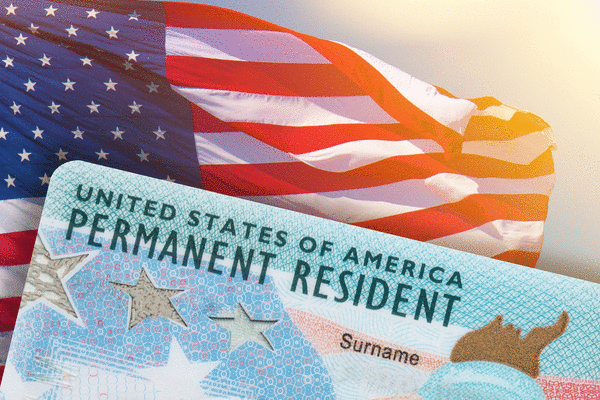
States, cities and counties filed a pair of lawsuits Monday challenging new federal rules that will allow immigrants’ use of safety net resources to be taken into account for green cards and other applications to stay in or enter the country.
The new federal policy goes into effect Friday and broadens the discretion of immigration officers reviewing applications for green cards, certain visas or admissions into the United States, allowing officers to consider enrollment in public benefits, such as housing and food assistance, Medicaid and the Children’s Health Insurance Program, as something called “public charge.”
When officers determine a person could become dependent on government benefits, that “public charge” is a ground for inadmissibility under federal law. Such noncash benefits were previously restricted from public charge consideration under the Biden administration.
The Trump administration rescinded that 2022 policy, arguing that it is protecting taxpayer dollars and expects immigrants to be self-sufficient.
Both lawsuits were filed against the U.S. Department of Homeland Security and the U.S. Citizenship and Immigration Services in the U.S. District Court for the Southern District of New York.
Many mixed-status households are expected to forgo benefits and disenroll from programs, causing U.S. citizen dependents, including children, to lose care and benefits for which they’re legally entitled to receive, experts and state officials say.
In their lawsuit, 22 states and the District of Columbia pointed to DHS estimates that say states nationwide may lose roughly $4.05 billion in annual federal transfer payments for Medicaid and CHIP programs alone. Of that nationwide total, the plaintiffs may stand to lose about $2.2 billion in reduced federal payments.
The states include Colorado, Connecticut, California, Delaware, Hawaii, Illinois, Maine, Maryland, Massachusetts, Michigan, Minnesota, Nevada, New Jersey, New Mexico, New York, Oregon, Pennsylvania, Rhode Island, Vermont, Virginia, Washington and Wisconsin.
Due to disenrollments, states nationwide could lose about $1 billion in the Supplemental Nutrition Assistance Program, or SNAP. Of that, the plaintiff states could lose $575 million in reduced federal payments.
The states argue that the new rules contain many ambiguities and will cause the states to“ultimately be forced to fill the breach” by funding gaps out of their own budgets, leading to “staggering” costs.
Along with losing federal funding due to disenrollments from state programs, public agencies will face administrative costs, the states argue, and as households forgo enrolling in benefits, such as preventative healthcare and nutritional assistance, including school lunches, public health will suffer, leading to an increase in disease prevalence and driving up the costs of medical care, they argue.
In a separate lawsuit, a coalition of cities and counties — New York City; Chicago; San Francisco; Santa Clara County, California; Seattle and King County, Washington — say the new rule is unlawful in reversing “longstanding limits on public charge determinations.” Roughly 1.3 million people, including 600,000 children, could lose care and coverage in those places, the suit argues.
New York City, which led the cities’ lawsuit, estimates it would see 6,000 fewer annual primary care visits.
“The new public charge rule seeks to push immigrant families away from the programs that have kept people fed and healthy for decades,” New York City Mayor Zohran Mamdani said in a news release. “New Yorkers will be afraid to see a doctor or ask for help they are legally entitled to. That fear will not stop at the families that the federal government is targeting. Families who remain fully eligible for benefits will feel a chilling effect and all New Yorkers will pay for it.”
The coalition also argues that children would be forced to withdraw from free or low-cost education programs. It notes that about 19% of Seattle residents and 26% of King County residents rely on such programs.
_____
_____
©2026 States Newsroom. Visit at stateline.org. Distributed by Tribune Content Agency, LLC.






Comments