Judge clears way for civil lawsuit over KKK post in Michigan
Published in News & Features
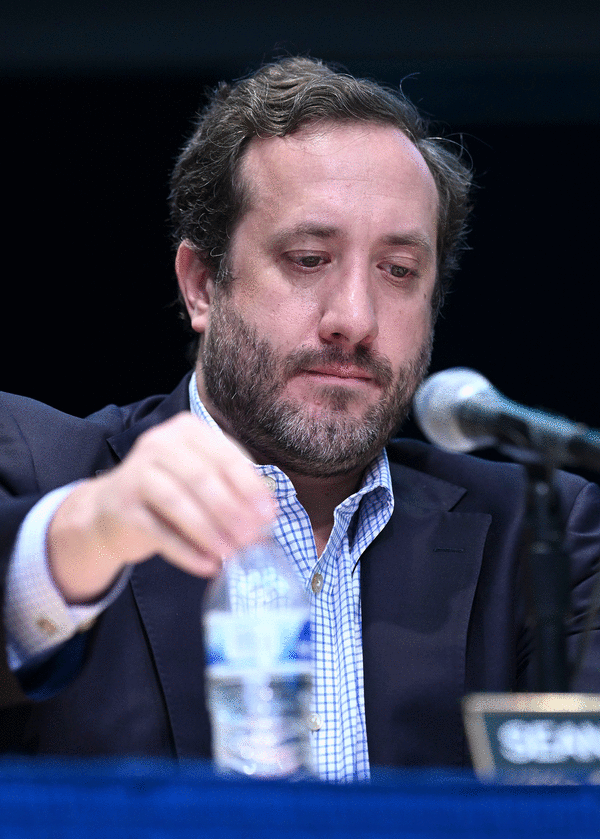
DETROIT — A Wayne County judge on Monday declined to dismiss a civil lawsuit filed by a Grosse Pointe billionaire and school board member who is suing one of his constituents over a social media post.
Judge Kevin J. Cox in Wayne Circuit Court heard nearly an hour of arguments from attorneys for Sean Cotton, an elected trustee on the Grosse Pointe Public School System board, and Kurt Lyons, a 77-year-old retiree who lives in the district.
Lyons' attorney, Julie Hurwitz, sought to have the case dismissed under a new Michigan law designed to protect public speakers from frivolous lawsuits. Lyons accused Cotton of having political views aligned with the Ku Klux Klan in a Facebook group page in March.
Cox, the third Wayne County judge assigned to the case, denied the request.
"There are genuine issues of fact presented on this record, and it would be inappropriate and impermissible under the statute for the court to dismiss the action at this time," Cox ruled from the bench on Monday during a Zoom court hearing.
No date was set for the next hearing in the case.
Two Wayne County judges had already recused themselves from presiding over the controversial case.
The recusals by Catherine L. Heise and Dana Margaret Hathaway, judges in Wayne County Circuit Court, have delayed the litigation for more than 100 days.
Heise and Hathaway each filed their own motion for disqualification for "the appearance of impropriety" in the matter.
Hurwitz had filed an emergency motion in Wayne County Circuit Court seeking an immediate hearing to prevent further delays.
Hathaway was originally assigned the case in April when Cotton sued Lyons, accusing him of defamation and alleging economic damages from the online post. She disqualified herself on June. 2.
The matter was reassigned to Heise, who issued an order on Aug. 3 saying she can't hear the case; it was then reassigned to Cox.
The case between the two men will test Michigan's new Uniform Public Expression Protection Act, which aims to shield public speakers from abusive and frivolous litigation filings used to silence critics.
The measure, which took effect in March, passed with full bipartisan support in Michigan's Legislature as a tool against "Strategic Lawsuits Against Public Participation," or SLAPPs. Michigan was the 39th state to pass the law.
Hurwitz said the statute allows defendants targeted by a SLAPP suit to file a special motion for expedited relief, which Hurwitz did shortly after the lawsuit was filed. That motion can freeze the expensive and time-consuming discovery process while the court determines whether a lawsuit has merit.
Hurwitz is concerned about repeated delays in the case.
Lyons, who has lived in the district for 36 years, said he has never spoken to Cotton before, at a meeting or elsewhere. But the two sparred online on the GPPSS Community Discussion Facebook page, which is private and not an official district page. It has more than 5,400 members.
Cotton's attorney alleged that Lyons crossed the line, "venturing far beyond healthy debate and reasonable discussion" on March 5 when he posted: "The donor's political views align with the Ku Klux Klan."
Cotton, an attorney himself, operates a super PAC called Pointers for Academic Excellence, or PFAE, to which he has contributed more than $1.1 million since 2024. Super PACs can raise and spend unlimited amounts of money to promote a campaign or candidate, as long as they do not coordinate with a party or candidate.
In an interview with The Detroit News in May, Lyons said he meant Cotton when he said donor.
Cotton, who posts under his school board Facebook page Sean Cotton for Grosse Pointe, tagged Lyons and responded within an hour on the group page: "whkh (sic) donor? Me? Are you saying my thpt (sic) political views align with those of the Ku Klux Klan?"
Days after the online post, Cotton's attorney sent a letter demanding an online apology from Lyons. When he didn't get one, he sued, seeking $25,000 or more in damages.
Cotton's lawyer is asking for an injunction requiring Lyons to remove the social media post and publish a statement that what he said was false.
Lyons did not apologize, telling the News that his comments are protected by the First Amendment and by the new Michigan statute. Being the target of a civil lawsuit has been stressful and caused some sleepless nights, Lyons said, but he is fighting the litigation because what he said was truthful and his speech is protected.
"I have every right under the First Amendment of the United States Constitution and the Michigan Constitution and Michigan case law to express my opinions about Trustee Cotton, especially because he is a public office holder representing an electorate, an electorate of which I am part, and OK, so that pretty much says it all," Lyons told the News. "I did not lie."
Cotton, a 1995 graduate of Grosse Pointe South High School, says in the lawsuit that he has committed "substantial resources to combating the evils of racism" and cited two examples.
He said he is a significant collector of African American art, valued at tens of millions of dollars, which he has loaned to the Detroit Institute of Arts for public exhibitions. He also cited a nearly $10 million contribution to finance the production and distribution of a film that tells the story of a young Black artist who overcame the abuse and neglect of his drug-addicted, absentee father.
Cotton, owner of the Grosse Pointe News, has declined interview requests from the News.
_____
©2026 The Detroit News. Visit detroitnews.com. Distributed by Tribune Content Agency, LLC.






Comments