A year after Silverio Villegas González's killing, neighbors say fear remains
Published in News & Features
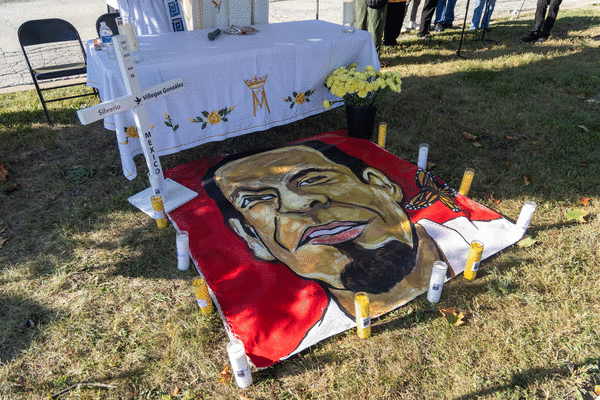
CHICAGO — Exactly one year after Silverio Villegas González was shot and killed by an immigration enforcement agent during a traffic stop, his neighbors returned to the stretch of Grand Avenue in the western suburbs where he died.
But those who gathered in Franklin Park Saturday morning came not only to remember Villegas González. They showed up, Marisela Sandoval said, because the threat facing their community has endured since the gunshot that killed him.
“We haven’t forgotten what happened a year ago,” said Sandoval, 42. “The fear still exists, it just exists in different dimensions.”
Sandoval was among hundreds of community members who attended events marking the anniversary of when U.S. Immigration and Customs Enforcement agents pulled over the 38-year-old shortly after he dropped off his children at daycare. During the confrontation, Villegas González was shot in the neck before his car crashed into a semi truck, officials have said.
At a tearful morning memorial, local leaders said community members are still grappling with unanswered questions about a case they say the government has disclosed little about. Hours later, that same frustration echoed among crowds who flocked to Melrose Park to demand an immediate end to federal immigration enforcement in Illinois.
“We find it very hard today to have to gather in these spaces,” said the Rev. Brendan Curran, a Catholic priest and immigrant rights advocate. “We feel like we have been victims of terror.”
Betty Alzamora led protesters down Mannheim Road Saturday afternoon, her neon green vest bright against a procession of handmade signs and banners. She remembers the day Villegas González was killed and said fears of such violence still keep some of her family members from going out in public.
“I’m filled with rage and grief at the same time,” said Alzamora, a first-generation American citizen. “Days like today are commemorative because they didn’t need to happen this way.”
Since last fall, democratic leaders have pointed to discrepancies between publicly released footage and DHS’s claim that an agent was dragged a significant distance by Villegas González’s vehicle and seriously injured. But body-worn camera footage later released by Franklin Park police showed the agent telling officers at the scene that his injuries were “nothing major.”
DHS also said agents had targeted Villegas González because of a criminal history that included “reckless driving.” But The Chicago Tribune found no criminal history for Villegas González, who had lived in the Chicago area for almost two decades.
Curran described those discrepancies as part of the “federal version” of what happened that day, one he said advanced a narrative that Villegas González “got what he deserved.” Instead, Curran said, the community must bear witness to a man who had simply been driving his children to school.
“Let us set the record straight,” he said. “Silverio was a humble, proud, courageous father. That is the story of Silverio.”
Illinois State Police announced in May that Franklin Park police had asked its Public Integrity Task Force to investigate the shooting. Once completed, state police said the investigation would be turned over to the Cook County state’s attorney’s office. On Saturday, local leaders said the FBI has not released findings or conclusions from its own examination into the case.
“We still have not received the results of that investigation,” said Irene Avitia, a village trustee for Franklin Park. “Our community deserves to know what happened that day.”
In the wake of the federal government’s 64-day immigration enforcement operation, residents said Saturday that the presence of federal agents still looms over their communities. Jason Loda, who spent last fall tracking ICE and Border Patrol agents, said he hasn’t stopped patrolling.
Agents are still operating in Chicago and the surrounding suburbs, Loda said, and some of his neighbors continue to worry for their safety. Others described the same unease, including Maria Pedraza, who said her citizenship no longer provides the reassurance it once did.
“It doesn’t matter your race or language,” said Pedraza, 56. “Even if you are legal in this country, there’s still fear.”
As musicians performed songs in Spanish, attendees of Saturday’s memorial were invited to leave offerings at a temporary altar honoring Villegas González. Some approached with candles or bouquets. Others brought handfuls of grape tomatoes, a traditional offering meant to welcome visiting spirits.
The tomatoes were grown at the spot where Villegas González was killed, just feet from where a bench will soon serve as a permanent memorial. The village board approved the bench last month, according to state Rep. Norma Hernandez, though a date for its installation has not yet been set.
It will replace the thick poster board bearing Villegas González’s name, a temporary symbol residents have maintained for the past year. With a place to sit, the bench will give locals space to remember a tragic death, but also to mourn all that followed
“When people look at that monument, they will remember that something wrong happened in this place,” said Vicente Diaz, 66. “And maybe, it will help them to change the way they think about all of this.”
©2026 Chicago Tribune. Visit chicagotribune.com. Distributed by Tribune Content Agency, LLC.






Comments