Falcon Heavy launch on tap Sunday with NASA space telescope mission
Published in News & Features
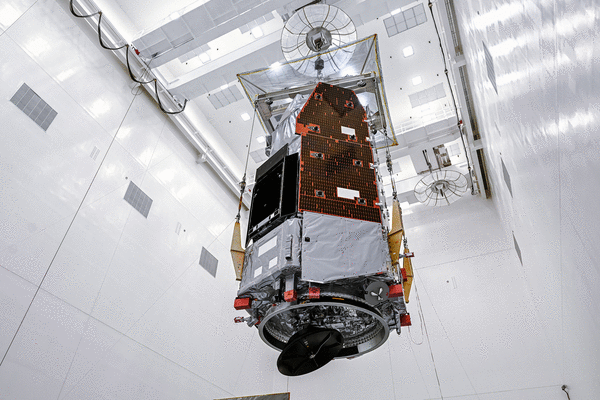
ORLANDO, Fla. — Though SpaceX’s powerful Starship won’t be flying from Florida for some time, the company’s powerhouse Falcon Heavy is set for a rare launch early Sunday.
The Falcon Heavy – essentially three Falcon 9 rockets strapped together – is set to take flight with NASA’s Nancy Grace Roman Space Telescope from Kennedy Space Center’s Launch Pad 39-A. Liftoff is scheduled for 7:26 a.m.
Plans call for the $4.3 billion telescope to eventually be positioned 1 million miles away from Earth at a spot called Lagrange Point 2, putting the Earth between it and the sun. It’s where the James Webb and other space telescopes are parked, giving them a pristine view of the galaxy.
Roman’s job is to unlock the mysteries of dark energy while also planet hunting outside our solar system.
Compared to the Hubble Space Telescope, Roman will have a 100 times wider view, even though the lens is the same size, and it will gather data 1,000 times faster.
It’s expected to map billions of galaxies, finding thousands more planets and study black holes during its primary five-year mission.
Space Launch Delta 45’s weather squadron forecasts only a 60% chance for good launch conditions Sunday, which would improve to 70% if delayed until Monday. The main concern would be showers that could bring in cumulus clouds and possible lightning.
Two of the Falcon Heavy’s boosters will make their way back to nearby Cape Canaveral Space Force Station for a landing, aiming for touchdowns at Landing Zones 2 and 40. This will be the first flight for one of the boosters while the other supported two previous Falcon Heavy launches.
This is only the 13th time Falcon Heavy has flown since its debut in 2018 when it launched Elon Musk’s Tesla roadster into deep space.
The rocket produces 5.1 million pounds of thrust at liftoff, which is only second to NASA’s Space Launch System among active rockets launching from the Space Coast.
Starship, though, when it arrives, will more that triple the power of Falcon Heavy.
But Falcon Heavy is still one of the spectacles that draw crowds for its launch.
This is only the second time it will launch this year after having not launched at all in 2025. Space Coast launches in general will be diminished until Starship gets up and running as SpaceX announced it would cease Falcon 9 missions for its Starlink satellite program from the Space Coast.
Expect droves to gather from Titusville to Cocoa Beach for a chance to view the launch.
Of note, the Playalinda District of Canaveral National Seashore will have a delayed opening because of the launch. NASA roadblocks will be established on the Max Brewer Bridge and the Haulover Canal bridge, Kennedy Parkway. Roadblocks will be lifted after successful launch or scrub. The Apollo district from New Smyrna Beach will open at its regular time of 6 a.m.
But popular viewing spots will be open such as Jetty Park at Port Canaveral, opening early at 6:30 a.m., and the beach, which are about 10 miles south of the launch pad, while Space View Park in Titusville, the Max Brewer Bridge and other spots along the Indian River are about 15 miles from the pad.
Kennedy Space Center Visitor Complex’s extra-cost launch viewing packages are sold out.
------------
©2026 Orlando Sentinel. Visit at orlandosentinel.com. Distributed by Tribune Content Agency, LLC.






Comments