Tropical Storm Dolly falls apart; just a tropical wave on way to Caribbean, hurricane center says
Published in News & Features
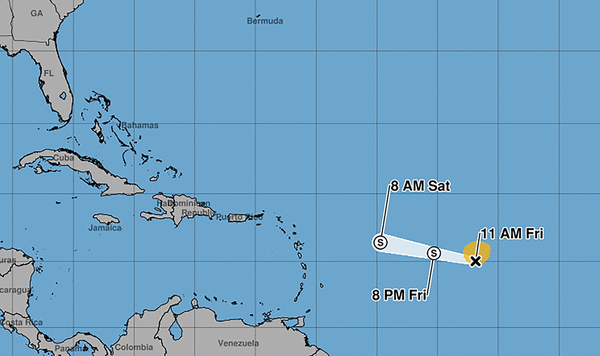
ORLANDO, Fla. — The National Hurricane Center on Friday said the short-lived Tropical Storm Dolly had broken apart to become just a tropical wave as it sped toward the Caribbean.
As of the NHC’s 11 a.m. advisory, the remnants of Dolly was located about 1,000 miles east of the Leeward Islands moving west at 25 mph. It still had maximum sustained winds of 40 mph, but had lost its circulation.
“On the forecast track, the remnants should be nearing the Leeward Islands Saturday night and Sunday,” forecasters said. “The winds associated with the remnants of Dolly are expected to decrease below tropical-storm force on Saturday.”
Tropical-storm-force winds extend out up to 115 miles from its center.
The system is still forecast to bring heavy rain that could affect the Leewards late Saturday into Sunday, then the Virgin Islands, Puerto Rico and Hispaniola from Sunday into Monday.
“This heavy rain may produce flash flooding within areas of higher terrain of the Leeward Islands,” forecasters said.
The first advisory came at 11 a.m. Thursday, so Tropical Storm Dolly lasted just 24 hours.
The name Dolly had many people wondering if it had anything to do with the death this week of beloved entertainer Dolly Parton.
The NHC said that was not the case.
“The timing of the use of the name Dolly for this storm is purely coincidental,” forecasters noted in the NHC’s tropical discussion. “Tropical storm and hurricane names for the North Atlantic Basin originate from six pre-determined rotating lists established by the World Meteorological Organization Region IV Hurricane Committee.”
He said the name Dolly had replaced Diana after the 1990 hurricane season and was first used in 1996.
Dolly becomes the fourth named storm of the 2026 Atlantic hurricane season after tropical storms Arthur, Bertha and Cristobal.
Hurricane season began June 1 and runs through Nov. 30, but the height of hurricane season runs from mid-August through mid-October.
The National Oceanic and Atmospheric Administration earlier this month updated its seasonal forecast and now expects between seven and 13 named storms this year. Of those, two to six would become hurricanes. It also predicted that there might not be any major hurricanes this year, or at most two.
Already, 2026 was forecast to have lower-than-average storm generation, and that has been reduced even further with the latest forecasts from the NOAA and other weather groups.
An average year would see 14 named storms and seven hurricanes, with three of those growing to Category 3 strength or higher.
-----------
©2026 Orlando Sentinel. Visit at orlandosentinel.com. Distributed by Tribune Content Agency, LLC.






Comments